
For Communications Teams
Where Communications Teams find their Next Stage.
The booking-intelligence platform built for founders at venture-backed companies who want to land podcast appearances on the shows that actually move pipeline. Replace your retainer. Reach the rooms your investors are already in.


The problem
Multi-executive outreach has no system of record.
Running podcast outreach for one executive is a project. Running it for three to eight is an operations problem, and most teams solve it with a spreadsheet, a shared inbox, and institutional memory. Targets collide when two executives suit the same show. Replies land in personal inboxes and vanish from the team's view. When the CCO asks what earned media produced this quarter, the answer is assembled by hand, from memory, the night before.
Every other channel the comms function runs has a reporting layer. Press coverage has monitoring. Social has analytics. Podcast outreach, the channel where executives spend the most personal time per placement, is usually the only one still running on recall. That gap is what PitchCentric closes; the general case for an auditable pipeline is on the podcast outreach software page.
The workflow
One workspace, a pipeline per executive.
The Team plan is built around the shape of a comms function: many operators, several executives, one source of truth.
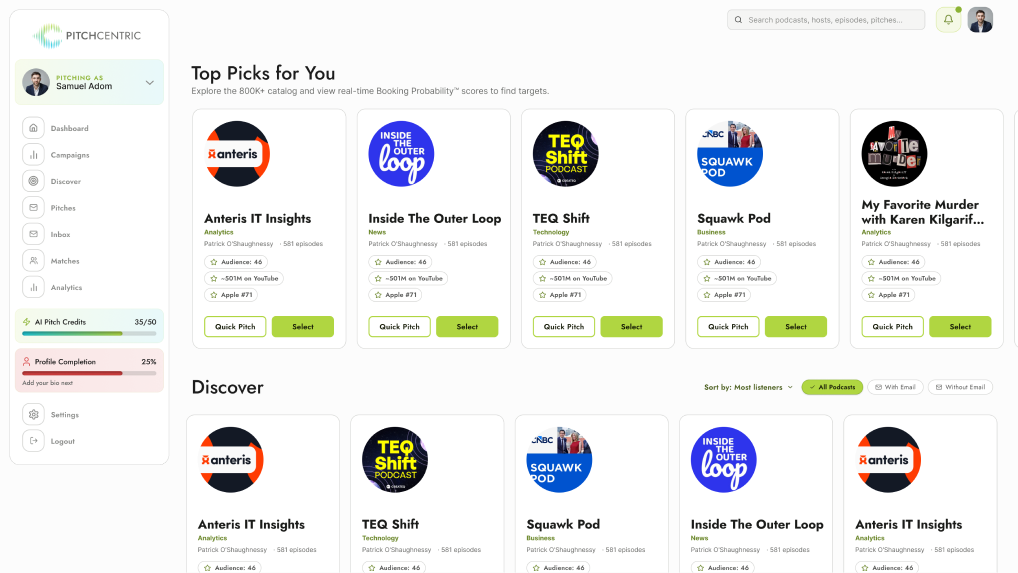
Profiles per executive
Each executive gets a profile with their own expertise, target list, and matches ranked by Booking Probability. No target collisions, no shared spreadsheet tabs.
Operators do the work
Comms staff run discovery, review drafted pitches, and manage follow-ups on behalf of each executive. Approval stays explicit; nothing sends without a decision.
Executives keep their inbox
Pitches send from each executive's own connected Gmail or Outlook account. Producers reply to the executive; the pipeline records the thread either way.
The analytics
The report a CCO actually wants.
Appearances, pitches, and replies rolled up by executive, ready for the read-out, not a screenshot of an inbox.

Which shows each executive targeted, with the Pod Score and Booking Probability at the time

Every pitch sent, who approved it, and what it said

Every producer reply, matched to its pitch and kept with the thread

Bookings by executive, each traceable from first discovery to confirmed date
The opportunity
What executive thought leadership looks like on podcasts.
Podcasts are the only earned channel where an executive gets an hour of a buyer's attention without an editor in between. That changes what good looks like. Message discipline, the skill comms teams drill for broadcast, reads as evasive over a long conversation. The format rewards a leader who has one genuine thesis and the willingness to argue it, concede its limits, and tell the stories behind it. An executive with a single arguable idea will outperform one armed with ten approved talking points, every time.
Show selection is where most programs go wrong. The instinct is to chase the largest audience; the better filter is the most concentrated one. A niche show whose listeners are precisely your buyers, your candidates, or your investors is worth more than a general-interest show many times its size, because thought leadership works by repetition inside a community, not by reach across strangers. The practical test for any target: would the host's last five guests belong on a panel with your executive? If yes, the audience will already have context for the conversation.
The appearance itself is the midpoint of the asset, not the end. A strong program treats each episode as raw material: the positions an executive sharpens by defending them out loud, the quotes that feed the next quarter of content, the clips that outlive the episode, and the relationship with a host who now knows the executive firsthand. Compounding, not coverage, is the goal.
Finally, measure honestly. Podcast attribution is imperfect and pretending otherwise erodes the CCO's trust in the whole program. Track what is real: appearances landed, the audience fit of the shows that said yes, the pipeline of conversations in flight, and the inbound signals that follow. Thought leadership on podcasts builds trust on a quarters-long horizon; report it that way, and the program survives contact with the QBR.
FAQs
Every question we get asked before
someone starts their trial.
If you have a concern about deliverability, AI quality, data privacy, or whether this will actually work for your specific situation, it's probably answered below.

How does pricing work for multiple executives?
The Team plan starts at $199 per month and covers up to five executive profiles, with additional profiles at $39 each. Team members and operators are unlimited, so the whole comms function can work in one workspace without per-seat math. The 15-day free trial, card required, runs on the full plan.
Can different people manage different executives?
Yes. Each executive has their own profile, target list, and pipeline, and operators can be assigned per executive. Sending happens through each executive's own connected Gmail or Outlook account, so producers always see a real address, and every reply routes back to the right pipeline.
What does leadership actually see in reporting?
A per-executive and roll-up view of the pipeline: shows targeted with their scores, pitches sent and by whom, replies, and bookings, each traceable back to the original pitch. It is the earned-media equivalent of a CRM report rather than a screenshot of an inbox.
Get started
Put executive earned media on the record.
One pipeline for every executive, with reporting a CCO can take to the board. Team from $199 per month.
15-day free trial, card required. Plans from $39 per month.