
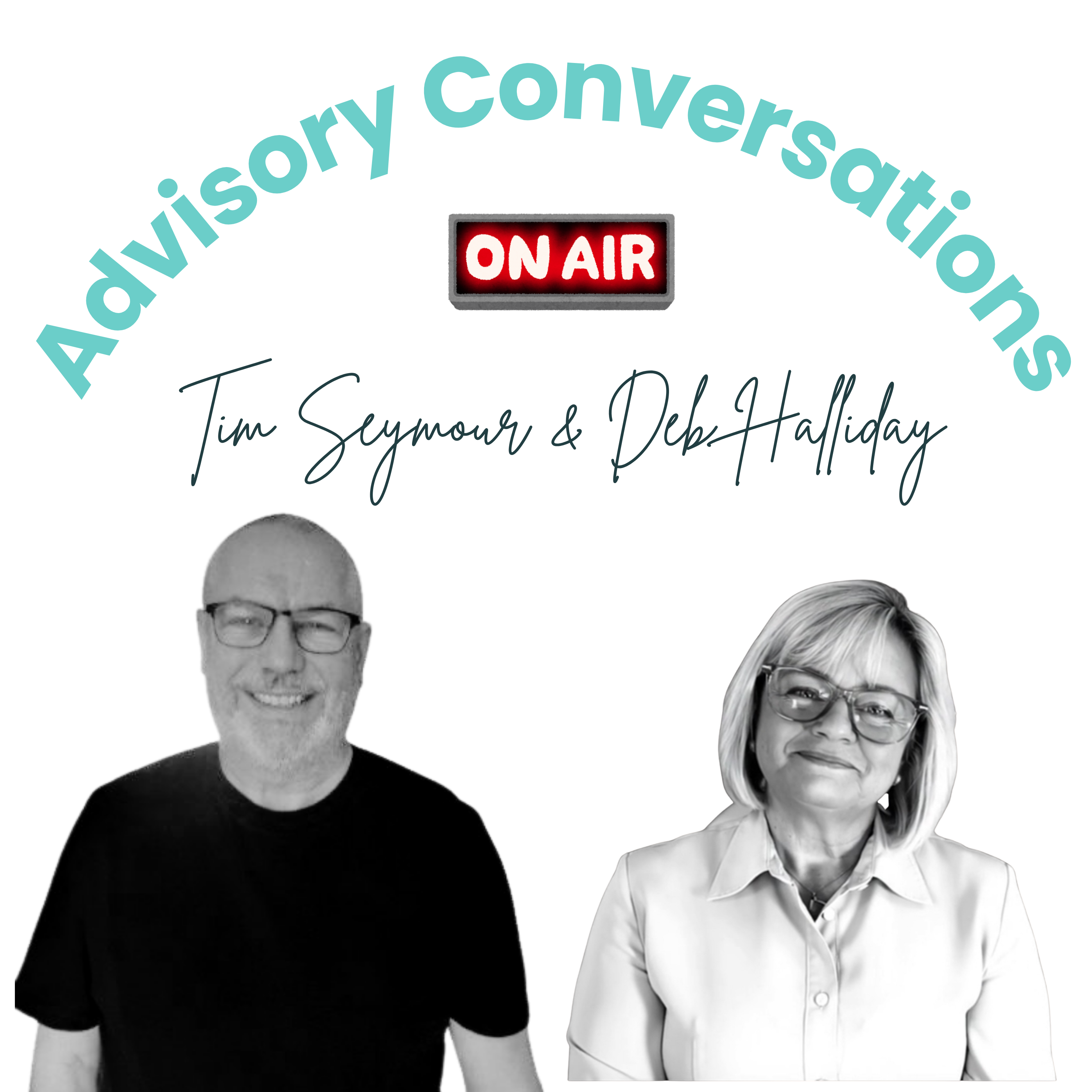
Advisory Conversations with Tim Seymour and Deb Halliday is a podcast for accounting professionals and financial coaches who are stepping into advisory and building something beyond compliance. This isn’t theory, and it’s not surface-level advice. Each episode is a real conversation between Tim and Deb, sharing their experience of moving from technician work into advisory, and what it actually takes to make that shift stick. From leading better client conversations, to developing commercial thinking, to building a team that can deliver advisory without the business owner being the bottleneck. You’ll also hear from occasional guests, including industry specialists, suppliers, and fellow professionals, offering practical insights you can apply straight away. If you’re looking to strengthen your advisory skills, build confidence in client conversations, and create a more scalable, team-led practice, this podcast will give you the perspective and direction to do it. Simple, honest, and grounded in real experience.
Pitch Analysis
Required Pod Score for this show. PitchCentric checks your profile against host openness, topical fit, and audience signals before you generate a pitch.
Contact path
Public web form
Booking probability
28%
Guest openness
Selective
80/100
Required Score
Sign up to generate a grounded pitch for Advisory Conversations with Tim Seymour and Deb Halliday.
What is Advisory Conversations with Tim Seymour and Deb Halliday?
Advisory Conversations with Tim Seymour and Deb Halliday is a business podcast hosted by Unknown Host, with 0 episodes on record and a Required Pod Score of 80. PitchCentric scores this show on Booking Probability, Listen Score, and live audience signals refreshed every 24 hours.
About the host
Unknown Host hosts Advisory Conversations with Tim Seymour and Deb Halliday, a business show with 0 episodes published.
Our AI reads these to draft pitches. Use them as grounding for a pitch that cites a real guest and a specific topic.
Episode #18
Unlocking Advisory Potential: How to Price with Assurance
Aug 17, 202637 minS1
In this episode of Advisory Conversations, Tim Seymour and Deb Halliday tackle one of the questions they hear more than almost any other. How do you price advisory services with confidence? For many accountants, bookkeepers, and financial professionals, pricing advisory can feel uncomfortable. There's often uncertainty around what to charge, whether clients will see the value, and whether you're experienced enough to justify the fee. The reality is that confidence in pricing rarely comes first. Confidence comes from experience, results, and seeing the impact your advice has on clients over time. Throughout this episode, we explore why advisory pricing is not about copying what someone else charges or trying to jump straight to premium monthly fees. Instead, it's about building confidence, capability, and value gradually. We also discuss the important difference between education and advisory. Education gives clients knowledge, frameworks, and understanding that can be applied by many businesses. Advisory is different. Advisory is bespoke. It focuses on the individual challenges, opportunities, and decisions facing a specific business at a specific point in time. When practitioners blur the lines between the two, clients can struggle to understand why one conversation is free while another carries a fee. We explore practical ways to introduce advisory conversations, create value for clients, and begin building an advisory offering that feels both commercially viable and personally comfortable. Because advisory isn't about charging more for the work you're already doing. It's about creating outcomes that clients value enough to invest in. In this episode you'll learn: • Why so many professionals struggle with pricing advisory confidently. • Why confidence usually follows experience rather than preceding it. • The difference between educational support and bespoke advisory services. • Why comparing your fees to others can hold you back. • How strategy sessions can help introduce advisory conversations naturally. • The role of case studies and client outcomes in building pricing confidence. • How to increase advisory fees over time as your experience and impact grow. Most successful advisory firms didn't start by charging premium fees from day one. They built confidence, created results, developed case studies, and increased value over time. If pricing advisory has ever felt uncomfortable or uncertain, this episode will give you a practical framework for getting started and growing your confidence along the way. Mentioned in this episode: APX Advert Business Course Library
Beyond Reports: Delivering True Advisory Value to Business Owners
Aug 10, 202626 minS1
In this episode of Advisory Conversations, Tim Seymour and Deb Halliday explore one of the biggest misconceptions in advisory. Management accounts are not advisory. Neither are KPI dashboards, spreadsheets, or beautifully designed reports. Because if a client doesn't understand what they're looking at or know what action to take next, the report itself has very little value. For many accountants and bookkeepers, producing management accounts has traditionally been seen as the end of the process. The reports are prepared, sent to the client, and the job is considered complete. But true advisory starts where the reports finish. The real value comes from helping clients understand what the numbers are telling them, why they matter, and what decisions they should make next. Throughout this episode, we discuss the difference between delivering information and creating understanding. We explore how better conversations around the numbers lead to better decisions, stronger businesses, and deeper client relationships. We also look at the role of education in advisory. Business owners don't need more reports. They need clarity, confidence, and context. Whether you're reviewing profitability, cashflow, margins, or growth plans, your role as an advisor is not simply to present the numbers. It's to translate them into meaningful actions that move the business forward. Because advisory isn't about producing reports. It's about creating better decisions. In this episode you'll learn: • Why management accounts alone do not create advisory value. • The difference between reporting information and creating understanding. • How to turn financial data into meaningful conversations. • Why client education sits at the heart of great advisory. • How regular conversations create stronger client relationships and better outcomes. • Why the future of advisory lies in interpretation, leadership, and action rather than reporting alone. If you've ever wondered why clients aren't excited by the reports you produce, this episode may change the way you think about management accounts forever.
The Art of Encouraging Client Action in Advisory Services
Aug 3, 202630 minS1
In this episode of Advisory Conversations, Tim Seymour and Deb Halliday tackle one of the biggest frustrations for advisors everywhere. Why do clients agree with the advice, leave the meeting motivated, and then do absolutely nothing? As advisors, it's easy to assume that if a client isn't taking action, they don't value the advice. In reality, the reasons are usually far more complex. Business owners are juggling competing priorities, constant interruptions, operational pressures, and an endless list of decisions. Even when they know exactly what they should do, implementation often gets pushed down the list as urgent issues take over. Throughout this episode, we explore why great advisory is not simply about giving good advice. It's about creating the accountability, structure, and support that help clients turn decisions into action. We discuss the importance of breaking larger goals into manageable steps, creating clear ownership around actions, and helping clients build momentum through small wins rather than overwhelming change. We also explore the role of the advisor in creating accountability without creating dependency. True advisory should empower clients to move forward confidently rather than relying on the advisor to drive every decision. Ultimately, advisory is not measured by the quality of the recommendations we make. It's measured by the actions clients take and the results they achieve. In this episode you'll learn: • Why clients often fail to implement advisory recommendations, even when they agree with them. • The psychological and operational barriers that prevent business owners from taking action. • How accountability can dramatically improve implementation and results. • Why breaking actions into smaller steps creates greater momentum. • How to support clients without becoming the bottleneck in their progress. • The difference between giving advice and creating lasting change. If you've ever left an advisory meeting wondering why nothing happened afterwards, this episode will help you understand what may be getting in the way and what you can do differently to help clients move forward. Mentioned in this episode: APX Advert Business Course Library
Identifying Future Advisors: Strategies for Empowering Your Team
Jul 27, 202627 minS1
Who should become an advisor in your practice? It's a question we hear all the time. Many practice owners assume the most technically capable person will naturally become their best advisor. But that's not always the case. In this episode of Advisory Conversations , Tim Seymour and Deb Halliday discuss how to identify the people in your team who have the potential to deliver great advisory. Sometimes it's the person with years of experience who isn't interested. Other times it's the less experienced team member who's curious, eager to learn and ready to grow. We explore why technical knowledge alone doesn't create a great advisor, and why curiosity, communication and a genuine desire to help clients often matter far more. We also discuss why advisory shouldn't sit with one person. Building an advisory team creates better outcomes for clients, removes the business owner as the bottleneck, and gives your team a clear pathway for growth. If you're wondering who in your practice could become an advisor, this episode will help you start looking beyond qualifications and towards potential. In this episode you'll learn: How to identify future advisors within your team. Why technical ability isn't the only requirement for advisory. The importance of curiosity and confidence in client conversations. How to encourage team members to step into advisory roles. Why advisory works best as a team effort, not an individual role. Practical ways to develop advisory skills across your practice. Learn more about Advisory Teams: https://advisoryteams.co.uk Find out more about APX Training: https://apxtraining.co.uk Join our free Advisory Teams community: https://facebook.com/groups/advisoryteams If you enjoyed this episode, please Like , Subscribe , and share it with another accountant or bookkeeper who wants to build an advisory practice that grows beyond them. #Accounting #Advisory #AdvisoryTeams #Accountants #Bookkeepers #PracticeGrowth #Leadership #BusinessAdvisory #TeamDevelopment #APXTraining Mentioned in this episode: Business Course Library APX Advert
Unlocking Business Potential: Why Only 20% of Firms Thrive
Jul 20, 202628 minS1
If 80% of businesses aren't making a profit, and 60% are simply breaking even, we have to ask an uncomfortable question. Are accountants really making the difference they could? In this episode of Advisory Conversations , Tim Seymour and Deb Halliday explore what those statistics mean for the accounting profession and why compliance alone isn't enough to help business owners build stronger, more profitable businesses. We discuss why the future of accounting isn't about producing better reports. It's about having better conversations. The most valuable advisors don't just explain the numbers after the event. They help business owners make better decisions before problems arise. That means moving from reporting the past to influencing the future. We also introduce the Advisory Pyramid and explore how accountants can help clients move from surviving to thriving through proactive advice, stronger relationships and structured advisory conversations. The episode also looks at why advisory shouldn't depend on one expert. Building an advisory team allows practices to deliver consistent, scalable support that creates better outcomes for clients while removing the business owner as the bottleneck. Whether you're just starting your advisory journey or looking to build an advisory-led practice, this episode will challenge the way you think about the role of today's accountant. Key takeaways Why so many businesses remain unprofitable despite having accountants. The difference between reporting numbers and creating business change. How the Advisory Pyramid helps identify where clients need the most support. Why better conversations create better business decisions. How advisory teams deliver greater value than relying on a single advisor. Why technology and AI should free up time for advisory, not replace it. Practical steps to move from compliance work into genuine advisory. Mentioned in this episode: Advisory Teams by Tim Seymour & Deb Halliday Mentioned in this episode: Business Course Library APX Advert
Every question we get asked before someone starts their trial.
If you have a concern about deliverability, AI quality, data privacy, or whether this will actually work for your specific situation, it's probably answered below.
What is the difference between Founder Solo and Founder Pro?
Founder Solo gives you 50 AI pitches per month using the credit model (Standard pitches cost 1 credit, Enriched pitches cost 2). Founder Pro raises that to 200 credits per month and adds full Booking Probability access, unlimited Magic Match, Apollo enrichment credits, and data export capabilities. Both plans use the same credit system, so you can stretch your monthly budget further by using Standard-mode drafting.
How do agency tiers work?
Agency tiers have no base fee. You pay per managed client and per talent profile. Agency Standard is $199 per client per month; Agency Pro is $399 per client per month. Both add $39 per talent profile per month. Your own team's user seats are always free.
What is a talent profile?
A talent profile represents one person (founder, executive, or spokesperson) you are booking onto podcasts. It includes their bio, topics, headshots, and outreach history. Team plans include 5 profiles; agency plans are pay-as-you-go.
Can I switch plans later?
Yes, at any time. Upgrades take effect immediately; downgrades apply at the end of the current billing period. Contact support if you need help migrating between plan families.
Do you offer a free trial?
Every paid plan includes a 15-day free trial. Your card is saved at signup but you will not be charged until day 16. Cancel any time from your dashboard.
What happens if I cancel?
You keep access until the end of your current billing period. No charges after that. Your data is retained for 30 days in case you reactivate.
Is the 20% annual discount automatic?
Yes. Select Annual on the pricing toggle and the discounted price is applied automatically at checkout. The annual price shown is the full year cost.
What if I have more than 50 profiles or 20 clients?
That is our Enterprise tier. Contact our sales team and we will build a custom plan with volume pricing, a dedicated account manager, and SLA guarantees.
