
Episode #55
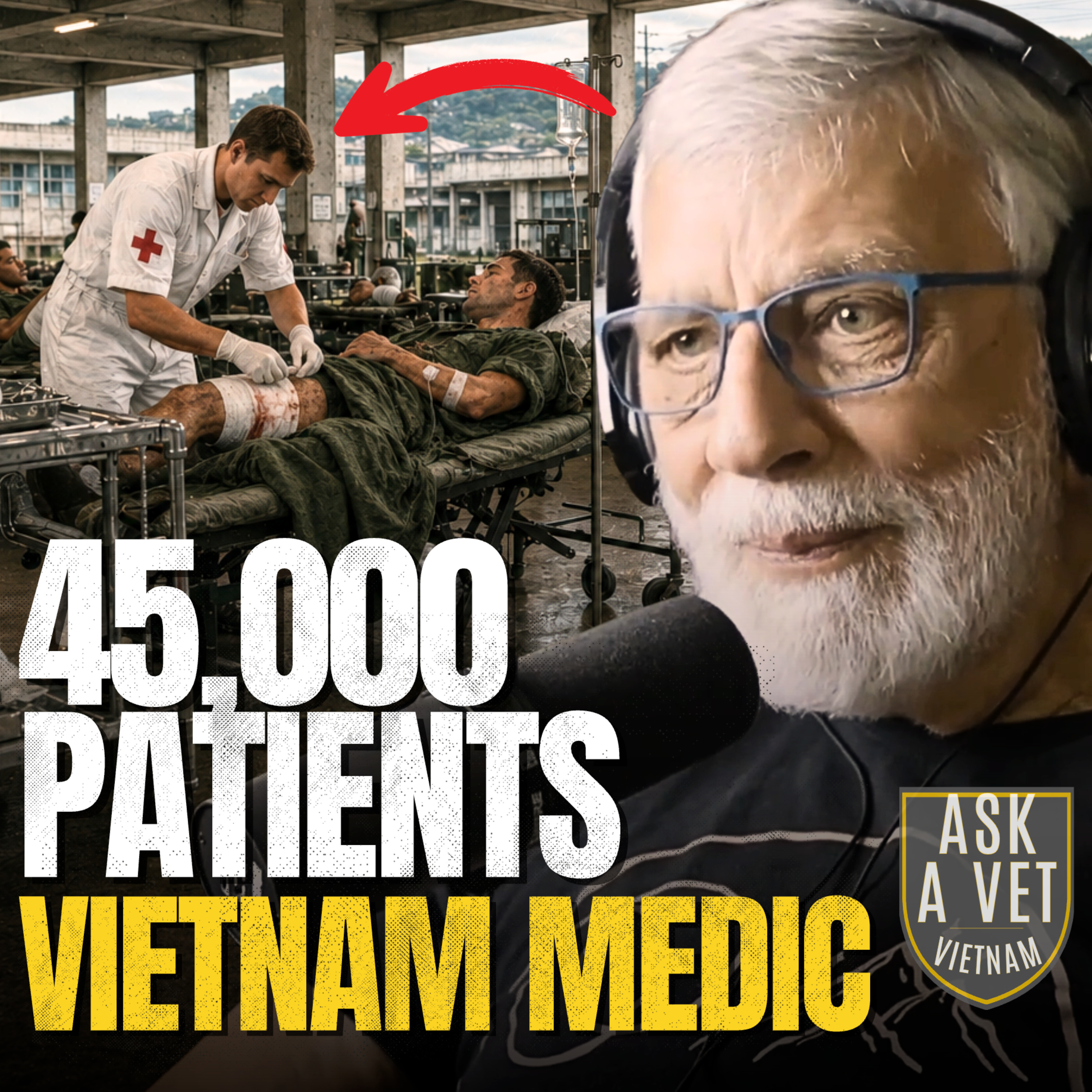
What They Don't Tell You About the Hospital That Treated 45,000 Vietnam Casualties
For three years, Michael Reeder treated the wounded of the Vietnam War without ever setting foot in Vietnam. Drafted in 1966 and trained as a combat medic, Michael expected to deploy in-country. Instead, because his younger brother was already serving in Vietnam, the Army sent him to the 106th General Hospital at Kishine Barracks in Japan — one of the primary evacuation hospitals for the most severely wounded American troops. Over the next three years, he estimates more than 45,000 patients passed through that hospital alone. In this episode, Michael takes us inside the burn ward and the orthopedic ward: the amputees, the burn victims, the booby-trap electrocutions, the quiet humor patients used to survive, and the letters he read aloud to men who couldn't hold a pen. He talks about what it meant to be "Doc" to thousands of young men whose names he never learned — and what it cost him to carry that for over five decades before finally being diagnosed with PTSD, despite never having been in combat himself. This is a story about a part of the Vietnam War rarely discussed: the evacuation hospitals of Japan, and the corpsmen who held the line between the battlefield and the world these soldiers were trying to get back to. Michael Reeder served as a U.S. Army combat medic at the 106th General Hospital, Kishine Barracks, Japan, from 1967–1970. 01:43 — Drafted, and enlisting to try to control his fate 03:10 — Basic training at Fort Bliss 08:31 — Combat medic training in San Antonio 13:35 — His first exposure to racism 18:12 — Orders to Japan instead of Vietnam — and why 19:44 — Arriving at Kishine Barracks, the 106th General Hospital 21:18 — Inside the wards: burns, orthopedics, and the septic ward 24:27 — The dust-off helicopters and the six-hour flight from Vietnam 27:04 — The scale: over 45,000 patients in three years 28:27 — How triage decided who stayed in Vietnam and who came to Japan 32:05 — First days on the Burn Ward 34:32 — Accidental burns and Viet Cong booby-trap electrocutions 37:40 — Transferred to Orthopedics — "I've waited 56 years for this" 41:51 — Who ran the ward: doctors, nurses, corpsmen 43:22 — Draftees vs. enlisted men, and who got the hardest cases 50:17 — The letter: "I can't stay married to a man without arms" 55:02 — Dark humor on the ward — the auctioneer and the urinal 56:04 — The patient he couldn't save: his hardest memory 1:00:31 — Why rank meant nothing once you were a patient 1:04:04 — The Purple Heart policy that showed "no empathy" 1:09:22 — Isolation, marriage, and fatherhood in the middle of it all 1:12:37 — Extending his tour: three deployments back to back 1:14:26 — Coming home to protestors — and silence from his own family 1:20:16 — Small mercies: wheeling patients outside, carrying men to the shower 1:25:37 — Four visits to the Vietnam Veterans Memorial Wall 1:32:52 — Losing a friend, and the moment the war became personal 1:44:00 — The years after: anger, a marriage that couldn't survive it 1:51:11 — Diagnosed with PTSD — as a man who was never in combat 1:57:09 — Healing through art: 25 years of mosaic work, turning 80 and returning to Japan 2:05:38 — Michael’s message to younger veterans ⚠️ Content note: This episode includes candid discussion of war trauma, injury, and suicidal ideation as part of Michael's healing journey. If you or someone you know is struggling, the Veterans Crisis Line is available 24/7 — dial 988, then press 1, or text 838255. Know a veteran with a story to tell? Reach out to humanographyproject@gmail.com