Episode #113
The Office of Resilience: Automotive's Missing Function
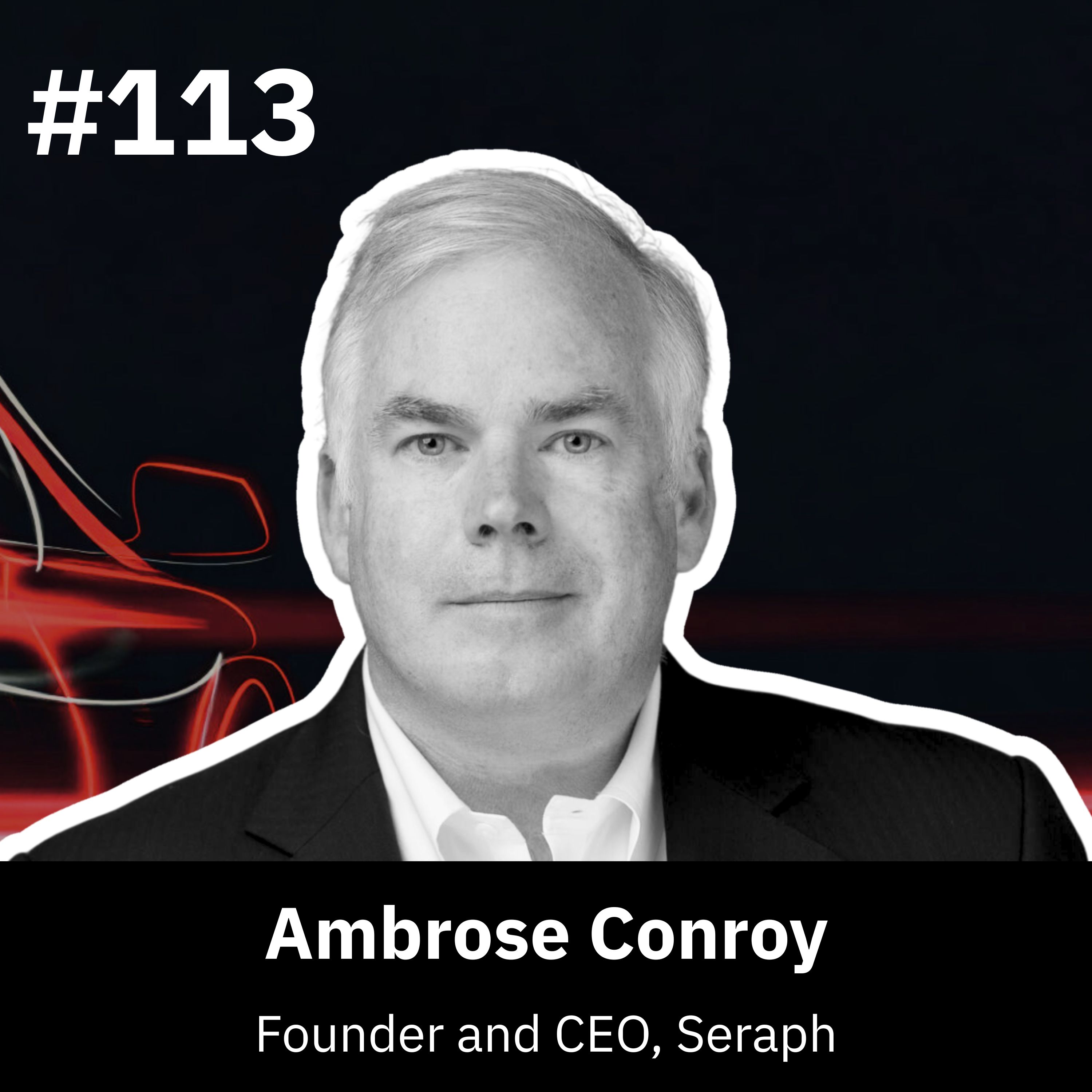
Resilience is the most used word in automotive, and one of the least staffed functions in it. It turns up in board decks, on conference panels, and in webinar titles, and then the next disruption hits, and the response doesn't look any different from the last one: a war room, a handful of empowered people, and a lot of luck. In this episode, Jan Griffiths and Tom Roberts sit down with Ambrose Conroy, CEO of Seraph, to put structure behind a phrase most leaders use loosely. Ambrose built his firm on crisis work, and his answer to the resilience question isn't a mindset. It's an org chart. Build an office of resilience, staff it full-time, and have it report to the CEO or the board. The model already exists outside automotive. Shell and Apple run standing teams that watch their value chains down to raw material pricing, and Apple's got roughly 100 people doing it. Toyota does the same work without giving it a name. What separates them from most OEMs and tier ones isn't intent. It's the ability to see across their own data. That's where most companies stop. Multiple ERP instances, disconnected PLM systems, and dozens of cross-reference tables make it slow to answer a simple question: what stops if the rare earth supply is disrupted, or if an earthquake takes out a plant in Japan? Ambrose and Tom are blunt about what dirty master data does to AI. It drifts. It hallucinates. It returns alerts nobody can act on. Speed is the second half of the argument. In the Novelis disruption, three OEMs faced the same problem. One had an alternate capacity locked in within 48 hours. One followed the full qualification process and lost weeks. The third didn't really know what was going on. The mindset shift is the hard part, and Jan says so plainly about her own years running the supply chain. Nobody wants to fund headcount against a risk that hasn't happened yet. The leaders who fund it anyway will be the ones still shipping when the next choke point closes. Themes Discussed in This Episode What an office of resilience actually does Why resilience fails as a part-time assignment Board and CEO ownership of enterprise risk Master data as the foundation of risk visibility Choke points, commodities, and what-if modeling The end of the annual cost-down Decision speed as a competitive advantage Measuring resilience against competitors This podcast is powered by QAD RedZone. Featured Guest Name: Ambrose Conroy Title: Founder and CEO of Seraph Consulting About: Ambrose is the Founder and CEO of Seraph Consulting. He founded Seraph to solve complex, bet-the-business problems for clients and to be the go-to partner for driving operational excellence. Before founding Seraph, Ambrose served as Vice President of Supply Chain Solutions at NAI Global and led the West Coast Global Business Transformation Group at PA Consulting, where he specialized in due diligence, crisis management, and strategic transformation. He began his career as a consultant at CSC. Connect: LinkedIn About Your Hosts Jan Griffiths Jan is the host and producer of the Auto Supply Chain Champions Podcast and The Automotive Leaders Podcast . A former automotive manufacturing and supply chain executive, Jan is recognized as a Champion for Culture Change in the automotive industry. She brings direct, grounded conversations to leaders navigating execution, disruption, and transformation across the global automotive ecosystem. Tom Roberts (Co-host) Tom is Co-host of the Auto Supply Chain Champions Podcast and Vice President of Strategic Industry Development at QAD . He works closely with automotive and industrial manufacturers to close the gap between insight and execution, helping leaders move from visibility to systems of action that drive real operational outcomes. Mentioned in the Episode: Seraph choke point analysis webinar deck Episode Highlights [00:04:35] What an Office of Resilience Is: Ambrose anchors it to the board risk committee mandate. The office exists to protect your ability to deliver today's products and services, no matter what happens. [00:05:34] Seeing Across Your Own Data: The blocker isn't strategy. It's architecture. Most OEMs and tier ones have built systems that can't give anyone a cross-enterprise view. [00:07:57] AI Drifts on Dirty Data: Fifty reference tables and disconnected PLM systems produce alerts nobody trusts. Tom points out that's exactly where big data analytics projects fell over a decade ago. [00:09:04] If It's Not in the System, It's Risk: Working around the system of record feels faster in a crisis, and it's what leaves you people-dependent when things start going wrong, and people get tired. [00:13:44] The Cost-Down Era Is Over: Annual price decreases aren't coming back. Ambrose argues that if you're not running the what-if scenarios, the crisis and chaos will cost you far more than the five or ten strategic heads you didn't want to fund. [00:16:45] Who Owns It: CEO, CFO, or board. Anywhere below that, silos and politics kill it before it's produced anything. [00:19:42] Part-Time Doesn't Work: You need full-time people from finance, legal, supply chain, and strategy, led by someone with the standing to challenge peers. Ambrose calls it a grooming ground for future senior executives. [00:22:02] Three OEMs, One Disruption: The Novelis situation exposed the gap between empowered decision-making and process compliance, measured in weeks of lost capacity. [00:24:09] Measuring Risk You Prevented: Purchasing savings as a metric is done, and Ambrose points to an OEM that skipped a volume-specific contract to capture some. Success is relative now: how fast your organization absorbs disruption compared with direct competitors. Top Quotes [00:06:33] Ambrose Conroy: "It's not just getting out of China, it's not just regionalization, it's making sure you have business continuity moving forward, no matter what." [00:16:15] Ambrose Conroy: "So an office of resilience needs to be able to take that into account, and you need to have the data to do it. But you also need to have the organization, you need to have the will, and you need to have the sponsorship from a board level or a CEO level to make it work." [00:27:00] Ambrose Conroy: "There's a lot of choke points out there right now that could close, thinking through those proactively and comparing how your organization performs to those of your direct competitors is the cleanest way to measure the impact and success of the office of resilience." If this episode resonated, share it with a fellow automotive leader and subscribe to the Auto Supply Chain Champions Podcast, where we're closing the gap between insight and action across the global automotive supply chain. Follow the Auto Supply Chain Champions Podcast for real conversations with leaders who are making hard choices, focusing their bets, and leading with intent. Follow the podcast: Learn more about QAD Redzone: https://www.qad.com/