Episode #145
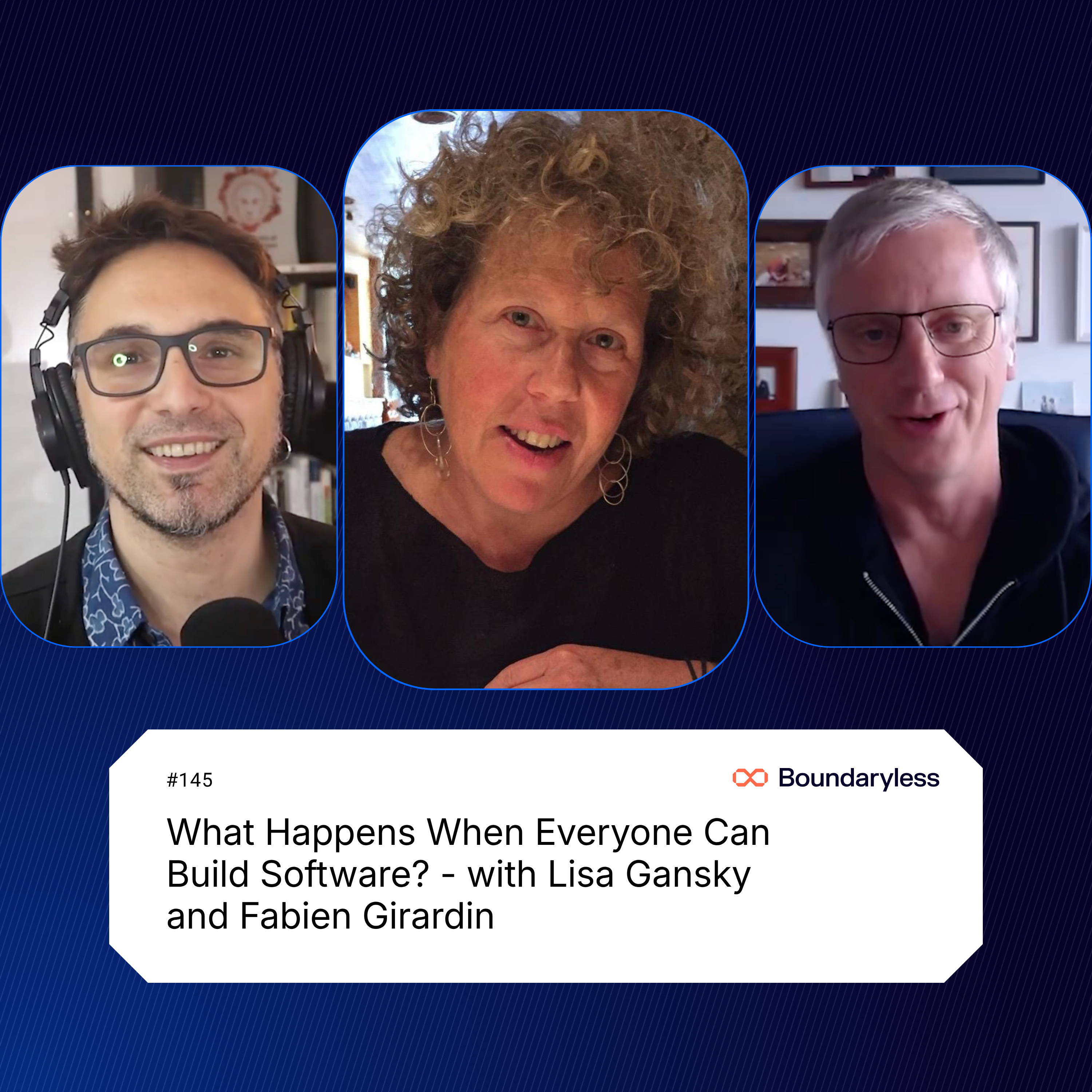
#145 - What Happens When Everyone Can Build Software? - with Lisa Gansky and Fabien Girardin
What happens when anyone can build software - and the people closest to the work start designing their own tools? Organisational designer and co-founder of Boundaryless, Lisa Gansky joins independent technologist and researcher Fabien Girardin to explore the rise of personal software: AI-enabled tools created by individuals to solve their own problems, reshape their workflows, and challenge long-held assumptions about how organisations adopt technology. Together, they discuss why experimentation and play are becoming essential organisational capabilities and whether the greatest obstacle to organisational transformation is no longer technology, but our inability to imagine systems beyond today's managerial logic. This episode helps us rethink not just how software is built, but how organisations evolve when everyone can become a maker. Tune in. Together, Lisa and Fabien also explore how AI-native software challenges traditional organisational assumptions, moving beyond the familiar "build or buy" dilemma towards enabling employees to create the tools they need themselves. Rather than viewing these emerging practices as shadow IT, they challenge us to think about how personal software reveals the long tail of unmet organisational needs, offering leaders valuable signals about where work, coordination, and existing systems fall short. They also explore the organisational implications of a world where software is increasingly probabilistic rather than deterministic. Drawing on examples from engineering, banking, and community-led experimentation, they discuss why cultivating communities of practice, creating spaces for bottom-up innovation, and "gardening" organisational change may prove more valuable than attempting to centrally manage AI adoption. Key Highlights 👉 AI is lowering the barriers to building software, enabling individuals across organisations to create personal software tailored to their own work rather than relying solely on enterprise systems. 👉 As AI increasingly generates outputs, human work shifts from execution towards editing, judgment, and shaping shared meaning - making sense-making a core organisational capability. 👉 Personal software should not be dismissed as "shadow AI"; it can reveal unmet needs, workflow friction, and opportunities for organisations to rethink how work is coordinated. 👉 Play, experimentation, and curiosity are becoming strategic organisational capabilities, creating the conditions for innovation. 👉 Rather than asking whether AI is "good enough," organisations should ask what new forms of collaboration and coordination become possible with today's capabilities. 👉 The conversation contrasts top-down organisational redesign with bottom-up transformation, suggesting that lasting change may emerge through thousands of local experiments rather than central planning. 👉 Successfully adopting AI requires leaders to act less as controllers and more as gardeners - cultivating environments where communities of practice, learning, and unexpected innovations can flourish. Topics /chapters (00:00) What Happens When Everyone Can Build Software? - INTRO (01:36) Introducing Fabien and Lisa (03:28) The Organisational Implications of AI-Native Software (09:50) The Solo AI Paradox (18:39) From Doing the Work to Defining Meaning (41:56) The Revolution Isn't Waiting for Better AI (57:24) Closing Thoughts Remember that you can always find transcripts and key highlights of the episode on our website: https://www.boundaryless.io/podcast/girardin-Gansky Episode recorded on Jun 07, 26 Find out more about the show and the research at Boundaryless at https://boundaryless.io/resources/podcast/ Get in touch with Boundaryless: Twitter: https://twitter.com/boundaryless_ Website: https://boundaryless.io/contacts LinkedIn: https://www.linkedin.com/company/boundaryless-pdt-3eo Music Music from Liosound / Walter Mobilio. Find his portfolio here: https://blss.io/Podcast-Music