Neuroscience and artificial intelligence work better together. Brain inspired is a celebration and exploration of the ideas driving our progress to understand intelligence. I interview experts about their work at the interface of neuroscience, artificial intelligence, cognitive science, philosophy, psychology, and more: the symbiosis of these overlapping fields, how they inform each other, where they differ, what the past brought us, and what the future brings. Topics include computational neuroscience, supervised machine learning, unsupervised learning, reinforcement learning, deep learning, convolutional and recurrent neural networks, decision-making science, AI agents, backpropagation, credit assignment, neuroengineering, neuromorphics, emergence, philosophy of mind, consciousness, general AI, spiking neural networks, data science, and a lot more. The podcast is not produced for a general audience. Instead, it aims to educate, challenge, inspire, and hopefully entertain those intere
Pitch Analysis
Required Pod Score for this show. PitchCentric checks your profile against host openness, topical fit, and audience signals before you generate a pitch.
Contact path
Verified email
Booking probability
35%
Guest openness
Selective
Verified email on file
80/100
Required Score
Sign up to generate a grounded pitch for Brain Inspired.
Our AI reads these to draft pitches. Use them as grounding for a pitch that cites a real guest and a specific topic.
Brain Inspired
BI 246 Andrea Gambarotto: Cognition Requires Agency
Sep 16, 20261h 58m
Support the show to get full episodes, full archive, and join the Discord community . The Transmitter is an online publication that aims to deliver useful information, insights and tools to build bridges across neuroscience and advance research. Visit thetransmitter.org to explore the latest neuroscience news and perspectives, written by journalists and scientists. Read more about our partnership . Sign up for Brain Inspired email alerts to be notified every time a new Brain Inspired episode is released. To explore more neuroscience news and perspectives, visit thetransmitter.org . Andrea Gambarotto is a postdoctoral philosopher and researcher at the University of Luxembourg. He is an expert in the philosophy of Georg Wilhelm Friedrich Hegel, most commonly known as Hegel. More recently he has been studying the relation between some of Hegel's ideas and those of modern theoretical biology regarding questions of autonomy and agency. Andrea argues that, where Immanuel Kant believed we should explain biological stuff and inanimate stuff the same way- via mechanistic explanations, Hegel believed to explain the biological stuff, we should leverage the fact the biological organisms have intrinsic purpose… agency. And, Hegel's approach is in line with what's called the enactive approach in cognitive science, which has a long history and continues to thrive. Andrea explains all of that during our discussion. One reason I invited Andrea on is because these issues get the heart of what some of us care about, which is, what are the differences and similarities between our natural intelligence and engineered artificial intelligence? Why should we care about those differences? A large language model isn't alive, but does it have a mind? Should we call what it does cognition? What are the relations between life, mind, cognition, intelligence, consciousness? Those kinds of questions. We even discuss why the famed octopus might be really intelligent but not conscious. Andrea Gambarotto Gambarotto papers Enactivism and the Hegelian stance on intrinsic purposiveness Body plan organization and the evolution of conscious agency Blog: Dialectical Systems Papers also mentioned Weber & Varela 2002: Life after Kant: Natural purposes and the autopoietic foundations of biological individuality . Mossio & Bich 2014: What makes biological organisation teleological? Bechtel & Bich & 2021: Grounding cognition: heterarchical control mechanisms in biology . Pessoa 2026: Beyond networks: Toward adaptive models of biological complexity . Levins 1998: Dialectics and Systems Theory . Barandiaran & Moreno 2006: On What Makes Certain Dynamical Systems Cognitive: A Minimally Cognitive Organization Program . Books mentioned Linguistic Bodies: The Continuity between Life and Language Radical Embodied Cognitive Science An Evolutionary Story of Agency 0:00 - Intro 7:51 - Intrinsic and extrinsic purposiveness 14:39 - Hegel, Kant, and autonomy 28:07 - Constraint closure and enactivism 35:13 - How Hegel and Enactivitsm agree 43:58 - Dialectics 57:44 - Brain activity and enactivism 1:20:02 - Heidegger and cognitive science 1:26:59 - Artificial intelligence and Hegel 1:29:15 - Mind agency decoupling 1:43:38 - Evolution of conscious agency 1:52:42 - Heterarchy via McCulloch
BI 245 Dan Levenstein: Neuro-AI, Dynamics, and Model Systems
Sep 1, 20261h 36m
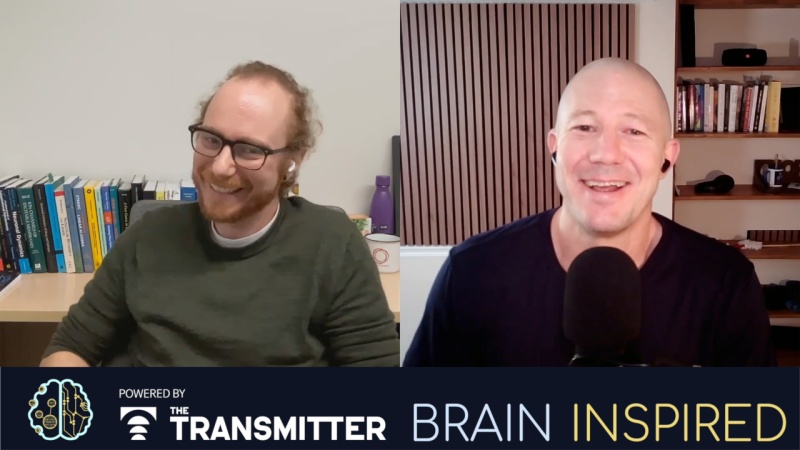
Support the show to get full episodes, full archive, and join the Discord community . The Transmitter is an online publication that aims to deliver useful information, insights and tools to build bridges across neuroscience and advance research. Visit thetransmitter.org to explore the latest neuroscience news and perspectives, written by journalists and scientists. Read more about our partnership . Sign up for Brain Inspired email alerts to be notified every time a new Brain Inspired episode is released. To explore more neuroscience news and perspectives, visit thetransmitter.org . Daniel Levenstein started his NeuroAI and Dynamics Lab at Yale University about a year ago. We briefly discuss what it's like to transition from a postdoc to a principle investigator, i.e. head of the lab. But most mostly we discuss his work and ideas. Dan studies spontaneous neural activity during sleep, specially in brain areas like hippocampus and cortex, and how this internally generated spontaneous activity is related to learning and memory and navigation. Really, he used to study those processes directly through experimental brain recording datasets. These days he builds and studies models of those processes, using AI models and seeing how their dynamics and functions match what we see in brains. Levenstein Lab Related papers On the Role of Theory and Modeling in Neuroscience The problem-ladenness of theory Sequential predictive learning is a unifying theory for hippocampal representation and replay 0:00 - Intro 9:12 - Neuro-AI 18:23 - Experiment vs theory 20:36 - Ground vs active state neuron activity 25:38 - Beginning a lab 31:34 - Sleep and Internally generated activity 40:02 - Spiking neural networks 52:13 - Naturalistic neuro-AI 59:52 - Cognitive maps, world models 1:04:16 - Weasel words and motifs 1:08:17 - Transformers and brains 1:18:53 - AI vs biology 1:24:32 - Neuroscience theory
BI 244 Marco Facchin: Philosophy and Science of Biological Brains
Aug 19, 20261h 30m
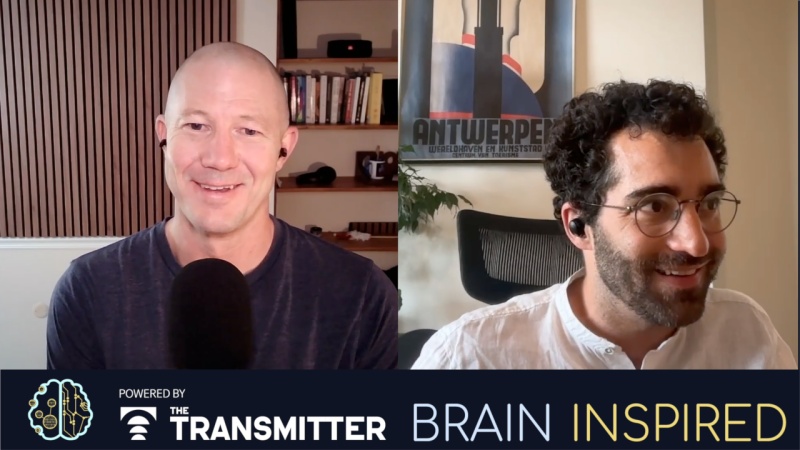
Support the show to get full episodes, full archive, and join the Discord community . The Transmitter is an online publication that aims to deliver useful information, insights and tools to build bridges across neuroscience and advance research. Visit thetransmitter.org to explore the latest neuroscience news and perspectives, written by journalists and scientists. Read more about our partnership . Sign up for Brain Inspired email alerts to be notified every time a new Brain Inspired episode is released. To explore more neuroscience news and perspectives, visit thetransmitter.org . Marco Facchin is a postdoctoral philosopher of neuroscience and cognitive sciences more broadly at the University of Antwerp. He and his colleague Farid Zahnoun recently hosted a workshop called Beyond Neuro-computationalism with themselves and a handful of speakers, almost all of whom have been on Brain Inspired. In that workshop, they discussed many topics around this sort of forever ongoing reassessment in neuroscience and philosophy about how best to think about cognition, the role of brains, embodied, enactive, embedded, extended - known together as 4E cognition - how much biological detail matters for a good explanation, and so on. The talks from that workshop are online, and I'll link to them in the show notes. So today Marco and I discuss how that all went, and many of the topics and themes I just mentioned, plus his own work and ideas along those lines. Marco Facchin Social: @marcofacchin.bsky.social Beyond neuro-computationalism talks . Why can’t we say what cognition is (at least for the time being) Predictive processing and anti-representationalism Defusing the Representation-Hungry Challenge Structural representations do not meet the job description challenge Structure and function in the predictive brain 0:00 - Intro 3:30 - Beyond neuro-computationalism 14:02 - Vicente Raja motifs 17:58 - 4E cognition 32:36 - Philosophy and neuroscience 42:18 - The problem with predictive processing 48:56 - Role of AI in understanding brains and minds 54:05 - Metabolic constraints 1:07:58 - A philosopher's view of neuroscience 1:13:27 - A-lieving and AI 1:25:47 - AI consciousness
BI 243 Alison Barth: Learning as a Window to Cortex
Aug 4, 20261h 40m
Support the show to get full episodes, full archive, and join the Discord community . The Transmitter is an online publication that aims to deliver useful information, insights and tools to build bridges across neuroscience and advance research. Visit thetransmitter.org to explore the latest neuroscience news and perspectives, written by journalists and scientists. Read more about our partnership . Sign up for Brain Inspired email alerts to be notified every time a new Brain Inspired episode is released. To explore more neuroscience news and perspectives, visit thetransmitter.org . Alison Barth runs the Barth Lab at Carnegie Mellon University, where they use learning experiments in mice to try to figure out how the cortex works. As you may know, the brain in general but also the cortex itself is made up of a large variety neuron cell types, with different activity properties. Alison has the gritty job of identifying those different cell types in sensory cortex, and seeing how they change when animals learn to associate rewards with sensory stimulation. So unlike many of the guests, who take a much more zoomed out view and look at how populations of neurons carry out some function, Alison is happiest down at the cellular level. So we talk about her work, why she prefers to work at that scale, and a variety of related topics. Barth Lab . Related papers Barth lab publications . Learning, prediction accuracy, and neural plasticity in sensory cortex. 0:00 - Intro 4:24 - Alison's trajectory to learning and memory 21:02 - Automated mouse learning experiments 25:34 - What is success in this line of work? 32:34 - How many cell types do we need to explain? 34:33 - Current experiments 38:11 - How does cortex work? 45:19 - Predictive processing 1:02:01 - Obstacles 1:10:41 - Role of AI 1:33:38 - Moving forward
BI 242 Kathryn Nave: How Life Gets its Meaning and Intelligence
Jul 14, 20261h 45m
Support the show to get full episodes, full archive, and join the Discord community . The Transmitter is an online publication that aims to deliver useful information, insights and tools to build bridges across neuroscience and advance research. Visit thetransmitter.org to explore the latest neuroscience news and perspectives, written by journalists and scientists. Read more about our partnership . Sign up for Brain Inspired email alerts to be notified every time a new Brain Inspired episode is released. To explore more neuroscience news and perspectives, visit thetransmitter.org . Kathryn Nave is a Leverhulme Trust Early Career Fellow at the University of Edinburgh, and the author of the book A Drive to Survive: The Free Energy Principle and the Meaning of Life . In the book, Kate dives deep into the free energy principle and active inference, which are popular approaches to studying brains, minds, and organisms in general, and which are being used in artificial intelligence. Ultimately, Kate finds these approaches come up short as explanatory frameworks for life, and autonomy, and intelligence. Instead, Kate and many others advocate a framework that Kate calls constraint closure or closure of constraints, but also goes by the name organizational closure. This is a concept from philosophy and theoretical biology that people like Alvaro Moreno and Matteo Mossio have put forth in their 2015 book Biological Autonomy. The core ideas are also found in various forms from people like Robert Rosen, Stuart Kauffman, Alicia Juarrero, Terrence Deacon, and others. We discuss what constraint closure is, why Kate thinks it's a solid foundation to build on, and what if anything it means for cognitive science and brain sciences to embrace this constraint closure view. I highly recommend the book even if you're looking for a primer on the free energy principle and active inference. As we discuss, Kate's journalism experience has helped her become a wonderful communicator of these notoriously difficult concepts. Kathryn Nave @kathrynnave ; @kathrynnave.eurosky.social . A Drive to Survive: The Free Energy Principle and the Meaning of Life Related episode: BI 241 Johannes Jaeger: Agency and the Cyborg Myth Mentioned in the episode: We Need To Rewild The Internet Beyond Control: Finding the Purpose of Enactive Cognitive Science 0:00 - Intro 5:39 - Journalism back to philosophy 15:56 - How Kate got into predictive processing etc. 21:30 - Predictive processing and phenomenology 30:45 - Organizational closure 37:37 - Constraint closure beyond the single cell 45:04 - Brain as metabolic 50:12 - Basal cognition 52:13 - Degeneracy 55:08 - Neutral networks 1:00:33 - AI and autonomy 1:08:12 - Meaning and mind 1:10:02 - Why do we need brains? 1:17:33 - Reframe neuroscience? 1:23:51 - Reifying models 1:27:43 - Free energy principle and active inference 1:37:16 - Tolerating as much variability as possible
Every question we get asked before someone starts their trial.
If you have a concern about deliverability, AI quality, data privacy, or whether this will actually work for your specific situation, it's probably answered below.
What is the difference between Founder Solo and Founder Pro?
Founder Solo gives you 50 AI pitches per month using the credit model (Standard pitches cost 1 credit, Enriched pitches cost 2). Founder Pro raises that to 200 credits per month and adds full Booking Probability access, unlimited Magic Match, Apollo enrichment credits, and data export capabilities. Both plans use the same credit system, so you can stretch your monthly budget further by using Standard-mode drafting.
How do agency tiers work?
Agency tiers have no base fee. You pay per managed client and per talent profile. Agency Standard is $199 per client per month; Agency Pro is $399 per client per month. Both add $39 per talent profile per month. Your own team's user seats are always free.
What is a talent profile?
A talent profile represents one person (founder, executive, or spokesperson) you are booking onto podcasts. It includes their bio, topics, headshots, and outreach history. Team plans include 5 profiles; agency plans are pay-as-you-go.
Can I switch plans later?
Yes, at any time. Upgrades take effect immediately; downgrades apply at the end of the current billing period. Contact support if you need help migrating between plan families.
Do you offer a free trial?
Every paid plan includes a 15-day free trial. Your card is saved at signup but you will not be charged until day 16. Cancel any time from your dashboard.
What happens if I cancel?
You keep access until the end of your current billing period. No charges after that. Your data is retained for 30 days in case you reactivate.
Is the 20% annual discount automatic?
Yes. Select Annual on the pricing toggle and the discounted price is applied automatically at checkout. The annual price shown is the full year cost.
What if I have more than 50 profiles or 20 clients?
That is our Enterprise tier. Contact our sales team and we will build a custom plan with volume pricing, a dedicated account manager, and SLA guarantees.