
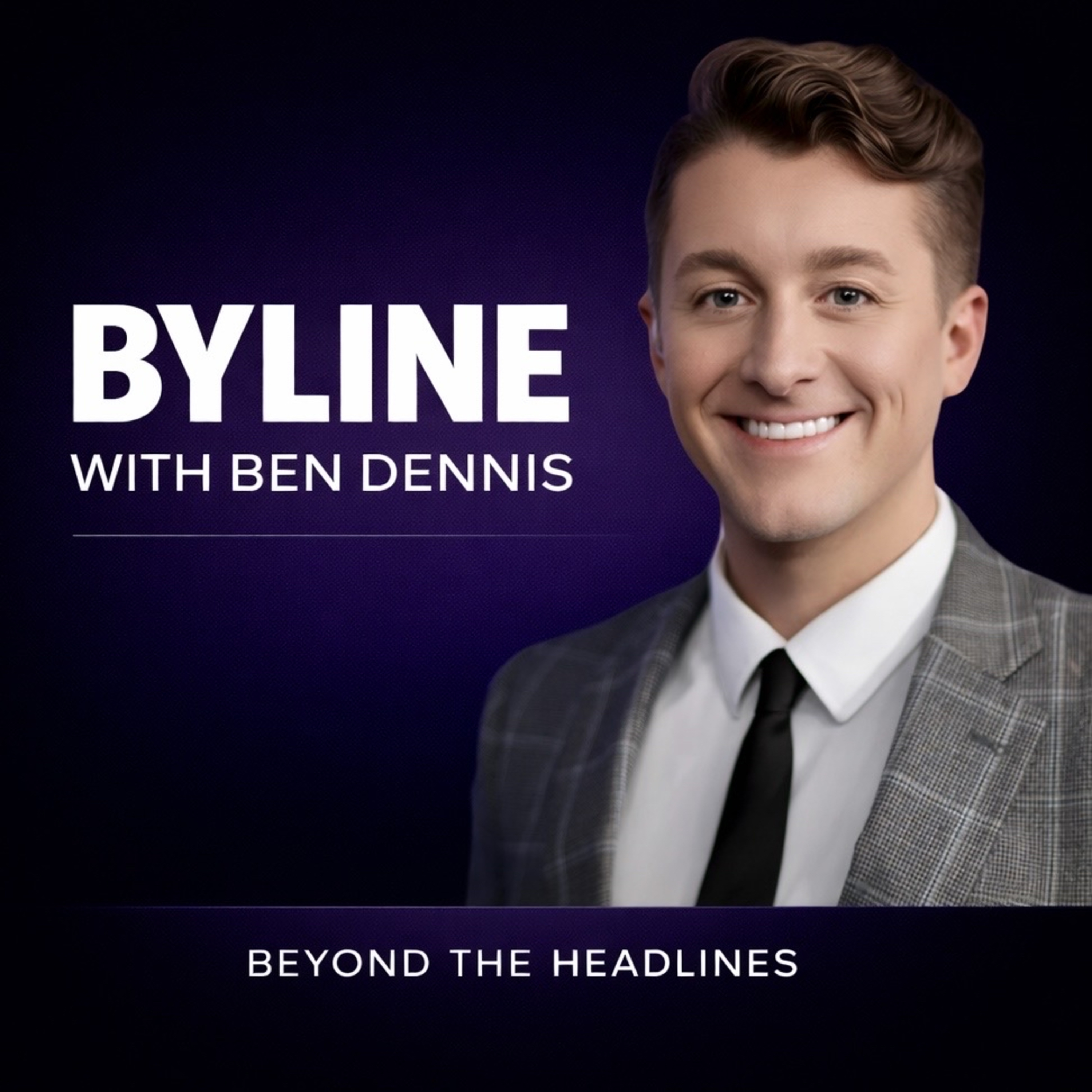
Byline with Ben Dennis
How Does This War End?
Former CENTCOM commander Gen. Joseph Votel on Iran, strained U.S. defenses and the dangerous fight over the Strait of Hormuz.

Loading…

Byline with Ben Dennis is a weekly interview series that goes beyond the headlines to examine how consequential decisions are made, who influences them and what happens next. Journalist Ben Dennis brings together experts, policymakers and people with firsthand experience for thoughtful conversations about politics, media, technology, law, national security and the forces reshaping public life. Each episode cuts through the noise to explain why the story matters—and what it could mean for everyday people.
Required Pod Score for this show. PitchCentric checks your profile against host openness, topical fit, and audience signals before you generate a pitch.
Contact path
Verified email
Booking probability
39%
Guest openness
Selective
Sign up to generate a grounded pitch for Byline with Ben Dennis.
Signup to Generate a PitchByline with Ben Dennis is a news podcast hosted by Ben Dennis, with 32 episodes on record and a Required Pod Score of 80. PitchCentric scores this show on Booking Probability, Listen Score, and live audience signals refreshed every 24 hours.
Ben Dennis hosts Byline with Ben Dennis, a news show with 32 episodes published.
Our AI reads these to draft pitches. Use them as grounding for a pitch that cites a real guest and a specific topic.

Byline with Ben Dennis
Former CENTCOM commander Gen. Joseph Votel on Iran, strained U.S. defenses and the dangerous fight over the Strait of Hormuz.

Byline with Ben Dennis
Generative AI is moving deeper into political communication, journalism and the systems distributing information online. The immediate question is no longer simply whether a deepfake can be identified. It is how synthetic content changes trust once it circulates alongside reporting, commentary and propaganda. Ben Dennis speaks with University of Cambridge psychology professor Sander van der Linden about the human behavior driving this shift. They examine why an AI label may not settle whether people accept or share a piece of content, how artificial accounts can draw real users into spreading a message and why that overlap makes manipulation more difficult to confront. The conversation also explores where journalists should draw boundaries around AI, what meaningful disclosure looks like and why large language models should not be mistaken for human judgment. Sander also explains “psychological inoculation”—an approach intended to build resistance to manipulation—and why the challenge ahead is remaining skeptical without becoming cynical.

Byline with Ben Dennis
What if your representatives could see how people back home want them to vote—before they cast a vote in Congress? The nonprofit Digital Democracy Project is testing that idea. Its platform allows registered voters to weigh in on pending legislation through their phones, then compares the results with lawmakers’ actual votes. The organization says it uses identification and voter-registration records to determine each participant’s district. These are not official elections, the results are not binding, and participation on the platform does not necessarily reflect the views of an entire constituency. Founder Ramon Perez argues the technology could give voters a more direct voice, expose gaps between lawmakers and their districts, and counter some of the influence held by lobbyists and special-interest groups. But could it create a new set of problems? In this episode of Byline, Ben Dennis presses Perez on whether a platform with limited participation can claim to represent a district; whether organized groups could flood the system; how personal information and ballots are protected; and whether AI can accurately translate complicated legislation into plain language. They also discuss the organization’s funding, oversight and the risk of exchanging today’s political gatekeepers for new technological ones. This is not an endorsement of digital democracy (endorsements are never Ben's goal). It is an examination of an ambitious proposal—and the central question behind it: Can technology give people more power in government without simply amplifying the loudest voices?

Byline with Ben Dennis
Who gets to decide when America’s most historic public spaces should change? Washington, D.C., has always evolved. Presidents and first ladies have influenced its landscape, new memorials have reshaped the National Mall, and security needs have changed how the public experiences some of the country’s most recognizable places. Now, projects proposed or advanced during President Donald Trump’s second term—including the White House ballroom and a proposed monumental arch—are renewing questions about presidential influence, historic preservation and public input. Charles Birnbaum, president and CEO of the Cultural Landscape Foundation, joins Ben Dennis to explain how changes to historic landscapes are traditionally reviewed, what Section 106 of the National Historic Preservation Act requires, and why his organization has challenged some current projects and review processes. The conversation explores the balance between security and accessibility, the role of presidents and first ladies in shaping Washington, public input in memorial design, original design intent, redevelopment and the question of whether today’s approach could influence how future administrations pursue major projects. Birnbaum also raises questions about how some projects are funded and the role nonprofit organizations play in advancing them. A conversation about how Washington changes, who gets a voice and what happens next.

Byline with Ben Dennis
The 2026 midterms are still months away, but the political fight for 2028 may already be taking shape. Will voters cast their ballots based on affordability, foreign policy, cultural issues, or frustration with Washington? Are Democrats building a message beyond opposition to President Trump? And what does the future of the Republican Party look like once Trump is no longer on the ballot? Political analyst and Randolph-Macon College professor Rich Meagher joins me to discuss the issues driving voters, why affordability remains one of the most powerful forces in American politics, and whether both parties are preparing for a post-Trump era. In this episode: • Why affordability continues to dominate political conversations • Whether Democrats are finding a message beyond anti-Trump politics • Signs some Republicans are beginning to distance themselves from Trump • Why younger voters may be looking for a new generation of leaders • Whether cultural issues still resonate with voters the way they once did • What the race for 2028 could look like before the 2026 midterms are even over • The role AI, technology, and economic uncertainty could play in future elections What issue do you think will matter most to voters this November?
Recent guests on Byline with Ben Dennis. Study who booked and why before you pitch.
Sponsor detection runs nightly. Check back soon.
Based on semantic analysis of episode topics and host coverage, this show is a strong guest fit for executives in:
Industry fit is computed by PitchCentric using vector embeddings of the show's episode catalog.
Is this podcast yours and you'd like to remove or correct details? Request removal or email privacy@pitchcentric.com.
FAQs
If you have a concern about deliverability, AI quality, data privacy, or whether this will actually work for your specific situation, it's probably answered below.
Founder Solo gives you 50 AI pitches per month using the credit model (Standard pitches cost 1 credit, Enriched pitches cost 2). Founder Pro raises that to 200 credits per month and adds full Booking Probability access, unlimited Magic Match, Apollo enrichment credits, and data export capabilities. Both plans use the same credit system, so you can stretch your monthly budget further by using Standard-mode drafting.
Agency tiers have no base fee. You pay per managed client and per talent profile. Agency Standard is $199 per client per month; Agency Pro is $399 per client per month. Both add $39 per talent profile per month. Your own team's user seats are always free.
A talent profile represents one person (founder, executive, or spokesperson) you are booking onto podcasts. It includes their bio, topics, headshots, and outreach history. Team plans include 5 profiles; agency plans are pay-as-you-go.
Yes, at any time. Upgrades take effect immediately; downgrades apply at the end of the current billing period. Contact support if you need help migrating between plan families.
Every paid plan includes a 15-day free trial. Your card is saved at signup but you will not be charged until day 16. Cancel any time from your dashboard.
You keep access until the end of your current billing period. No charges after that. Your data is retained for 30 days in case you reactivate.
Yes. Select Annual on the pricing toggle and the discounted price is applied automatically at checkout. The annual price shown is the full year cost.
That is our Enterprise tier. Contact our sales team and we will build a custom plan with volume pricing, a dedicated account manager, and SLA guarantees.
