Episode #127
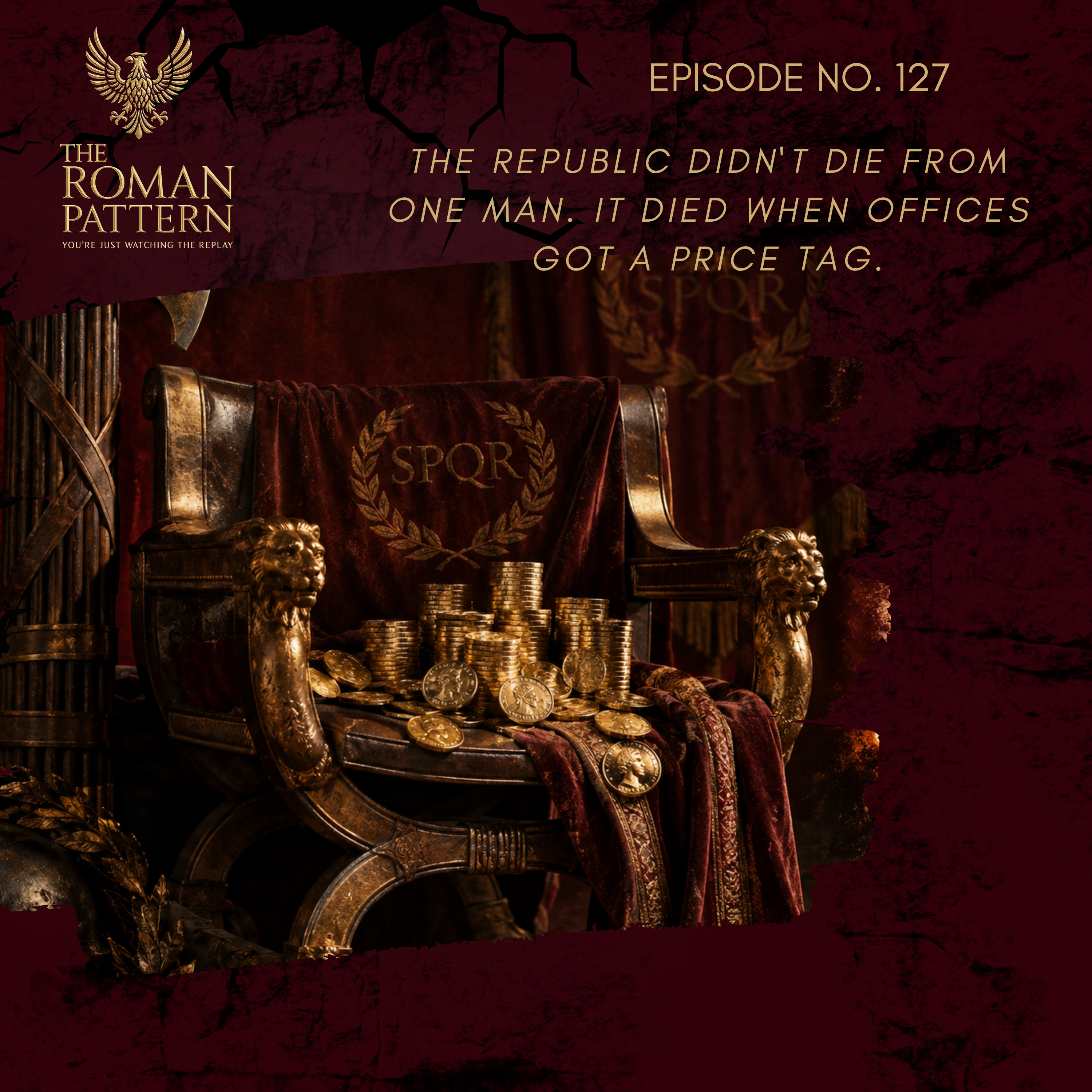
The Republic Didn't Die From One Man. It Died When Offices Got a Price Tag.
The Roman Republic didn't collapse because one man grew too powerful. It collapsed because the offices themselves acquired a market price, and everyone kept showing up to work. In this episode we walk the decade between Sulla's abdication and the First Triumvirate: the years Crassus built his fortune out of proscriptions and fire brigades, Pompey extorted a consulship at 35 with no prior office, Cicero prosecuted Verres and learned that you cannot prosecute your way out of a system where the prosecutors are the next defendants, Clodius took a plebeian name in an afternoon so he could weaponize the tribunate, and Cato's incorruptibility supplied the final push that produced the Triumvirate. This is the Money-Borders-Power framework applied to the middle piece: what happens when private wealth becomes a substitute for legal authority, and the written rules stay perfectly valid while the actual decisions get made somewhere else. The Republic still met. The consuls still processed through the streets. Everyone kept showing up to work. That's the part worth understanding. ️ Subscribe for the full Fall of the Republic arc. CHAPTERS: 00:00 Cold open: the office with a market price 01:29 Intro: Pompey, Crassus, and money coming into Rome 05:28 Sulla's lock, and the cash he left on the table 10:33 The consulship of 70 BC: how an exception gets laundered 15:22 Cicero vs. Verres, the trial that changed nothing 19:55 The pirate command: a second Roman government 28:53 Pompey disbands his army, and the Senate refuses him 30:35 The machinery: how offices got a price tag 36:46 Clodius, the streets, and Cato's last stand 44:47 60 BC: three men write down what Rome was already running SOURCES Primary: Cicero, In Verrem (Actio Prima & Actio Secunda) — the three-year budget line Cicero, Ad Atticum 4.15 — the July 54 BC interest-rate spike (4% → 8%) and the perjury contract read aloud in the Senate Cicero, Pro Lege Manilia (66 BC) — carrying the eastern command to Pompey Plutarch, Life of Crassus; Life of Pompey; Life of Cato Minor; Life of Cicero Sallust, Bellum Catilinae Cassius Dio, Roman History, Books 36–37 (the Gabinian and Manilian laws; the 17-of-35 tribes count) Appian, Civil Wars Books 1–2 Secondary: Ronald Syme, The Roman Revolution (1939) — "whatever the form of government, an oligarchy lurks behind the facade" Erich Gruen, The Last Generation of the Roman Republic (1974) Fergus Millar, The Crowd in Rome in the Late Republic (1998) Ernst Badian, Publicans and Sinners (1972) Robin Seager, Pompey the Great: A Political Biography Elizabeth Rawson, Cicero: A Portrait Modern parallel references: Citizens United v. FEC 558 U.S. 310 (2010); SpeechNow.org v. FEC 599 F.3d 686 (D.C. Cir. 2010) Authorization for Use of Military Force, Pub. L. 107-40 (Sept. 18, 2001) Stop Trading on Congressional Knowledge Act (STOCK Act), Pub. L. 112-105 (2012) ━━━━━━━━━━━━━━━━━━━━━━━━━━━━ ▶️ THE FALL OF THE REPUBLIC ARC (in order): • Tiberius Gracchus • Marius • The Social War • Sulla • Spartacus • The Men Who Bought the Republic ← you are here • Pompey • Cicero, Catiline & the last constitutional voice • Caesar in Gaul → the Rubicon • Actium