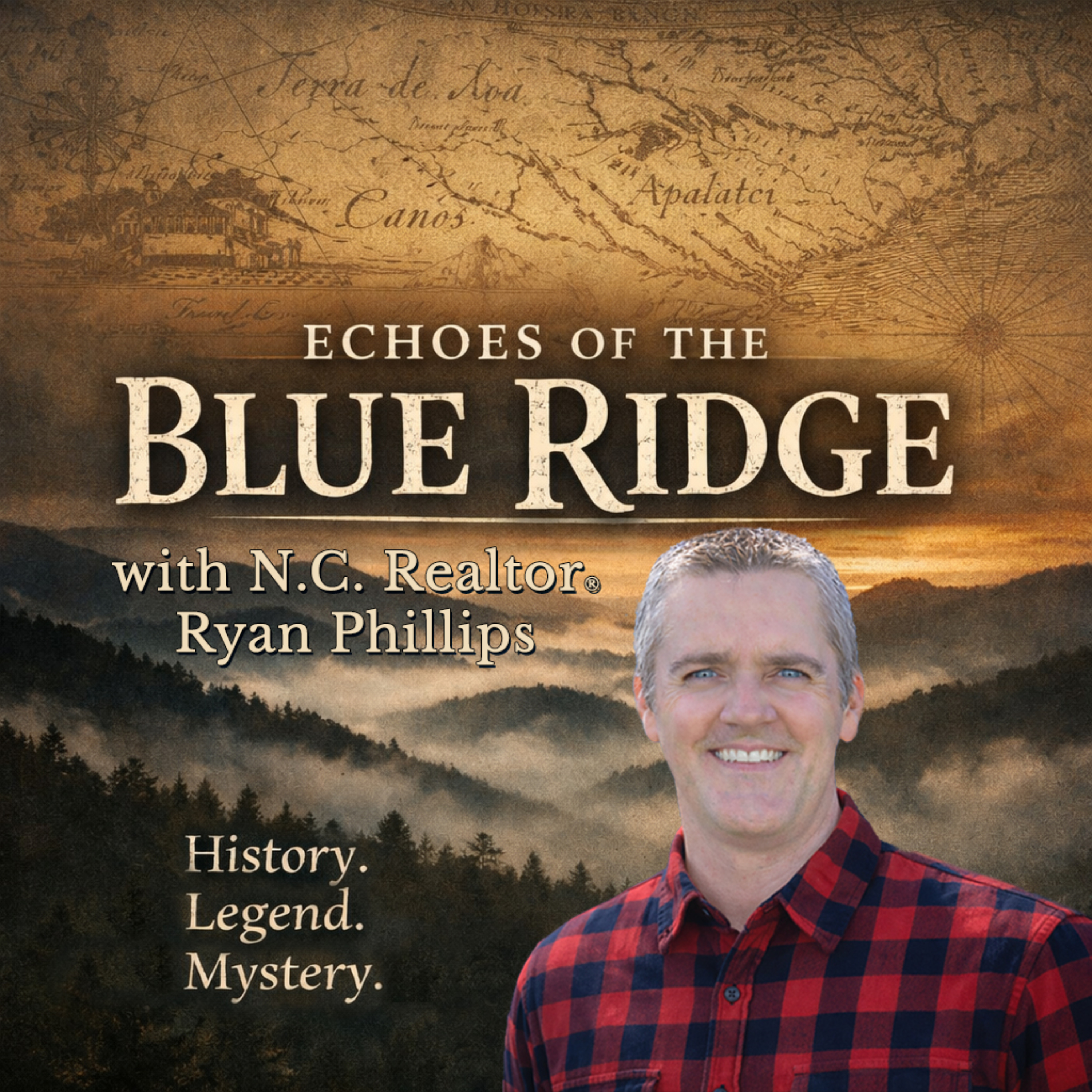
The Blue Ridge Mountains hold more than scenery, they hold memory.Echoes of the Blue Ridge examines the real history, persistent legends, and unanswered mysteries of the Blue Ridge Mountains. Ancient cultures. Lost forts. Mountain uprisings. Forgotten conflicts.In each short episode, the past is explored carefully, where record and legend meet.Hosted by North Carolina Realtor® Ryan Phillips.
Pitch Analysis
Required Pod Score for this show. PitchCentric checks your profile against host openness, topical fit, and audience signals before you generate a pitch.
Contact path
Verified email
Booking probability
31%
Guest openness
Selective
Verified email on file
80/100
Required Score
Sign up to generate a grounded pitch for Echoes of the Blue Ridge: History, Legend, Mystery..
What is Echoes of the Blue Ridge: History, Legend, Mystery.?
Echoes of the Blue Ridge: History, Legend, Mystery. is a history podcast hosted by Ryan Phillips, with 32 episodes on record and a Required Pod Score of 80. PitchCentric scores this show on Booking Probability, Listen Score, and live audience signals refreshed every 24 hours.
About the host
Ryan Phillips hosts Echoes of the Blue Ridge: History, Legend, Mystery., a history show with 32 episodes published.
Our AI reads these to draft pitches. Use them as grounding for a pitch that cites a real guest and a specific topic.
Episode #27
Episode 27: "The Twin Poplars of Peace Where the Cherokee and Catawba Laid Down Their Weapons"
Aug 16, 20268 minS1
In the mountains of Caldwell County, North Carolina , two towering poplar trees came to represent something remarkable in the troubled years surrounding the Civil War: peace between men who had once stood on opposing sides . Known as the Twin Poplars of Peace , the trees became tied to the story of former Union and Confederate soldiers who gathered beneath their branches as old wartime divisions slowly gave way to reconciliation. In this episode of Echoes of the Blue Ridge , we travel into Caldwell County to explore the history behind the Twin Poplars, the people connected to them, and a mountain community attempting to heal after a war that had divided neighbors, friends, and families. The Civil War left wounds throughout the Southern Appalachians, and some of them lasted for generations. But the Twin Poplars preserve another kind of memory. Not of a battle. Not of revenge. But of the difficult decision to put an old war behind you and live together again. Two trees. Two sides. And beneath their branches, peace .
Episode 26: "Before Asheville Was Asheville: The Story of Morristown"
Aug 9, 20269 minS1
Before there was Asheville, there was Morristown . In the 1790s, a small frontier settlement began taking shape in the mountains of newly formed Buncombe County. John Burton laid out 42 half-acre lots along an old north-south route, helping establish the framework of a town that would eventually become the largest city in Western North Carolina. But these mountains already had a much older history. They stood within the ancient homeland of the Cherokee, along routes traveled long before surveyors drew streets or settlers established a county seat. In this episode of Echoes of the Blue Ridge , we trace Asheville's beginnings from Cherokee homeland and mountain crossroads to Morristown, its 1797 renaming in honor of Governor Samuel Ashe, and the early work of John Burton, remembered as the Father of Asheville . Before the hotels, the railroad, and the city skyline, Asheville was little more than a collection of lots surrounded by mountains. And the story of the city we know today began there.
In the winter of 1831, a quiet cabin in the mountains of Burke County became the scene of one of North Carolina's most infamous murders. A young woman named Frankie Silver stood accused of killing her husband, Charlie Silver, with an axe before attempting to destroy the evidence in the family fireplace. The shocking crime captivated the public, inspired newspaper coverage across the region, and eventually led to one of the state's earliest and most enduring murder legends. But was Frankie Silver a cold-blooded murderer? Or was she a young wife driven to desperation by years of abuse? For nearly two centuries, historians, writers, musicians, and storytellers have debated that question. The historical record offers conflicting accounts, leaving room for both fact and folklore to shape the story that followed. In this episode of Echoes of the Blue Ridge , we separate documented history from mountain legend as we revisit the trial, the execution, the famous ballad that kept Frankie's name alive, and the unanswered questions that continue to surround one of Appalachia's greatest mysteries. Some stories fade into history. Others become legends. And few have echoed through the Blue Ridge Mountains longer than the Ballad of Frankie Silver.
Episode 24: "High Mountain Corridors, The Ancient Paths of Yancey, Mitchell, and Avery"
Jul 26, 20267 minS1
Long before highways crossed the Blue Ridge, ancient footpaths wound through the highest mountains in the eastern United States, linking valleys, hunting grounds, trading routes, and sacred places across what are now Yancey, Mitchell, and Avery Counties. These rugged ridges were more than barriers. They were corridors of movement. Cherokee hunters followed them in search of game. Medicine people climbed them seeking vision and ceremony. Early explorers, settlers, drovers, and soldiers would later travel many of the same mountain passes, leaving their own footprints on trails that were already thousands of years old. Towering peaks like Mount Mitchell, Roan Mountain, and Grandfather Mountain watched over this network of ancient pathways, while rivers such as the Toe and Cane carved natural routes through some of the wildest country in Appalachia. In this episode of Echoes of the Blue Ridge , we journey across these high mountain corridors to discover how geography shaped the lives of those who came before us, and why these ancient routes became the lifeblood of the Southern Blue Ridge. The mountains were never empty. Long before they appeared on maps, they were already connected by paths, stories, and generations of travelers whose echoes still linger among the highest peaks of North Carolina.
High above the border of North Carolina and Tennessee, Max Patch rises as a broad grassy summit surrounded by miles of forest and fading Blue Ridge mountains. Today, hikers climb the bald to watch the sunset, feel the mountain wind, and follow the Appalachian Trail across one of the most recognizable summits in the Southern Appalachians. But long before modern trails and county lines, these high ridges formed ancient corridors traveled by Cherokee hunters, traders, medicine people, and generations of mountain travelers. In Cherokee tradition, the mountains were not empty wilderness. They were living places filled with memory, spiritual power, and presence. Certain peaks were believed to stand closer to the spirit world, and old traditions surrounding the ridges near Max Patch spoke of powerful unseen beings moving across the heights. In this episode of Echoes of the Blue Ridge , we explore the mystery of the Appalachian balds, the ancient pathways that crossed Max Patch, and the spiritual geography that shaped the Cherokee understanding of the high mountains. Stand on the summit long enough, with the wind moving through the grass and clouds drifting across the ridges, and it becomes easy to understand why these mountains inspired reverence. The forests may disappear at Max Patch. But the old spirits of the Blue Ridge were never believed to be far away.
Every question we get asked before someone starts their trial.
If you have a concern about deliverability, AI quality, data privacy, or whether this will actually work for your specific situation, it's probably answered below.
What is the difference between Founder Solo and Founder Pro?
Founder Solo gives you 50 AI pitches per month using the credit model (Standard pitches cost 1 credit, Enriched pitches cost 2). Founder Pro raises that to 200 credits per month and adds full Booking Probability access, unlimited Magic Match, Apollo enrichment credits, and data export capabilities. Both plans use the same credit system, so you can stretch your monthly budget further by using Standard-mode drafting.
How do agency tiers work?
Agency tiers have no base fee. You pay per managed client and per talent profile. Agency Standard is $199 per client per month; Agency Pro is $399 per client per month. Both add $39 per talent profile per month. Your own team's user seats are always free.
What is a talent profile?
A talent profile represents one person (founder, executive, or spokesperson) you are booking onto podcasts. It includes their bio, topics, headshots, and outreach history. Team plans include 5 profiles; agency plans are pay-as-you-go.
Can I switch plans later?
Yes, at any time. Upgrades take effect immediately; downgrades apply at the end of the current billing period. Contact support if you need help migrating between plan families.
Do you offer a free trial?
Every paid plan includes a 15-day free trial. Your card is saved at signup but you will not be charged until day 16. Cancel any time from your dashboard.
What happens if I cancel?
You keep access until the end of your current billing period. No charges after that. Your data is retained for 30 days in case you reactivate.
Is the 20% annual discount automatic?
Yes. Select Annual on the pricing toggle and the discounted price is applied automatically at checkout. The annual price shown is the full year cost.
What if I have more than 50 profiles or 20 clients?
That is our Enterprise tier. Contact our sales team and we will build a custom plan with volume pricing, a dedicated account manager, and SLA guarantees.