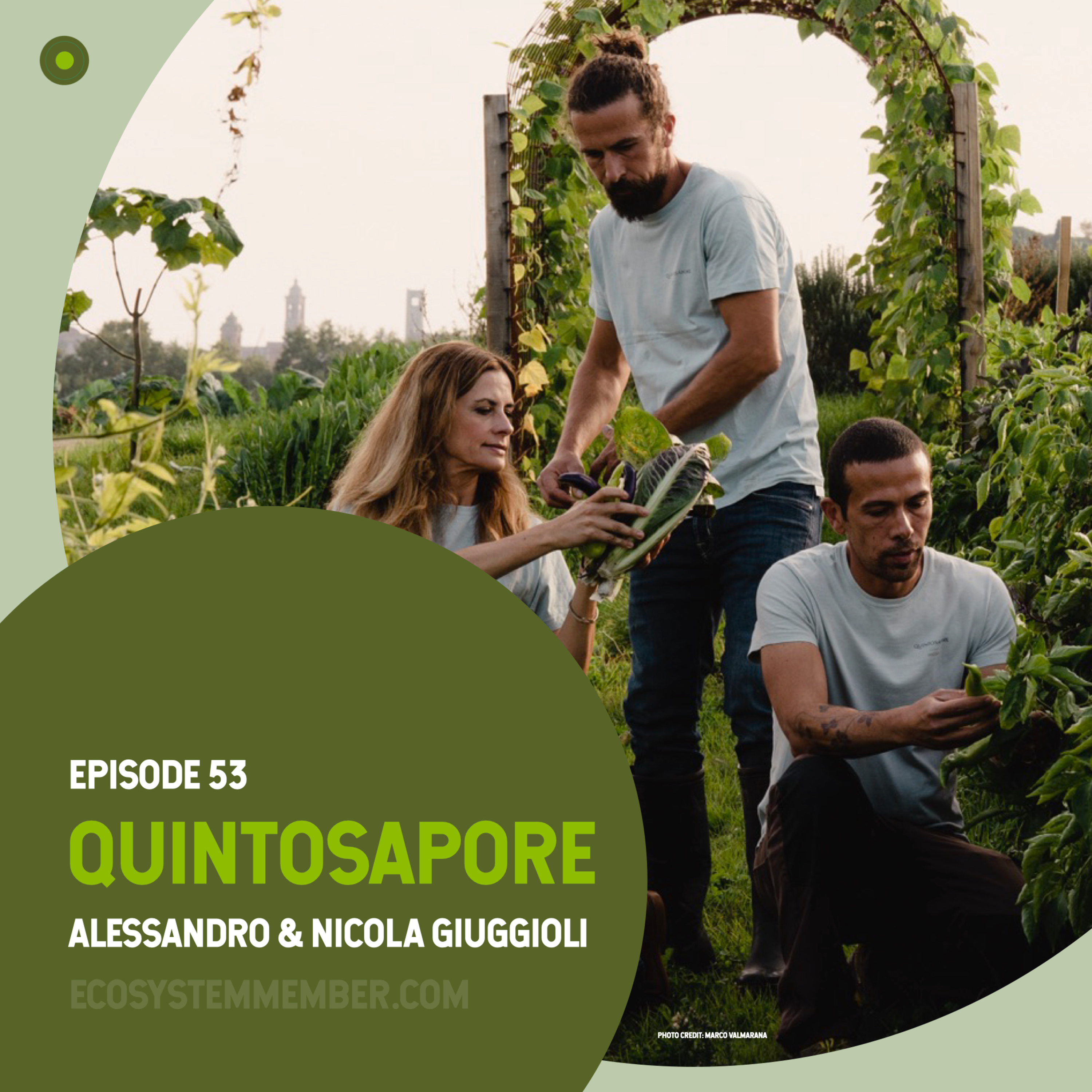
Episode #53
How Nature's Complexity Creates Resilience for People and Planet
Quintosapore: Biomimic Farming, Complexity, and Building Resilience in Italy Rick speaks with Nicola and Alessandro Giuggioli of Quintosapore in Italy about how they went from sustainability and cinema careers to building a farm shaped by observation, experimentation, and nature itself. T hey explain their Biomimic Farming approach, why they treat the woodland as their model, and how complexity has made both their land and business more resilient. Guests: Nicola Giuggioli and Alessandro Giuggioli of Quintosapore Key topics Nicola’s background in sustainability consulting and Alessandro’s career in acting, producing, writing, and directing How their childhood connection with nature in Umbria shaped their approach to farming Why starting with an abandoned property during COVID gave them freedom to experiment What Biomimic Farming means and why the woodland is their primary teacher How trial, error, and major mistakes shaped their learning Their water-resilience system using organic matter, living ground cover, biochar, rain harvesting, shade trees, and recycled paper mulch How they saved approximately 65% of their water in two years Why they use a practical toolbox of techniques rather than a fixed certification How biodiversity became an asset, with approximately 1,650 species and varieties What the 2023 heat wave and drought taught them about complex ecosystems How the farm developed multiple revenue streams through fresh produce, transformed foods, hospitality, tours, and events Chapters 00:00 — Introducing Quintosapore and the farm’s unlikely origin story 00:42 — Nicola’s sustainability background and early lessons from Umbria 04:02 — Alessandro’s cinema career and the decision to start farming 07:01 — Why starting from an abandoned plot created room to experiment 10:25 — What Biomimic Farming means and why the woodland is the model 11:29 — From one-problem-one-solution farming to systems thinking 12:19 — The water-saving toolkit 14:27 — How their approach differs from other farming movements 16:51 — Why complex systems are more resilient than simple ones 18:03 — Replacing certification with a practical toolbox 19:31 — Why agriculture is slow to change 21:16 — Does this approach take more work? 22:26 — Why crop diversity reduces climate risk 25:20 — Building a seed collection with 1,650 varieties 27:41 — The 2023 heat wave and a 70% crop loss 29:18 — Letting ecological balance return 30:37 — Interbeing and the role of love in growing plants 33:58 — Measuring success without becoming trapped by metrics 38:52 — Three revenue streams: food, transformation, and hospitality 40:16 — Turning abandoned interlines into productive zones 44:18 — Italian food culture and direct-to-consumer trust 47:01 — Why sustainability becomes mainstream when it becomes cheaper 50:19 — Two lessons: observe nature and diversify revenue 51:51 — Building a greenhouse restaurant and expanding the guest experience Notable quotes “The only book that we read when we want to learn how to grow things is Nature.” “Complexity is your friend.” “We don’t want to save the planet. The planet is already safe. We need to save ourselves.”