eX-skeptic
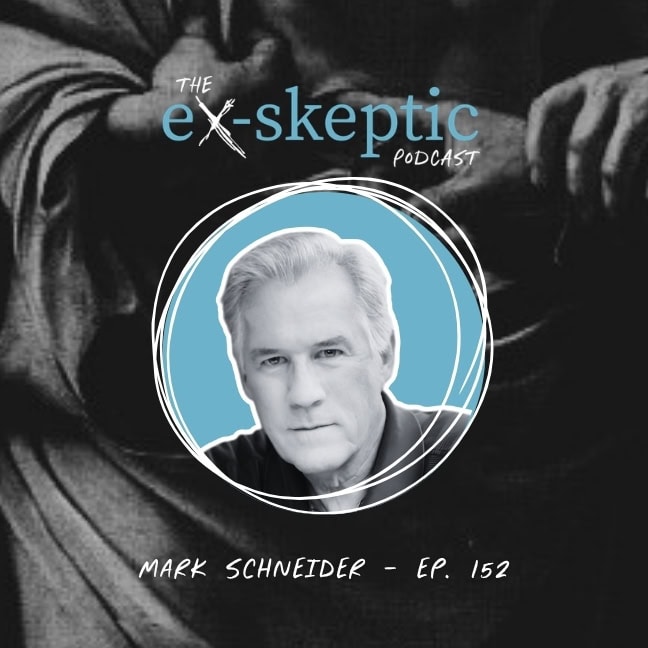
From Darkness to Light – Mark Schneider’s Story | Ep. 152
What happens when your search for truth leads beyond philosophy and into the unexpected? Mark Schneider is a former skeptic whose life was marked by profound questions about meaning, purpose, and reality itself. Though raised in a nominal Catholic home, faith became irrelevant to Mark early in life. As a young man, he embraced a materialistic worldview and searched desperately for answers through philosophy, psychology, and human wisdom. But after years of wrestling with despair and searching for what he called "the one truth," Mark encountered something he never expected - not merely an idea or a system of thought, but the person of Jesus Christ. ️ Love the show? Support the mission and explore eX-skeptic merch here: https://ex-skeptic-shop.fourthwall.com/ Want to support this channel? Tax-deductible donations available here: https://givebutter.com/CB6WoH Guest Bio: Mark Schneider is a former Silicon Valley executive and patent litigator who explores the intersection of law, technology, and Christian thought. He is the author of Ransomed: One Man’s Journey out of Darkness into the Light of Truth. With degrees in electrical engineering from California Polytechnic University and law from Trinity Law School, he brings a sharp analytical lens to questions of truth and belief. Mark also founded a Salt & Light ministry at his church and continues to engage cultural and moral issues with clarity and conviction. Resources Mentioned: eX-skeptic Guides: https://exskeptic.org/bookstore/ Mark’s Resources: • Mark R. Schneider, Esq. Website: https://markrschneider.com/ • YouTube: https://www.youtube.com/@protectourkids2393 Book: Ransomed: One Man's Journey Out of Darkness into the Light of Truth — Mark Schneider Ministry Connect with eX-skeptic: Website: https://exskeptic.org/ Facebook: http://www.facebook.com/exskeptic Instagram: http://www.instagram.com/exskeptic Twitter: http://x.com/exskeptic YouTube: https://www.youtube.com/@exskeptic Email info: info@exskeptic.org eX-skeptic Transcript Ep. 152 August 28, 2026 Mark Schneider Chapters 00:00:00—Intro 00:02:12 — Meet Mark 00:04:48 — From Nominal Faith to No Belief 00:08:12 — When Faith Seemed Unnecessary 00:10:09 — Uprooted and Angry 00:14:18 — The Sudden Descent into Darkness 00:17:04 — Searching for an Anchor 00:21:48 — When Philosophy Offered No Answers 00:26:59 — An Encounter with the Spiritual Unknown 00:28:56 — Returning to Fresno, Finding Temporary Relief 00:32:15 — When the Darkness Returned 00:36:47 — The Search for “The One Truth” 00:39:28 — A Failed Search for Peace 00:42:59 — “Smile, Jesus Loves You” 00:46:41 — Discovering That Truth Is a Person 00:52:34 — The Peace That Remained 00:53:41 — Grounding Faith in Objective Truth 00:55:15 — What Should a Seeker Do? 00:59:58 — Where to Start Reading the Bible 01:02:28 — Who Do You Say That I Am? 01:02:36 — Who Do You Say That I Am? 01:04:21 — Closing Intro MARK SCHNEIDER: I felt just incredible love and I didn't hear it with audible ears but with spiritual ears. I heard this voice said, “I am the truth that you've been searching for.” Jesus, the source of all that ever existed, had suddenly entered into me and it was powerful I can't even describe it how powerful it was. JANA HARMON: Hello and welcome to eX-skeptic , where we explore unlikely stories of belief. We feature former atheists and skeptics who came to question their assumptions and consider the truth of Christianity. I'm your host, Janna Harmon, and I'm so glad you're here. Whether you're someone who's curious, questioning, or deeply exploring what you believe and why. Thank you for joining us. What if the truth you've been searching for can't be reduced to an argument, a philosophy, or a system of thought. What if truth is more than a principle to discover? What if truth is personal? My guest today is Mark Schneider, a former skeptic who spent years wrestling with darkness, meaning in the deep question of whether life had any objective grounding at all. He went searching for what he calls the one truth, something solid enough to explain reality and strong enough to hold the weight of his life. But what he found was much more unexpected than a new idea, a worldview. In this conversation, Marc shares how his search for truth led him beyond materialism, beyond abstract answers, and ultimately to the person of Jesus Christ. And if you're someone who has questions about God, meaning, or whether Christianity is actually true, you'll find curated playlists on our YouTube channels around big questions like, “Is there more to life than this?” And “Is it rational to believe in God?” And if you'd like to talk personally with a former guest about your own questions or doubts. Reach out to us at info@exskeptic.org Here's my conversation with Mark Schneider Meet Mark JANA HARMON: Welcome to eX-skeptic. Mark, it's great to have you with me today. MARK SCHNEIDER: Well, Jana, I'm so delighted to be here with you. Thank you for giving me this opportunity. JANA HARMON: Wonderful. I'd love the listeners to know a bit about your background, the things that you love to do, that you have your hands in a little bit about your work. Can you tell us about all of that? MARK SCHNEIDER: My professional background, I'm an engineer. Electrical engineer by training. I started my career in Silicon Valley for a large technology company that I was with for quite some years. In the middle of my career, I decided to go to law school. And so after that, I joined the legal department of Hewlett-Packard company, who I was with for a long time. And after that, I went into private practice as a patent litigator for a number of years. But my real, um, passion is for, uh, ministry. And, um, there was a series of laws that had passed in California that were affecting children in our public school system. Um, it was really laws designed to indoctrinate them into a worldview that is completely foreign to the one most Americans grew up with and came to love. And as a result of that, um, me and some colleagues started a ministry called Protect Our Kids . And that was in April of 2019. So, protect our kids as a ministry to help parents become better advocates for their children in the public school system and actually try to reform public education in California and beyond. So currently, Jana, that POK is taking most of my time these days. JANA HARMON: Hmm. Well, if anyone is interested in hearing more about that, especially if they live in California, we'll put that link in the show notes, so they'll be able to find out more about your work there. Now, I met you about a month ago, and you were so generous to give me a pre-publication release of your new book called Ransomed . The subtitle, One Man's Journey Out of Darkness into the Light of Truth. I can tell you. For again those who are listening. This is a wonderful book. It's a really, really wonderful book. Not only does it tell your story, but it really gives an excellent substantive grounding for the Christian worldview and for the biblical text. From Nominal Faith to No Belief Let's talk about your journey and starting with your childhood. What did that look like in terms of a faith background. MARK SCHNEIDER: Well, it was very nominal in terms of faith. I was born in Oakland in the sort of the poorest post-World War Two boom years, and as a child my dad worked in local government, and that meant frequent moves. So, we were moving all the time in different homes, and I attended a bunch of different schools. And finally, we ended up in Fresno, of all places. And, um, as an adolescent, I really came to love it. It was just an incredible place to, uh, to be a young man. Uh, growing up until the wonders of adulthood, um, uh, the Sierra Nevada mountains were, uh, our backyard. So, we spent our winter skiing and our summers backpacking through the mountains. But in terms of faith, um, both my parents were nominal Catholics. Catholicism was really sort of handed down to them by both sets of grandparents, who followed the church pretty carefully. But I think for my parents it was more of a tradition than a heartfelt, um, a belief in Catholicism. I did, however, spend time in parochial schools, actually a couple of them when finances could afford it. So, I would say Jana that Catholicism gave me sort of a conceptual idea about God. Um, but it certainly wasn't deep in any way, and it certainly wasn't personal. And when my grandmother Marie died, um, she was sort of the foundation and pretense of my family's faith. And very shortly after that, I noticed that we stopped going to mass and altogether. So, I was 13 years old at the time, and one day I asked my dad about it. I said, dad, you know, why aren't we going to mass anymore? And he said, very candidly, he said, well, Mark, your mother and I talked about it, and we realized we just didn't believe it. So, we stopped going and that was it. Jana, I didn't give it much thought because I was nominal myself. And after that, I very quickly forgot all about anything having to do with the spiritual realm, with God. I really knew I'd never read the Bible at all. I had really no interest in spiritual things whatsoever. So certainly, by the time I entered adolescence, spiritual things were a thing of the past for me. JANA HARMON: So, would you have agreed with your father's statement that you just didn't believe that anymore? Or are you just. MARK SCHNEIDER: Absolutely. JANA HARMON: Right? MARK SCHNEIDER: Yes, I would say so. Certainly, by that time in the public school system. Um, the teaching of evolution and Darwinism was becoming more prominent. And as most people raised in the school system, you go along with what you're taught. And I was part and parcel of that teaching, so I accepted it pretty much at face value. When Faith Seemed Unnecessary JANA HARMON: Mhm. Yeah. So, accepting, accepting a belief at face value. You know you didn't believe in God but what kind of did you believe in. Did you. You believed in science I suppose. You believed in rational thought or rational thinking or. MARK SCHNEIDER: I would like to be able to tell you that I had some deep-seated personal philosophy or worldview that I had worked out, but I'm afraid to say it was much simpler than that. Um, my, um, intellectual life was sort of governed by my appetites at the time. As a young boy growing into adulthood, I was more concerned with having good friends, doing fun things, be an important part of my peer group, and really not having any particular ideas or grounding for any worldview whatsoever. One thing I did know though, is that I didn't believe in God. JANA HARMON: What did you think belief in God was, or Christianity or religion at that point when you moved away from it? How would you have described what that is? MARK SCHNEIDER: It was sort of a crutch for people who needed it. I viewed it sort of abstractly. It had never had any, um, um, really, uh, personal compulsion in my life one way or the other. It wasn't a factor that it wasn't important at all. My family and my friends never, even ever even spoke about spiritual matters, let alone the deep things of, you know what it meant to be a Christian or, you know, believe in an afterlife. It simply was not discussed. And because of that, it just became completely unimportant. JANA HARMON: Just irrelevant to your life. You didn't need God, correct? You didn't need that. That's right. Right. MARK SCHNEIDER: That’s right. It's the furthest, furthest thing from my mind. Uprooted and Angry JANA HARMON: So, talk with us about your life. I know that there were. You said you moved a good bit and that that was very pivotal in your life at times. Why don't you kind of walk us through? I know you were happy in Fresno, but then. Then you continued to move and some things happen that that weren't just as good, I think. MARK SCHNEIDER: Yes. Um, for some reason I was particularly affected by these moves. And there were there were many of them before we finally landed in Fresno. And even when we landed in Fresno, we lived in a number of different places before, um, I landed in the middle school and then the high school that I grew to enjoy so much. So, I just didn't like these, these moves at all. And one day in the middle of my junior year in Fresno, my dad made a fateful announcement at the dinner table one night. He announced that he'd taken another job in this place called Orange County. That was 300 miles to the south. I'd never been to Southern California, except once to go to Disneyland when I was eight years old. But the very idea of being uprooted yet again, in the middle of a very important time, of what I considered in my life, where I'd been accepted. I thought I was living the life of American Graffiti. It was just a wonderful time. And now I was being told that we were going to be uprooted from all of that and start all over again in this in, in another city, 300 miles away from everything I knew. And that set in motion, Jana, a change in psychology for me. It was not imposed upon me. It's one that I chose. And the psychology that I chose to engage was simply, for lack of a better term, a sense of bitterness and anger at, um, at this sudden change now that was being imposed on me. So, we did ultimately end up moving to Orange County. Um, fortunately was over, um, Christmas break. So, we lived in a hotel while the house that was being built for us was finishing, so I wouldn't have to start school for a couple of weeks after we moved. We lived. We lived in this sort of a squat hotel on this very busy street, uh, called Harbor Boulevard in Fullerton, which is in the heart of Orange County. And I had nothing to do for a couple of weeks. And so, I just sat watching TV. Um, walking up and down the street, just sort of harboring this slow boiling bitterness at, uh, where my life had suddenly landed. And this increased over time. Um, I did end up going to a wonderful high school. It turns out El Dorado High School and a little town called Placentia, um, in Orange County. And to my surprise, um, my peers were very friendly. Um, they really reached out to me. I don't know whether that was because, uh, there were a lot of people from the outside that had suddenly moved into the area. It was a new community, and that could have been part of the reason. But it actually stunned me that that people were so friendly, but far from embracing my peers. I rejected them. I wanted nothing to do with them. My one goal was to escape this place and to figure out any way that I could to get back to my old life and my old friends. Up, up in the Central Valley. So, for about six months, um, I sort of nurtured this slow boiling bitterness and internal anger. And until one day, it all came crashing down. The Sudden Descent into Darkness JANA HARMON: Hmm. Tell me about that. MARK SCHNEIDER: Well, um, the day was like any other. It was a sunny day at El Dorado. I've just been going about my classes, and I was walking down the hallway. Oh, of course, I'll never forget it. Forget it. It's emblazoned in my mind. I was walking down the hallway, just thinking to myself how much I hate this place, and I wish I could get out of here. When all of a sudden, Janet, um, my mind was sort of besieged by a wave of mental anguish. Um, something actually, um, came in and took over, uh, my psychology where I went from, yes, being bitter, but certainly feeling normal mentally and emotionally and able to experience joy and happiness and look forward to things, to one second later being sort of, uh, tossed into a sea of despondency. Um, all of a sudden, thinking itself was painful. Um, I felt like something inhabited me, and I had no idea what it was, but it was just a dark, despondent gloom, and it happened in literally a second. In fact, it was so strong that I felt I was going to vomit, and I literally shook my head and sort of a hapless attempt to shake off whatever it was that had just entered into me, but I couldn't. There was no there was no way of escape. And you can imagine, you know, what happened afterwards? I for several weeks, I just sort of went about in a state of shock, wondering what on earth has happened to me. I went from one day being a normal teenager, a young man who could enjoy life, even though I was bitter about where I was to suddenly not being able to be happy, to experience pleasure, to experience joy. Um, and my very thoughts being sort of enveloped in a darkness and a pale of darkness, and there was no way to shake it except through sleep. JANA HARMON: Wow, that. That would be incredibly disturbing. Um, especially for such a sudden change. So, it sounds almost like a clinical depression, but it it, it almost sounds like more than that the way that you're describing it at that point. Searching for An Anchor JANA HARMON: Just wondering, as someone who didn't believe in God, did you believe in any kind of spiritual reality at all? Dark or light? MARK SCHNEIDER: No. And that's the irony. And of course, as I'll continue to share, as we get more into my story, it never, ever occurred to me that there could be a spiritual element to what I was experiencing. Um, never once, which is sort of astonishing looking back. But in time I did start to consider questions that I'd never before thought of and consider them very seriously. Like, what is joy? Um, where does it come from? Is there any objective value to being happy? Um, why am I here anyway? Um. These questions. You know, I never even thought of them before, but suddenly they, they consumed me. And, um, before the attack, you know, I never had any question to question what philosophers, uh, call materialism. And now pondering this sort of left me emotionally depleted. But as the months wore on, I had to find some answer to this anguished state that I, I was, and I kept my depressed state from - to myself. I never told anybody about it, not even my parents. I didn't want to be tagged with or, you know, being associated with, I thought at the time were unhelpful labels like mentally ill or clinically depressed. I didn't really even understand what those meant. But, um, one day I decided to risk a query to my father about happiness. What? What he thought of it. And, um, his answer was true as far as it went. He basically said that happiness comes from setting goals and seeing them through. Happiness is a product of accomplishment, satisfaction in a life well run. And that was true as as far as it went. But my dad viewed happiness as sort of a layer of frosting atop an underlying emotional layer of mental well-being, sort of an inner quiet that, to the undisturbed mind is assumed. We just take it for granted. But my mind was anything but quiet. Accomplishment and goal setting were, were fine and well, but none of it meant anything until I could discover what difference it made. And I needed an anchor. And unfortunately, my father's recipe for happiness was unable to help me. So, Jana, with a little over a year now to go before graduation, I tried to make the most of things. I got a job. I bought my first car. I made a few friends. Um, I kept my grades up. Um, I dabbled in campus, uh, politics such that by from outward appearances, you know, I probably appeared as a very normal teenager. Um, albeit a cynical one, but, um, I was fighting a war of attrition against an unseen enemy whose power I had not even begun to grasp. And this led one night. I'll never forget this. I was alone in my bedroom. It was a warm, starlit Southern California night, and, um, I just sort of. A wave of anguish swept over me, and I literally felt like a little child, isolated and all alone. I didn't know what to do. And this was the one time, in my experience, Jana, that, um, I reached out to, hopefully, someone who would hear me. And I got down on my knees in my bedroom and I prayed this prayer. I