Exploring Modern AI in Tamil
2026 Day 5 - Spec-Driven Production Grade Development in the Age of Vibe Coding | Google AI Agents Course
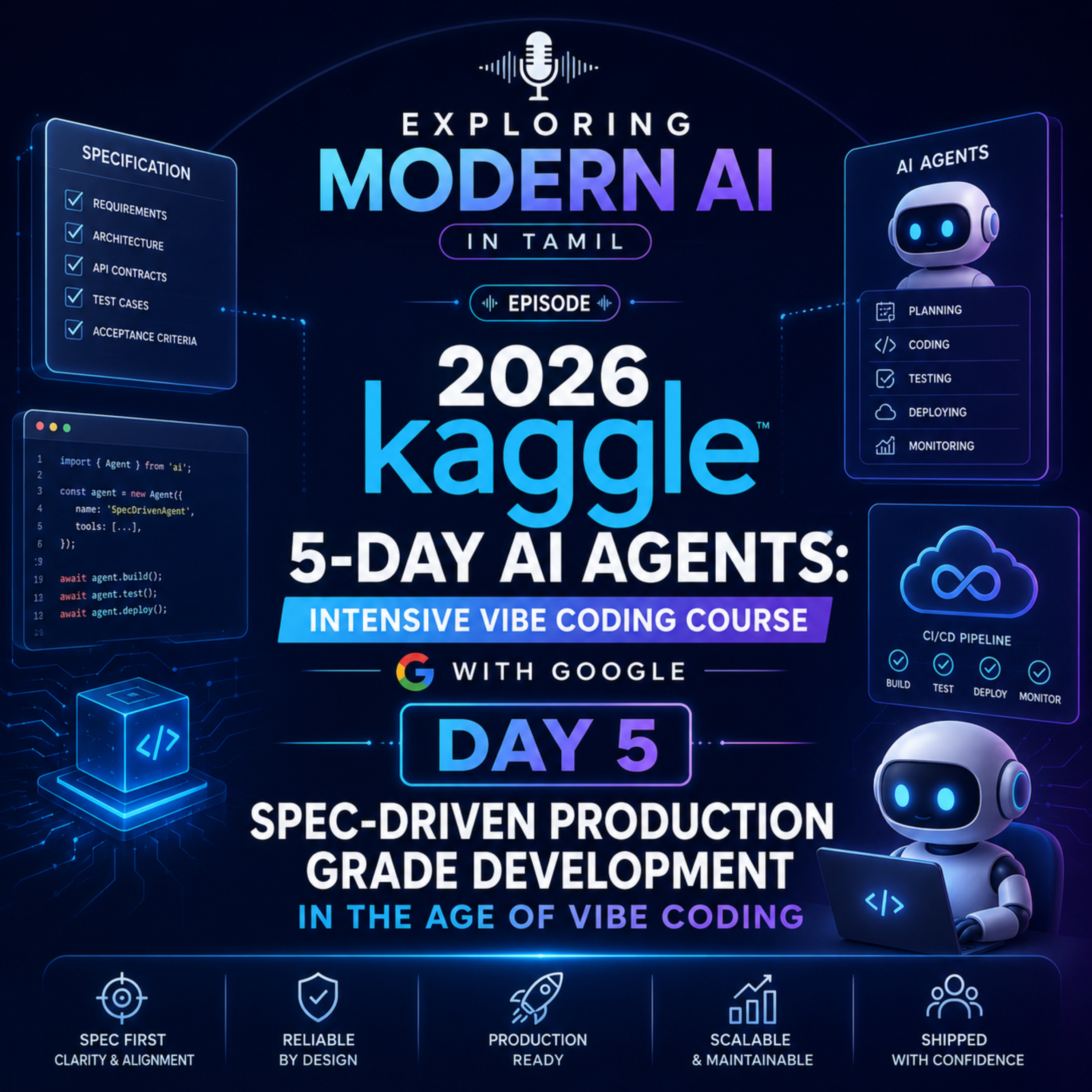
2026 kaggle 5-Day AI Agents Intensive Vibe Coding Course With Google Day 5: Spec-Driven Production Grade Development in the Age of Vibe Coding This episode of Exploring Modern AI in Tamil podcast explains these concepts clearly for someone new to Spec-Driven Development . - Shares how to organize specs in a project folder. - Explains how to use version numbers for tools. - Defines how an AI agent acts as a hybrid team member during development. - Explains why using YAML is better than JSON for complex configurations. - Describes techniques to prevent AI from guessing when building production code. - Provides an example of a Gherkin scenario to structure your architectural requirements. - Explains how to store repeatable workflows within an agent skills folder. - Describes how human reviewers should manage AI-generated pull requests effectively. - Details how to implement automated guardrails and sandboxing for safer code production. - Defines the Architect role during project scaffolding to ensure structured foundation building. - Describes how a developer evolves into a technical architect using agentic tools. - Discusses strategies for scaling AI coding workflows across large engineering teams. - Discusses methods to optimize token usage for cost effective AI reasoning. - Explains how to use Markdown headers to anchor AI attention during project planning. - Describes how to transition technical plans from Google Docs into spec files. - Focuses on using Behavior Driven Development to turn user needs into strict code requirements. - Details the difference between vibe coding and actual production grade reliability. - Explains how to structure project files to avoid context fragmentation for agents. - Details strategies for maintaining team alignment when many agents handle different project modules. - Explains how to manage global versus local agent memory using configuration files. - Outlines different execution modes for AI to avoid rushed or incorrect coding. - Compares the Architect and Implementer roles during the project scaffolding phase. - Shares tips for reducing token costs by flattening nested YAML data structures. - Describes how to maintain a cleaner context by using hierarchical configuration files. - Shows how to use skills files to automate common project maintenance tasks. - Explains ways to reduce token consumption during multi-turn agent reasoning loops.