
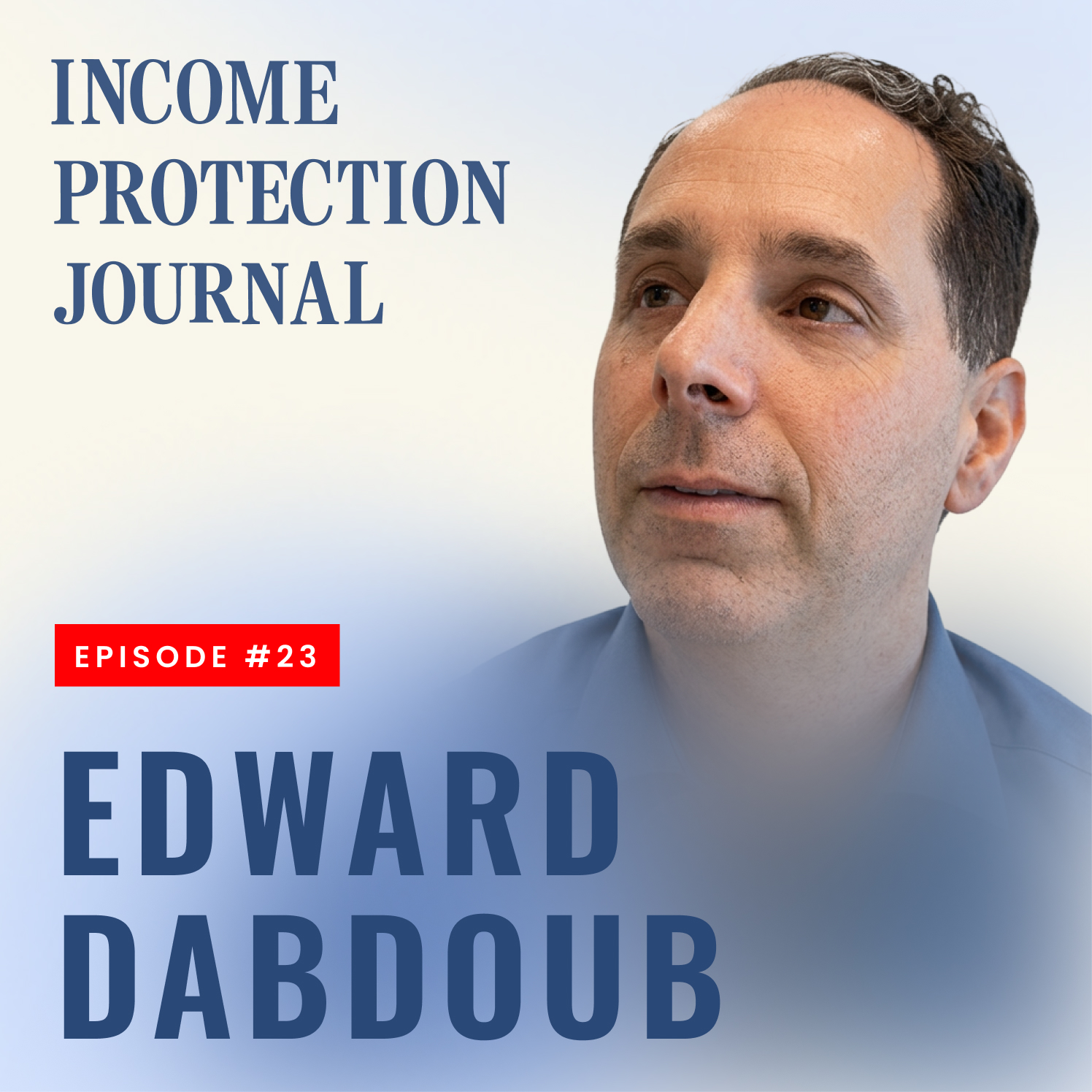
Income Protection Journal Podcast
Benefits Stop When Definition of Own Occupation Becomes Any Occupation
Picture a dentist who develops a tremor severe enough that dental work is no longer safe to perform. For two years, disability insurance pays a full benefit, because the policy defines disability as being unable to do the specific work of dentistry. Then, on schedule, nothing about the tremor changes, but the payments do. The policy's own definition of disability just switched, and the dentist no longer qualifies. I explored exactly why that switch happens, and why it doesn't happen under every policy, with Edward Dabdoub of the Dabdoub Law Firm in Coral Gables, Florida, on this episode of the Income Protection Journal Podcast. Edward has spent years studying how disability insurance policies define who qualifies as disabled, and how that definition can change over time. He walked me through the policy language to look for, which would also apply to an attorney relying on their law firm's group long term disability plan. Definition Changes at Two Years Most group long-term disability policies define disability one way for the first two years of coverage and a different way after that. For those first 24 months, you qualify as disabled if you cannot perform the material and substantial duties of your own occupation. That's why the dentist above kept getting paid while the tremor made dentistry unsafe. But after 24 months, the definition in a typical group policy shifts to any occupation, meaning any occupation you could reasonably do given your training, education and experience. A dentist who can no longer hold instruments steady can often still teach, consult or manage, and the moment an insurer decides that's true, the group benefit ends. The definition switched. Nothing about the dentist's hands did. That's the switch Edward has watched play out with his clients. So if that dentist had an own occupation insurance policy, an individual insurance policy, they would be able to find another occupation other than dentistry, and continue to get paid a full total disability benefit and essentially reinvent their career doing something else. Edward Dabdoub, managing partner of Dabdoub Law Firm in Coral Gables, Florida, on the Income Protection Journal Podcast Under an individual, true own-occupation policy, the definition Edward is describing never changes. What's insured is the ability to perform your own occupation specifically, not some other occupation you could theoretically be retrained for. That single difference in policy language is the entire reason two people with the identical dentist story can end up in two entirely different financial positions two years later. Edward has seen the group-plan version of that story more than once. The group insurance policy is different because after 24 months, the insurance company will likely terminate those benefits because they would take a position that well, there are other things you can go and do now, and many professionals were wired a certain way where we don't want to stay home if we're disabled, and we want to reinvent our careers. And so my clients were dentists. Some of them going to teaching, but if you have a group insurance policy that has that definition of disability change from own to any after 24 months, well, when you move into teaching, you're not going to continue getting paid after 24 months. Edward Dabdoub of Dabdoub Law Firm, who has spent years studying how insurers write disability definitions, on the Income Protection Journal Podcast Notice what actually disqualified those dentists from further group benefits. It wasn't that they recovered. It was that they found a second career, exactly the kind of resilience a group plan's own-to-any definition treats as proof the benefit is no longer needed. https://youtu.be/dXe05mgp7yQ Risk If Group LTD Is Your Only Coverage Attorneys may hear this dentist story and assume it doesn't apply to them, because practicing law rarely depends on fine motor skill the way dentistry does. But the definition-switch mechanism Edward described isn't written for one profession. It's built into the policy language of most employer-sponsored group long-term disability plans, including the ones law firms buy for their partners and associates. An attorney disabled by a condition that keeps her from trying cases or negotiating at the pace her practice demands can qualify for the full benefit for two years under the own-occupation standard, then lose it once an insurer decides she could reasonably do a different kind of work, like sweeping floors or a hospitality job. A law firm partner who has never looked past the group plan's summary page usually assumes coverage is coverage. It isn't. The same 24-month definition switch that reclassified Edward's dentist clients into teachers applies to a partner who could plausibly shift out of the courtroom and into compliance work, or an associate attorney who could move into a different practice area. Because the group plan's benefit is typically capped as a percentage of salary and tied to the firm's own group contract, a partner or associate has no ability to negotiate that definition individually. It comes with the plan, own to any, at 24 months, whether the attorney knew that going in or not. Solo practice presents the opposite problem. Without a firm behind them, there's no group long-term disability plan at all, own-occupation or any-occupation, unless a solo attorney has bought individual coverage separately. For a solo practitioner or a partner who wants the definition of disability tied to their own occupation to hold for the life of the policy rather than for exactly 24 months, an individual disability policy is the only structure built to do that. What to Check Before You Buy or Renew This is the question worth asking before you buy or renew any policy, group or individual. Does the definition of disability in this contract change at any point, and if it does, when and to what. It's a short question to put to a broker, and it's the difference between coverage that protects your ability to practice law specifically and coverage that only protects you until an insurer decides you could do something else instead. It's also the exact comparison we walk through when an attorney is comparing disability insurance for attorneys, definition by definition, carrier by carrier. Edward put the stakes plainly when I asked him what he'd want every law firm partner who assumes the firm already has this covered to hear. I think it would be individual disability insurance is king, right? Relying on group disability insurance means you're both underinsured and not going to have the worth at all that you will on with an individual insurance contract. These are two completely separate insurance policies. Managing partner Edward Dabdoub of Dabdoub Law Firm in Coral Gables, Florida, on the Income Protection Journal Podcast They are two completely separate insurance policies, and only one of them keeps its promise on the same terms two years, ten years or twenty years into a disability. The dentist who lost his benefit at month twenty-five didn't lose his tremor. He lost his definition. Before you assume your own disability insurance for attorneys will hold up the same way ten years from now, find out which definition you actually have.