What does it take to create experiences customers love, craft campaigns that captivate, and drive measurable results? Insights Unlocked features candid conversations with the builders, creators, and innovators driving some of the world’s most impactful digital transformations. Tailored for marketing, product, UX and CX leaders, each episode delivers actionable insights to help you create customer-first strategies and stay ahead in today’s competitive landscape. Each episode is about 30 minutes long. From optimizing product launches to leveraging AI for smarter workflows, Insights Unlocked is your go-to resource for designing experiences that resonate, drive loyalty, and achieve business results. Guests include influential leaders like Brian Solis, April Dunford, Kate Towsey, Jacob Nielsen, Teresa Torres, and Judd Antin among others, offering their expertise in CX, UX, and innovation. The podcast also highlights strategies and success stories from leading brands such as Verizon, Signet Jewelers, Figma, Microsoft, Tesco Bank, and more. UserTesting leaders and industry experts join as guest hosts, alongside show producer Nathan Isaacs, award-winning journalist and Senior Manager of Content Production at UserTesting. Brought to you by UserTesting, the leader in human insights and proactive customer experience strategies, Insights Unlocked empowers CMOs and marketing teams to craft experiences that drive growth, loyalty, and impact. Listen and subscribe wherever you get your podcasts. Show notes, curated clips and more at usertesting.com/podcast.
Pitch Analysis
Required Pod Score for this show. PitchCentric checks your profile against host openness, topical fit, and audience signals before you generate a pitch.
Contact path
Verified email
Booking probability
51%
Guest openness
Selective
Verified email on file
80/100
Required Score
Sign up to generate a grounded pitch for Insights Unlocked.
Insights Unlocked is a business podcast hosted by Unknown Host, with 0 episodes on record and a Required Pod Score of 80. PitchCentric scores this show on Booking Probability, Listen Score, and live audience signals refreshed every 24 hours.
About the host
Unknown Host hosts Insights Unlocked, a business show with 0 episodes published.
Our AI reads these to draft pitches. Use them as grounding for a pitch that cites a real guest and a specific topic.
Episode #236
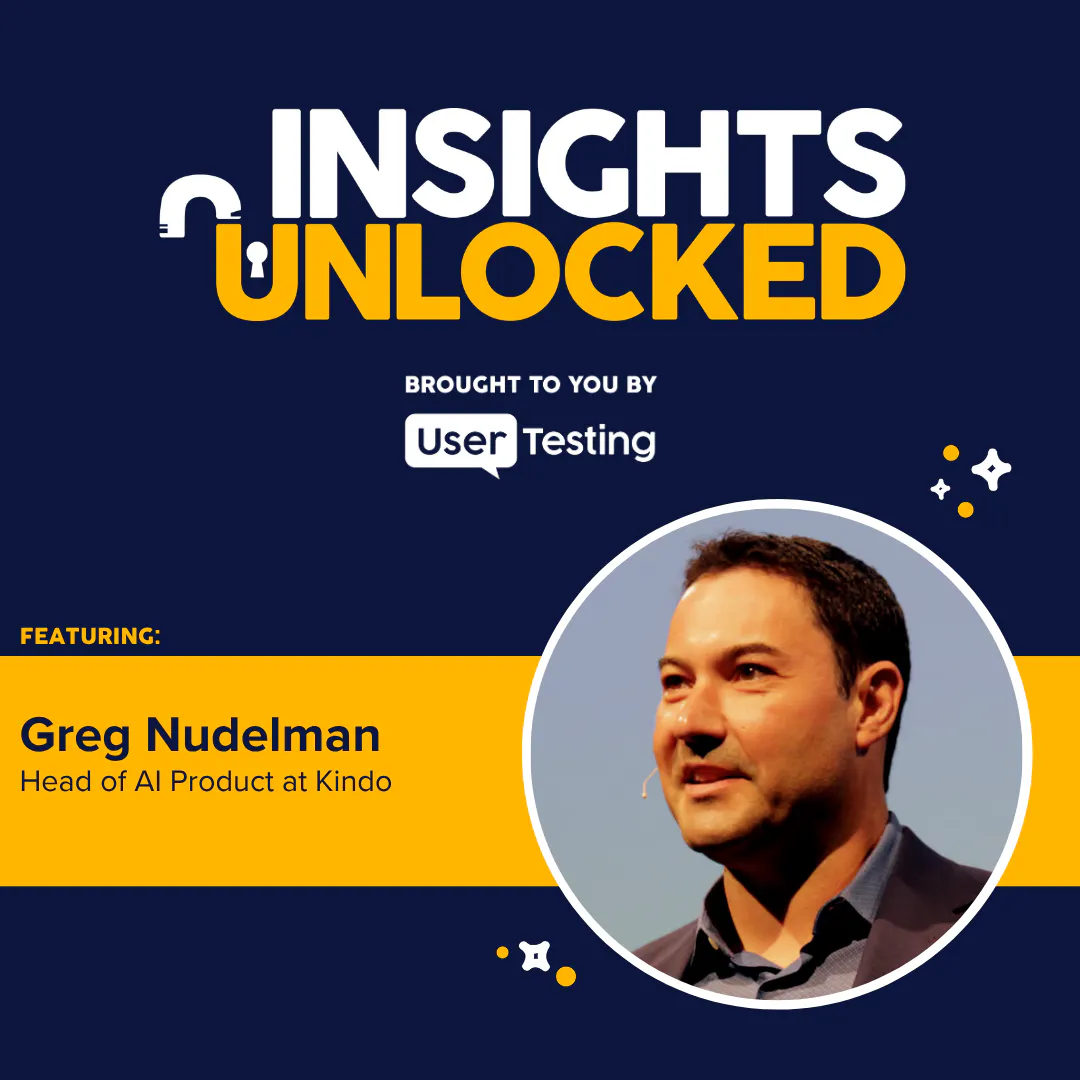
UX for AI: why building faster is no substitute for building the right thing
Aug 17, 20261h 4mS14
Episode web page: https://bit.ly/4wqOtMn Episode summary In this episode of Insights Unlocked, UserTesting’s Mike Mace sits down with AI product strategist, UX thought leader, and UX for AI author Greg Nudelman to explore how AI is reshaping the role of UX and product professionals—and what teams need to do differently to build AI products that deliver real customer and business value. Greg argues that simply using AI to work faster isn’t enough. As traditional UX tasks become easier to automate, the bigger opportunity is for UX researchers, designers, and product leaders to move upstream: uncover customer needs, frame the right problems, understand how AI systems work, and rapidly validate working concepts with customers. He shares his “snowball sprint” approach, where teams start small and continuously add capabilities only after validating that they’re solving the right problem. The conversation also explores why speed can become a liability when teams rush into AI development without considering real-world consequences. Greg discusses the importance of evaluating ROI and risk before building, including his use of a value matrix to examine what happens when an AI system gets something right—or wrong. For AI products with increasingly consequential actions, customer-centered design and responsible product leadership become more important, not less. Ultimately, Greg believes the companies that succeed with AI will be those that stay focused on customers and use the technology to empower people. For UX and product professionals, that means rediscovering their core strengths in empathy, problem-solving, discovery, and strategic thinking—and applying them to a new generation of AI-powered experiences. You’ll learn: Why UX professionals need to move beyond simply using AI to make existing workflows faster How customer discovery and strategic problem framing become even more valuable as AI accelerates product development Why Greg believes UX professionals should become AI product and relationship designers, not just interface designers How the “snowball sprint” approach keeps customers involved throughout AI product development Why teams should evaluate AI ROI, risk, and the consequences of incorrect outputs before they build How rapid prototyping and real-world customer feedback can help teams avoid expensive AI product failures What will separate the companies that succeed with AI from those that fall behind Resources & links Greg Nudelman on LinkedIn UX for AI book UX for AI website Greg’s “Iceberg UX” post Mike Mace on LinkedIn Learn more about Insights Unlocked: usertesting.com/podcast
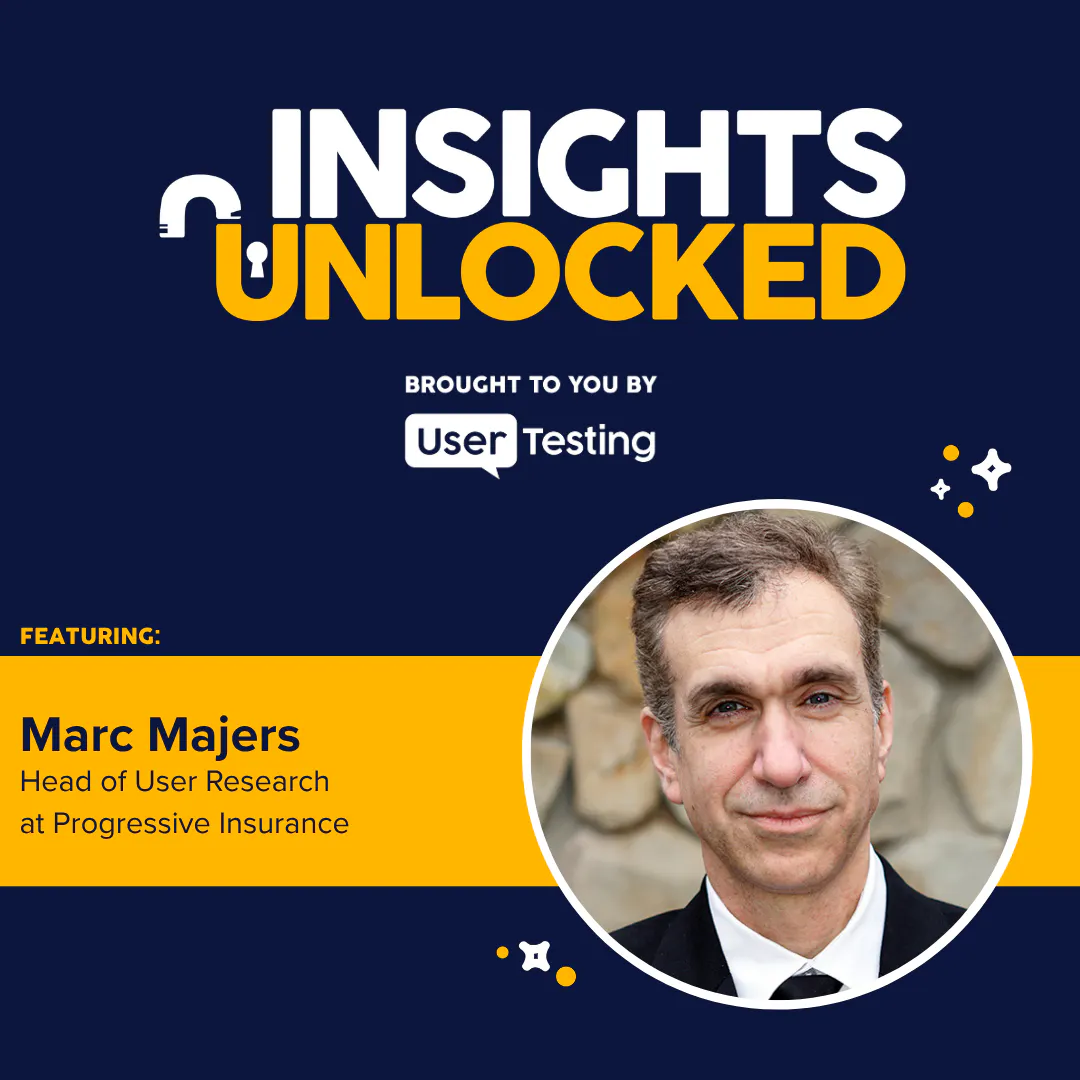
What a wedding DJ can teach you about user research
Aug 10, 202629 minS14
Episode web page: https://bit.ly/4hS9ls9 Episode summary In this episode of Insights Unlocked, Rachel Blackburn sits down with Marc Majers, Head of User Research at Progressive Insurance, UX educator, author, and host of the UX Pathways podcast, to explore what separates great user experiences from merely functional ones. Drawing on more than two decades in UX, Marc shares how empathy, curiosity, and continuous learning have shaped his career—and why understanding people remains the foundation of effective design, even as AI rapidly transforms the industry. Marc discusses how UX professionals can thoughtfully integrate AI into their workflows without losing sight of the human perspective, why organizations should view UX as a strategic business advantage rather than a design function, and how speaking the language of business helps teams demonstrate measurable impact. He also offers his perspective on synthetic users, the future of AI-powered experiences, and why testing should become an organization's default mindset. The conversation wraps with an unexpected look at the parallels between UX and Marc's work as a wedding DJ, revealing how both disciplines rely on understanding human behavior, anticipating needs, and designing experiences that keep people engaged. You'll learn: Why empathy and curiosity remain the most important skills in UX—even in the age of AI How UX professionals can adopt AI thoughtfully without replacing human judgment Practical ways to communicate the business value of UX to executives and stakeholders Why continuous testing creates better products and stronger organizational cultures How synthetic users can complement—but not replace—real customer research Why the future of UX depends on balancing technological innovation with human-centered design What designing great digital experiences has in common with keeping a wedding dance floor full Resources & links Marc Majers on LinkedIn: https://www.linkedin.com/in/mmajers/ UX Pathways: https://www.uxpathways.com/ Rachel Blackburn on LinkedIn: https://www.linkedin.com/in/racheleblackburn/ Learn more about Insights Unlocked: https://www.usertesting.com/podcast
How to avoid cultural blind spots in AI-powered customer research
Aug 3, 202648 minS14
Episode web page: https://bit.ly/4besnoH Episode summary AI can summarize customer feedback in seconds—but can it truly understand what customers mean? In this episode of Insights Unlocked, Jason Giles sits down with Chui Chui Tan, cultural strategist, founder of Beyō Global, and author of Research for Global Growth and International User Research, to explore why the biggest challenge in AI-powered customer research isn't analyzing data—it's interpreting it. Drawing on nearly two decades of experience conducting research across more than 50 markets, Chui Chui explains why themes like "trust," "convenience," and "it's too expensive" can mean entirely different things depending on cultural context. She argues that while AI excels at identifying patterns, human researchers remain essential for uncovering the motivations behind those patterns and translating them into better business decisions. The conversation explores how global teams can avoid costly misinterpretations, why translation alone isn't enough for international research, and how slowing down at the right moments can lead to more accurate insights—even in an AI-driven world. You'll learn: Why AI has shifted the research bottleneck from synthesis to interpretation How cultural context changes the meaning behind common customer feedback Why recurring themes aren't the same as actionable customer insights How to uncover the real drivers behind comments like "it's too expensive" or "I don't trust it" Why translation alone can't capture cultural meaning in global research A practical framework for moving from AI-generated signals to better business decisions How research teams can build simple checks into AI-assisted workflows to avoid costly mistakes Resources & links: Chui Chui Tan on LinkedIn: https://www.linkedin.com/in/chuichuitan/ Beyō Global: https://beyo.global/ Research for Global Growth: https://www.amazon.co.uk/Research-Global-Growth-Strategies-Cross-Cultural/dp/1068601701 Chui Chui Tan on YouTube: https://www.youtube.com/@chuichuitan Jason Giles on LinkedIn: https://www.linkedin.com/in/jaygiles/ Learn more about Insights Unlocked: https://www.usertesting.com/podcast
The mindset shift that turns UX research into a strategic business advantage
Jul 27, 202640 minS14
Episode web page: https://bit.ly/4fsY5jb Episode summary What does it really mean for UX research to have "a seat at the table"? According to Paul Humphrey, head of UX Research Practice at Next, it has less to do with presenting to executives and more to do with helping the people making product decisions achieve measurable business outcomes. In this episode of Insights Unlocked, host Amrit Bhachu sits down with Paul to discuss how he transformed UX research at Next from a reactive support function into a strategic driver of product and e-commerce decisions. Paul shares how empowering designers to conduct their own research, aligning studies with business metrics, and building relationships with stakeholders helped the team dramatically increase research adoption while demonstrating clear business impact. The conversation explores what it takes to prove the value of UX research, including a case study that contributed to reducing call center training and handling times, resulting in an estimated £2.75 million in savings. Paul also explains why researchers need to speak the language of the business—not just the language of usability—and why understanding stakeholder goals is often more important than delivering another research report. Finally, Paul and Amrit discuss the growing role of AI in UX research. Paul shares how Next is using AI to accelerate workflows while maintaining rigorous validation and quality standards, why researchers should embrace experimentation, and how curiosity remains the most valuable skill in an AI-powered future. You'll learn: What "having a seat at the table" actually means for UX researchers How to align UX research with business goals and stakeholder metrics Ways to demonstrate the business impact and ROI of UX research Why empowering designers to conduct research helps research scale How to build stronger partnerships with product and business leaders Lessons from Next's transformation from reactive to strategic research Practical approaches to measuring research success with business outcomes How AI is accelerating UX research while preserving quality and trust Why curiosity and adaptability are essential skills for the future of UX research Resources & links Paul Humphrey on LinkedIn (https://www.linkedin.com/in/paul-humphrey-7865a570/) Next (https://www.next.co.uk/) Amrit Bhachu on LinkedIn (https://www.linkedin.com/in/amritsbhachu/) Nathan Isaacs on LinkedIn (https://www.linkedin.com/in/nathanisaacs/) Learn more about Insights Unlocked (https://www.usertesting.com/podcast)
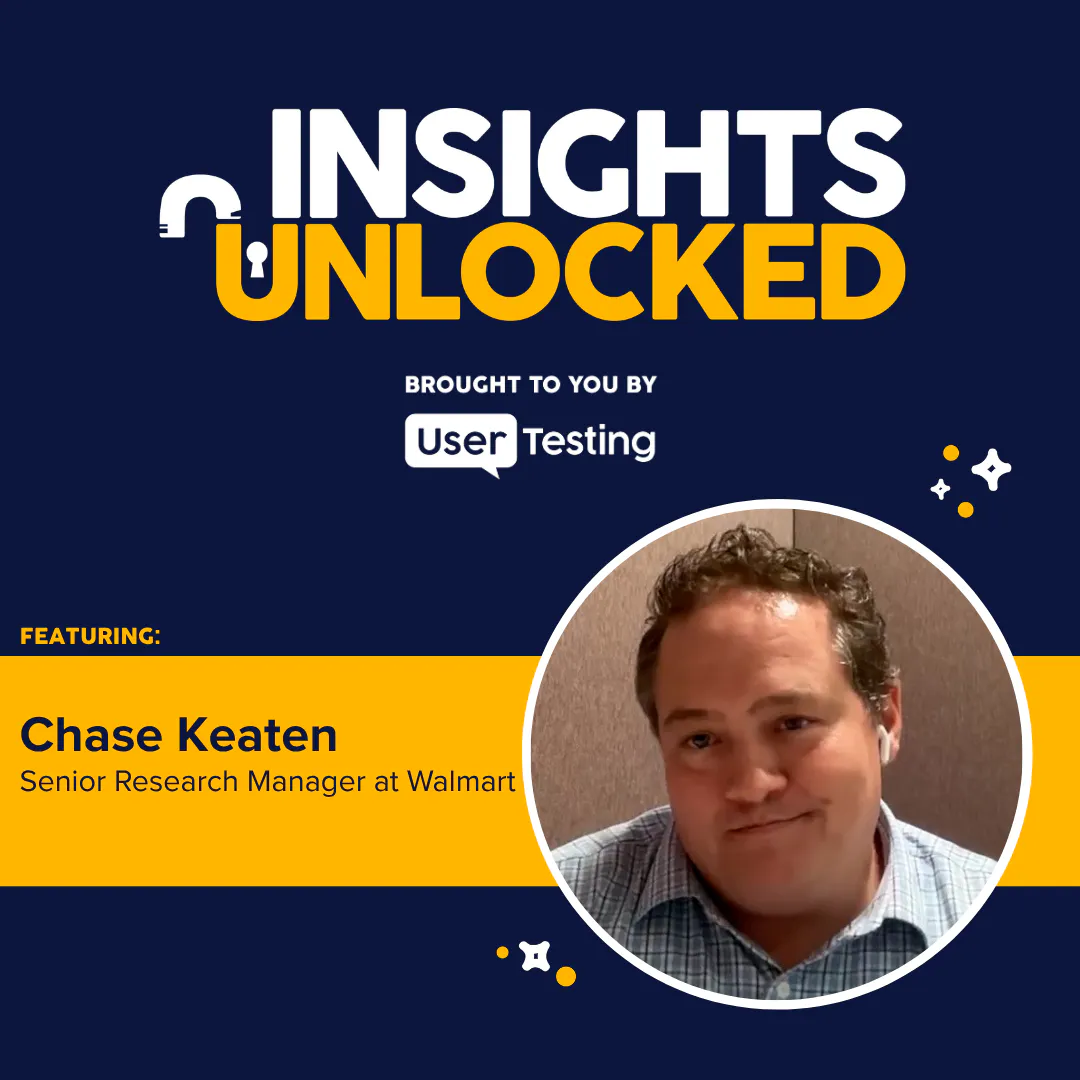
How to build agentic AI your customers will actually trust
Jul 20, 202654 minS14
Episode web page: https://bit.ly/4fjSOKR Episode summary: In this episode of Insights Unlocked, Mike Mace chats with Chase Keaten, senior research manager at Walmart, about the tension shaping how researchers, designers, and builders are learning to work with AI. Chase shares why he thinks the sharpest divide in tech right now isn't about tools—it's about two competing mindsets: an "always push forward" view of AI and a more cautious, human-centered one. He explains why holding both views at once, rather than picking a side, tends to lead to better decisions. The conversation also digs into the much-hyped "builder model," where one person plus a stack of AI agents is expected to replace a whole product team. Chase makes the case for why healthy conflict between humans—not simulated conflict from AI—is often what actually makes products better. He and Mike also explore why trust, not usability, may be the real currency of agentic AI, and Chase closes with practical advice for researchers and designers under pressure to "do something with AI" right now. You'll learn: Why two opposing views of AI—full-speed-ahead and human-centered caution—can coexist productively Why the "builder model" struggles to replicate the healthy conflict that makes products better How AI is reshaping design work, and why speed often comes at the cost of context and novelty Why trust, not usability, is becoming the key metric for agentic AI How a "personalization butler" could change the relationship between retailers and customers Practical advice for researchers and designers who feel pressure to use AI without a clear plan Resources & links Chase Keaton on LinkedIn (https://www.linkedin.com/in/chasekeaten/) Mike Mace on LinkedIn (https://www.linkedin.com/in/mikemace/) Nathan Isaacs on LinkedIn (https://www.linkedin.com/in/nathanisaacs/) Learn more about Insights Unlocked: https://www.usertesting.com/podcast
Every question we get asked before someone starts their trial.
If you have a concern about deliverability, AI quality, data privacy, or whether this will actually work for your specific situation, it's probably answered below.
What is the difference between Founder Solo and Founder Pro?
Founder Solo gives you 50 AI pitches per month using the credit model (Standard pitches cost 1 credit, Enriched pitches cost 2). Founder Pro raises that to 200 credits per month and adds full Booking Probability access, unlimited Magic Match, Apollo enrichment credits, and data export capabilities. Both plans use the same credit system, so you can stretch your monthly budget further by using Standard-mode drafting.
How do agency tiers work?
Agency tiers have no base fee. You pay per managed client and per talent profile. Agency Standard is $199 per client per month; Agency Pro is $399 per client per month. Both add $39 per talent profile per month. Your own team's user seats are always free.
What is a talent profile?
A talent profile represents one person (founder, executive, or spokesperson) you are booking onto podcasts. It includes their bio, topics, headshots, and outreach history. Team plans include 5 profiles; agency plans are pay-as-you-go.
Can I switch plans later?
Yes, at any time. Upgrades take effect immediately; downgrades apply at the end of the current billing period. Contact support if you need help migrating between plan families.
Do you offer a free trial?
Every paid plan includes a 15-day free trial. Your card is saved at signup but you will not be charged until day 16. Cancel any time from your dashboard.
What happens if I cancel?
You keep access until the end of your current billing period. No charges after that. Your data is retained for 30 days in case you reactivate.
Is the 20% annual discount automatic?
Yes. Select Annual on the pricing toggle and the discounted price is applied automatically at checkout. The annual price shown is the full year cost.
What if I have more than 50 profiles or 20 clients?
That is our Enterprise tier. Contact our sales team and we will build a custom plan with volume pricing, a dedicated account manager, and SLA guarantees.