Episode #10
加餐2: 破解AI專案開發技術陷阱
Aug 2, 202626 minS1
本集節目專為AI應用規劃師(iPAS)考生與AI專案初學者設計。內容依「資料前處理、模型訓練、模型評估、部署與監控」生命週期展開,抽絲剝繭常見技術陷阱。主持人透過「大公車」與「導航系統」等生動比喻,深入剖析One-Hot、PCA、優化器、GAN模式崩潰及批次處理等核心觀念,幫助你告別死背,重建底層邏輯,輕鬆看透實務與考題盲點! -- Hosting provided by SoundOn

Loading…
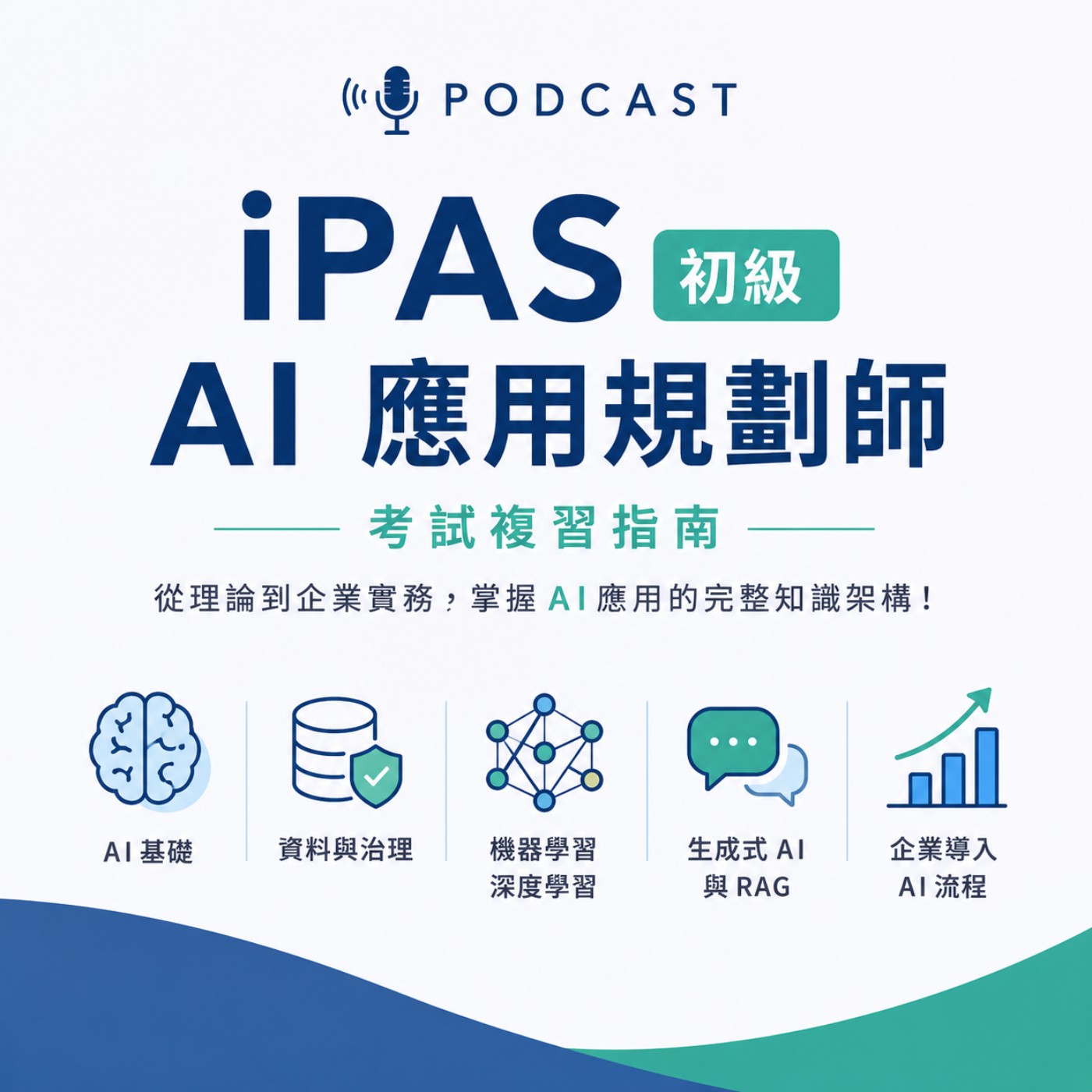
為 iPAS 初級 AI 應用規劃師考試提供了全面的複習指南。內容從 人工智慧的基本定義、分類與治理規範 出發,深入探討了 大數據處理、資料清理流程及隱私保護 等基礎建設。針對核心技術,腳本詳解了 機器學習的不同模式、深度學習結構以及模型評估指標,並對比了 鑑別式與生成式 AI 的應用差異。最後,課程聚焦於企業實務,介紹 RAG 技術、提示詞工程與微調方法,協助掌握從理論到 企業導入 AI 流程 的完整知識架構。--Hosting provided by SoundOn
Required Pod Score for this show. PitchCentric checks your profile against host openness, topical fit, and audience signals before you generate a pitch.
Contact path
Verified email
Booking probability
28%
Guest openness
Selective
Sign up to generate a grounded pitch for iPAS 初級 AI 應用規劃師備考.
Signup to Generate a PitchiPAS 初級 AI 應用規劃師備考 is a education podcast hosted by AI小撇步, with 10 episodes on record and a Required Pod Score of 80.
AI小撇步 hosts iPAS 初級 AI 應用規劃師備考, a education show with 10 episodes published.
Our AI reads these to draft pitches. Use them as grounding for a pitch that cites a real guest and a specific topic.
Episode #10
本集節目專為AI應用規劃師(iPAS)考生與AI專案初學者設計。內容依「資料前處理、模型訓練、模型評估、部署與監控」生命週期展開,抽絲剝繭常見技術陷阱。主持人透過「大公車」與「導航系統」等生動比喻,深入剖析One-Hot、PCA、優化器、GAN模式崩潰及批次處理等核心觀念,幫助你告別死背,重建底層邏輯,輕鬆看透實務與考題盲點! -- Hosting provided by SoundOn
Episode #9
本集節目專為「AI應用規劃師」設計,帶你跳脫死背、重塑觀念。我們將拆解「99%準確度」在不平衡資料下的陷阱,釐清精確率、召回率與F1分數(調和平均數)CNN(空間與平移不變性)、LSTM(以加法和閘門防止梯度消失)及GAN(生成器與鑑別器的對抗博弈)的運作機制。最後探討部署後的「資料與概念漂移」,並以「顯著性圖」打開心智黑盒子,建構完整的技術防護網。 -- Hosting provided by SoundOn
Episode #8
企業 AI 導入流程與風險合規 AI導入四大階段:依序為「準備 → 設計 → 驗證(POC) → 實施營運」。口訣:『準設驗實』(準備好設計,驗證後實施)。其中驗證(POC)的核心目的是以小規模、低風險的方式測試可行性,避免大規模失敗。 資料漂移與 MLOps:模型上線後準確率隨時間下降,主因為「資料漂移」(現實世界數據分布改變,偏離當初的訓練數據)。解決方法是導入 MLOps(機器學習運維),透過自動化監控與定期重新訓練來維持模型表現。 四大風險應對策略:包括「緩解」(採取技術手段降風險)、「迴避」(風險過高直接不做該功能)、「轉移」(買保險或簽合約由第三方承擔)及「接受」(風險極低且影響小,選擇不處理)。考題常以企業情境要求辨識對應策略。 ROI 與財務評估指標:基本公式為「(效益 - 成本) ÷ 成本 × 100%」。進階評估包含 NPV(淨現值,大於 0 代表投資划算)與 IRR(內部報酬率,高於公司資金成本即值得投資),並需搭配敏感度分析以評估假設變更後的影響。 GDPR 與 CCPA 法規對比:GDPR(歐盟個資法)最常考「72小時內」通報外洩、最高罰全球年營收 4% 與「被遺忘權」;CCPA(加州消費者隱私法)保護加州居民,包含拒絕個資被販售的權利。兩者適用對象與地區需明確區分。 -- Hosting provided by SoundOn
Episode #7
生成式 AI 核心技術與架構解析 GAN(生成對抗網路):由生成器(造假)與判別器(打假)互相博弈。記憶口訣:「造假幣與警察」,主要用於生成以假亂真的圖像(如 Deepfake),但有模式崩潰(多樣性不足)的限制。 VAE(變分自動編碼器):編碼器將資料壓縮為「潛在向量」,解碼器再重建還原。記憶口訣:「速記員與口譯員」,訓練較 GAN 穩定,常用於藥物分子設計與音樂生成。 Transformer 與自注意力機制:現代 LLM 的核心。其「自注意力機制(Self-Attention)」打破傳統逐字讀取限制,能同時分析整段文字的關聯性。AI 處理文字的基本單位則稱為「Token」。 RLHF(人類反饋強化學習):利用真人評分引導 AI 生成安全、有用且符合人類價值觀的回答。記憶口訣:「真人調教」,是解決 AI 幻覺與安全對齊(Alignment)的關鍵技術。 Temperature(溫度參數):控制 AI 輸出創意度與隨機性的旋鈕。數值高(高溫)輸出更具創意與隨機性,適合寫詩;數值低(低溫)輸出更固定且精準,適合寫程式或法律文件。 -- Hosting provided by SoundOn
Episode #6
No-code 與 Low-code AI 應用與評估 No-code 與 Low-code 的核心差異:No-code 完全不需程式碼,靠拖拉組裝,適合零技術業務人員;Low-code 需少量程式碼,適合有技術背景者進行客製化開發。口訣:『無代碼靠拖拉,低代碼做客製』。 平台選擇的六大考量因素:選擇平台必看:目標用戶、功能擴展性、安全合規、成本效益、技術支援、市場評價。記憶口訣:『目功安成技市』(目光安全城市)。 AI 民主化的核心意義與影響:指降低技術門檻,讓 AI 不再是工程師與大廠專利,而是人人都可用的工具。能提升中小企業競爭力、加速跨領域應用與人才培育。 AI No-code 平台的挑戰與風險:包含通用模型準確性受限、雲端部署的資料隱私風險、模型倫理偏見及舊系統整合困難。高敏感行業(如醫療、金融)需特別注意隱私與合規。 高頻情境考題判斷心法:『零技術、求快速』選 No-code;『要客製、有工程師』選 Low-code。醫療與金融機構首要考量『安全合規』;新創與中小企業首重『成本效益』。 -- Hosting provided by SoundOn
Sponsor detection runs nightly. Check back soon.
Based on semantic analysis of episode topics and host coverage, this show is a strong guest fit for executives in:
Industry fit is computed by PitchCentric using vector embeddings of the show's episode catalog.
Is this podcast yours and you'd like to remove or correct details? Request removal or email privacy@pitchcentric.com.
FAQs
If you have a concern about deliverability, AI quality, data privacy, or whether this will actually work for your specific situation, it's probably answered below.
Founder Solo gives you 50 AI pitches per month using the credit model (Standard pitches cost 1 credit, Enriched pitches cost 2). Founder Pro raises that to 200 credits per month and adds full Booking Probability access, unlimited Magic Match, Apollo enrichment credits, and data export capabilities. Both plans use the same credit system, so you can stretch your monthly budget further by using Standard-mode drafting.
Agency tiers have no base fee. You pay per managed client and per talent profile. Agency Standard is $199 per client per month; Agency Pro is $399 per client per month. Both add $39 per talent profile per month. Your own team's user seats are always free.
A talent profile represents one person (founder, executive, or spokesperson) you are booking onto podcasts. It includes their bio, topics, headshots, and outreach history. Team plans include 5 profiles; agency plans are pay-as-you-go.
Yes, at any time. Upgrades take effect immediately; downgrades apply at the end of the current billing period. Contact support if you need help migrating between plan families.
Every paid plan includes a 15-day free trial. Your card is saved at signup but you will not be charged until day 16. Cancel any time from your dashboard.
You keep access until the end of your current billing period. No charges after that. Your data is retained for 30 days in case you reactivate.
Yes. Select Annual on the pricing toggle and the discounted price is applied automatically at checkout. The annual price shown is the full year cost.
That is our Enterprise tier. Contact our sales team and we will build a custom plan with volume pricing, a dedicated account manager, and SLA guarantees.
