
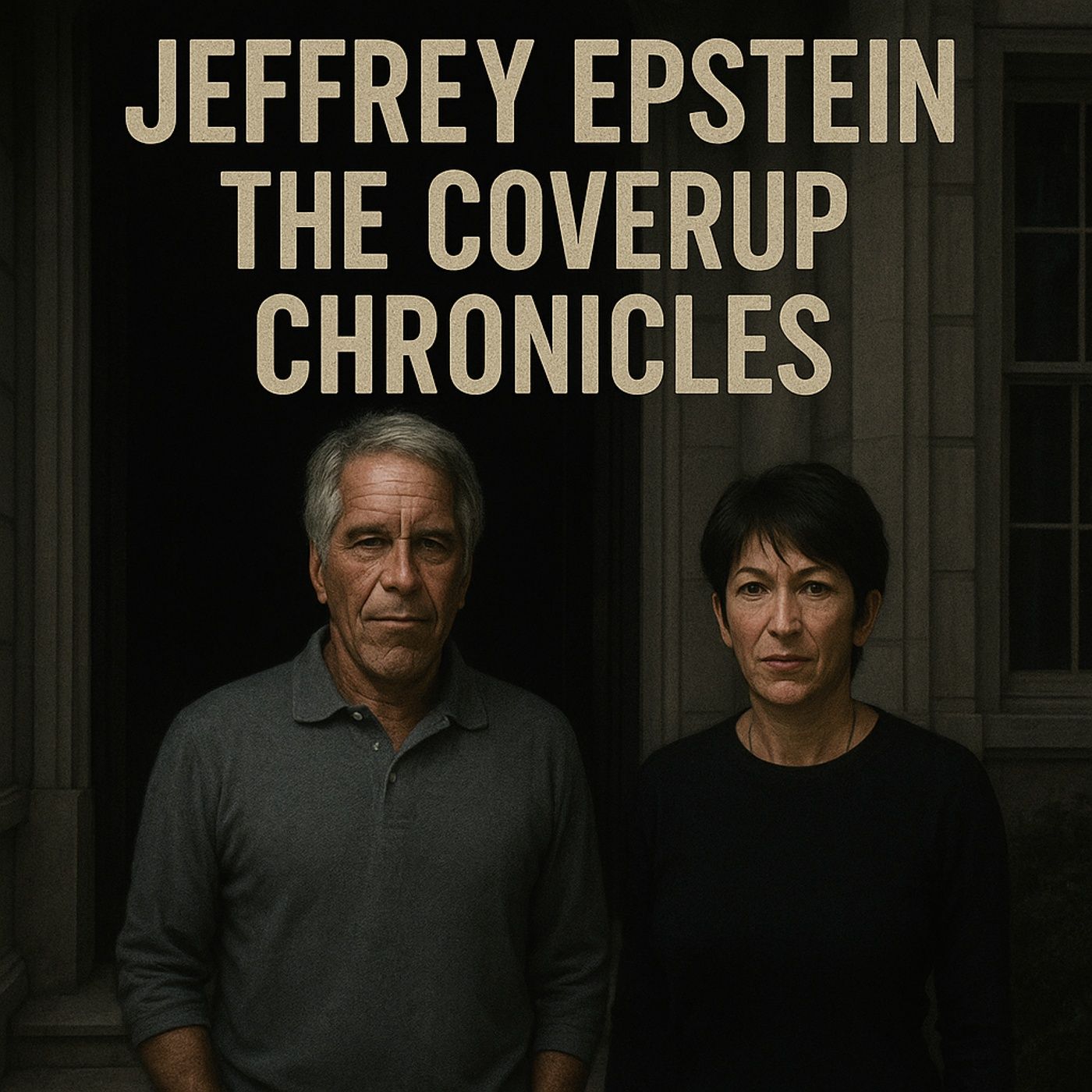
Jeffrey Epstein: The Coverup Chronicles is a podcast dedicated to examining not just who Epstein was and what he did, but how so many people and institutions worked—then and now—to keep it all hidden. This series cuts past the headlines and digs into the documentation: court filings, deposition transcripts, plea deals, sealed exhibits, and the bureaucratic paper trail that still tells the real story. Our focus isn’t on speculation or recycled outrage. It’s on facts—and the deliberate efforts to keep those facts out of public view. Each episode will feature in-depth analysis of newly surfaced records and underreported legal developments, alongside expert commentary that connects them to the broader machinery of power that shielded Epstein for decades. We’ll revisit the timeline from his first arrests through his 2008 plea deal, and into the re-investigations that followed his 2019 death in federal custody. And we won’t stop there—we’ll look closely at the current state of affairs: the closed probes, the lingering co-conspirators, the civil suits, and the glaring gaps in accountability. What makes The Coverup Chronicles different is that we’re not here to sensationalize the story—we’re here to document the ongoing concealment of it. This isn’t just about reliving Epstein’s crimes. It’s about following the networks that enabled them, protected him, and continue to obscure the truth. If you want an honest look at what’s still being hidden—by whom, and why—this is the podcast that pulls those threads. And I should know—I’ve spent over six years uncovering every dark corner of this case. My name is Bobby Capucci, and I’ve dedicated those same six years exposing the truth about Epstein and the powerful figures who enabled him. From on-the-ground investigations at Epstein’s Zorro Ranch, where I spoke with insiders, to national appearances on Tucker Carlson, I’ve followed this story farther than most are willing to go. Who helped Epstein build his empire? Who protected him? And who is still pulling the strings? The answers lie in the shadows of Jeffrey Epstein's criminal empire. . This is the truth they don’t want you to hear. And I’m here to make sure you do.
Pitch Analysis
Required Pod Score for this show. PitchCentric checks your profile against host openness, topical fit, and audience signals before you generate a pitch.
Contact path
Verified email
Booking probability
40%
Guest openness
Selective
Verified email on file
80/100
Required Score
Sign up to generate a grounded pitch for Jeffrey Epstein: The Coverup Chronicles.
Jeffrey Epstein: The Coverup Chronicles is a commentary podcast hosted by Unknown Host, with 0 episodes on record and a Required Pod Score of 80. PitchCentric scores this show on Booking Probability, Listen Score, and live audience signals refreshed every 24 hours.
About the host
Unknown Host hosts Jeffrey Epstein: The Coverup Chronicles, a commentary show with 0 episodes published.
Our AI reads these to draft pitches. Use them as grounding for a pitch that cites a real guest and a specific topic.
Jeffrey Epstein: The Coverup Chronicles
Murder In Moscow: The Experts Behind The case Against Bryan Kohberger (Part 2) (8/18/26)
Aug 20, 202611 min
Taylor Maichak, a forensic scientist with Idaho State Police Forensic Services, was expected to testify about DNA testing she performed on evidence gathered during the investigation, including a group of everyday items seized from the Kohberger family home in Pennsylvania. Those items included a Band-Aid, drinking straws, earplugs, lollipop sticks, nail clippers, a flosser, a Q-tip-style swab, coffee and water bottles. Maichak generated DNA profiles from several of those items and identified an unknown male profile from the Q-tip-style swab. She then compared that profile with the unidentified male DNA that had previously been recovered from the knife sheath found at the murder scene. Her analysis concluded that the Pennsylvania male was not the source of the sheath DNA, but that he could not be excluded as the biological father of the man whose DNA was on the sheath. The statistical calculation was extremely strong: at least 99.9998 percent of the male population would have been excluded as the possible father. Maichak also would have helped explain the much broader DNA work investigators performed as they attempted to identify or eliminate other people whose biological material appeared on evidence associated with the King Road house. Her reports documented comparisons involving numerous reference samples and unidentified DNA profiles recovered from various items, showing that the male profile obtained in Pennsylvania was excluded from several other DNA mixtures and unknown-male profiles found during the investigation. That distinction was important because her testimony would not simply have told jurors that DNA existed at the scene; it would have walked them through the process investigators used to separate unrelated DNA from the specific male profile recovered from the knife sheath. In practical terms, Maichak’s evidence would have provided an early forensic bridge between the sheath DNA and Kohberger’s family before investigators later obtained a direct reference sample from Kohberger himself, while also demonstrating that investigators had tested and compared other unidentified biological material rather than automatically attributing every unknown DNA profile to him. to contact me: bobbycapucci@protonmail.com source: 030326+REDACTED+Exhibits+S-1+through+S-13+to+States+Amended+Supp+Resp+to+Rqst+for+Disc+RE+Expert+Testimony.pdf

The Case for Viewing Epstein Through the Lens of American Intelligence (Part 1) (8/20/26)
Aug 20, 202612 min
Jeffrey Epstein’s life makes little sense when viewed through the lens of a rogue financier or even a Mossad agent, but it becomes coherent when understood as the creation of the CIA. From his early placement at the Dalton School by Donald Barr, to his sudden leap into finance at Bear Stearns, to his inexplicable relationship with Leslie Wexner, Epstein’s career looks less like chance and more like cultivation. His fortune was smoke and mirrors, likely bolstered by covert funding, and his so-called philanthropy in genetics and AI neatly overlapped with U.S. intelligence interests. His homes wired with cameras, his blackmail operations ensnaring politicians, scientists, and billionaires, and his sweetheart deal in Florida that shielded not just him but his co-conspirators—all of it suggests he was protected because he was too valuable to the intelligence state to lose. While Mossad connections through Ghislaine Maxwell cannot be denied, foreign services couldn’t have orchestrated the decades-long media suppression, the unprecedented non-prosecution agreement, or the circumstances of Epstein’s death in federal custody. Only U.S. intelligence had the power to build and protect him, then silence him when he became a liability. Epstein was not simply a predator; he was a CIA instrument of blackmail and control, designed to compromise America’s own elites and keep them in line. His death was not the end of a scandal—it was the final act of a cleanup operation, ensuring that the files, tapes, and evidence he gathered would never see daylight, and leaving the public with a scapegoat narrative while the machinery of secrecy rolled on. to contact me: bobbycapucci@protonmail.com
Mega Edition: Jean Luc Brunel And Prince Andrew And The Formal Investigation Into Both (8/20/26)
Aug 20, 202647 min
Jean-Luc Brunel and Prince Andrew were two of the most prominent figures in Jeffrey Epstein’s orbit to come under formal law-enforcement scrutiny as authorities continued examining the network surrounding Epstein. In France, prosecutors opened an investigation in 2019 into allegations involving rape, sexual assault of minors and criminal conspiracy, with Brunel becoming a major focus because of his longtime relationship with Epstein and his work in the modeling industry. Brunel was arrested at Charles de Gaulle Airport in December 2020 and formally placed under investigation over allegations involving sexual offenses against minors and adults. Investigators also examined allegations that Brunel had helped recruit, transport or provide young women and girls within Epstein’s orbit. He remained incarcerated while the investigation continued but died in a Paris jail in February 2022 before the allegations against him could be resolved at trial. Prince Andrew also became a significant focus of authorities investigating Epstein, particularly because of his relationship with Epstein and the allegations made against him by Virginia Roberts Giuffre. American prosecutors repeatedly sought to interview Andrew about Epstein and his associates, with then-U.S. Attorney Geoffrey Berman publicly stating in 2020 that Andrew had provided “zero cooperation” despite previously suggesting that he would assist investigators. Authorities eventually pursued formal legal channels in an effort to obtain his testimony, demonstrating that investigators considered his knowledge potentially relevant to the broader Epstein investigation even though he was not charged in the United States. Years later, scrutiny of Andrew intensified further in Britain as authorities examined allegations concerning his conduct and communications with Epstein. Together, the investigations surrounding Brunel and Andrew illustrated how the Epstein case extended far beyond Epstein himself, reaching into the lives of powerful associates whose relationships with him generated serious questions for law enforcement on both sides of the Atlantic. to contact me bobbycapucci@protonmail.com
Mega Edition: The Murders In Moscow And The Similarities Shared With Other Murders (8/19/26)
Aug 19, 202644 min
After Bryan Kohberger was arrested, commentators and true-crime observers drew comparisons between the Moscow killings and several notorious attacks on young women in shared residences, including the 1992 murders near the University at Buffalo and some of Ted Bundy’s crimes. The similarities being discussed were largely circumstantial and behavioral rather than proof of any direct connection: a male attacker allegedly entering a residence occupied by young women, striking during the overnight hours, using a knife, attacking multiple victims at close range and leaving behind a scene that appeared intensely personal and extraordinarily violent. The college setting also fueled the comparisons, because the victims were young, socially connected students living together or near one another, while the killer allegedly approached and departed without immediately being identified. The Bundy comparisons were especially common because Bundy had committed nighttime attacks against women in communal living environments, most famously the 1978 Chi Omega sorority-house attacks at Florida State University, where he entered the residence and assaulted several women in rapid succession. Similarities were also discussed in relation to the unsolved 1992 Buffalo-area student murders, which likewise involved young women and generated speculation about whether an offender had selected victims within a college environment. None of those parallels established that Kohberger had modeled the Idaho murders on Bundy or on the Buffalo case, however, and investigators did not publicly demonstrate that the crimes were connected. The comparisons were primarily attempts to understand the Moscow killings through the history of other predatory offenders who entered residential spaces, attacked vulnerable victims at night and relied on surprise, speed and close-range violence. to contact me: bobbycapucci@protonmail.com
Utah's Response To Tyler Robinson In Support Of Bind Over (Part 1) (8/19/26)
Aug 19, 202611 min
Utah prosecutors pushed back aggressively against Tyler Robinson’s attempt to weaken the capital case against him, arguing that the evidence presented at his preliminary hearing was more than enough to send him to trial on every charge. Robinson’s attorneys had asked Judge Tony Graf to eliminate the aggravating circumstance that could make him eligible for the death penalty, contending that prosecutors had not established that the shooting of Charlie Kirk created a great risk of death to anyone besides Kirk himself. Prosecutors rejected that argument, saying Robinson allegedly fired a high-powered rifle toward an event attended by thousands of people and that several individuals near Kirk were within the potential zone of danger. The state maintained that the evidence easily cleared the probable-cause threshold and argued that the aggravating factor could ultimately be proven beyond a reasonable doubt. Prosecutors also defended the broader case against Robinson, pointing to evidence they said connected him to the rooftop firing position, the rifle that was later hidden in a wooded area, discarded clothing and messages with his roommate concerning the shooting. They accused the defense of relying on legal precedent that had subsequently been rejected by the Utah Supreme Court without informing the judge of those later rulings, calling the omission a violation of the defense’s duty of candor. The state additionally defended the witness-tampering allegation involving Robinson’s roommate and argued that evidence supported the accusation that Kirk had been targeted because of his political expression, including an engraved cartridge recovered during the investigation. Judge Graf was expected to rule at a September 1 hearing on whether sufficient probable cause existed to send Robinson to trial, while Robinson had still not entered a plea. to contact me: bobbycapucci@protonmail.com source: Utah prosecutors push to send Tyler Robinson to trial on all charges | Fox News
Every question we get asked before someone starts their trial.
If you have a concern about deliverability, AI quality, data privacy, or whether this will actually work for your specific situation, it's probably answered below.
What is the difference between Founder Solo and Founder Pro?
Founder Solo gives you 50 AI pitches per month using the credit model (Standard pitches cost 1 credit, Enriched pitches cost 2). Founder Pro raises that to 200 credits per month and adds full Booking Probability access, unlimited Magic Match, Apollo enrichment credits, and data export capabilities. Both plans use the same credit system, so you can stretch your monthly budget further by using Standard-mode drafting.
How do agency tiers work?
Agency tiers have no base fee. You pay per managed client and per talent profile. Agency Standard is $199 per client per month; Agency Pro is $399 per client per month. Both add $39 per talent profile per month. Your own team's user seats are always free.
What is a talent profile?
A talent profile represents one person (founder, executive, or spokesperson) you are booking onto podcasts. It includes their bio, topics, headshots, and outreach history. Team plans include 5 profiles; agency plans are pay-as-you-go.
Can I switch plans later?
Yes, at any time. Upgrades take effect immediately; downgrades apply at the end of the current billing period. Contact support if you need help migrating between plan families.
Do you offer a free trial?
Every paid plan includes a 15-day free trial. Your card is saved at signup but you will not be charged until day 16. Cancel any time from your dashboard.
What happens if I cancel?
You keep access until the end of your current billing period. No charges after that. Your data is retained for 30 days in case you reactivate.
Is the 20% annual discount automatic?
Yes. Select Annual on the pricing toggle and the discounted price is applied automatically at checkout. The annual price shown is the full year cost.
What if I have more than 50 profiles or 20 clients?
That is our Enterprise tier. Contact our sales team and we will build a custom plan with volume pricing, a dedicated account manager, and SLA guarantees.