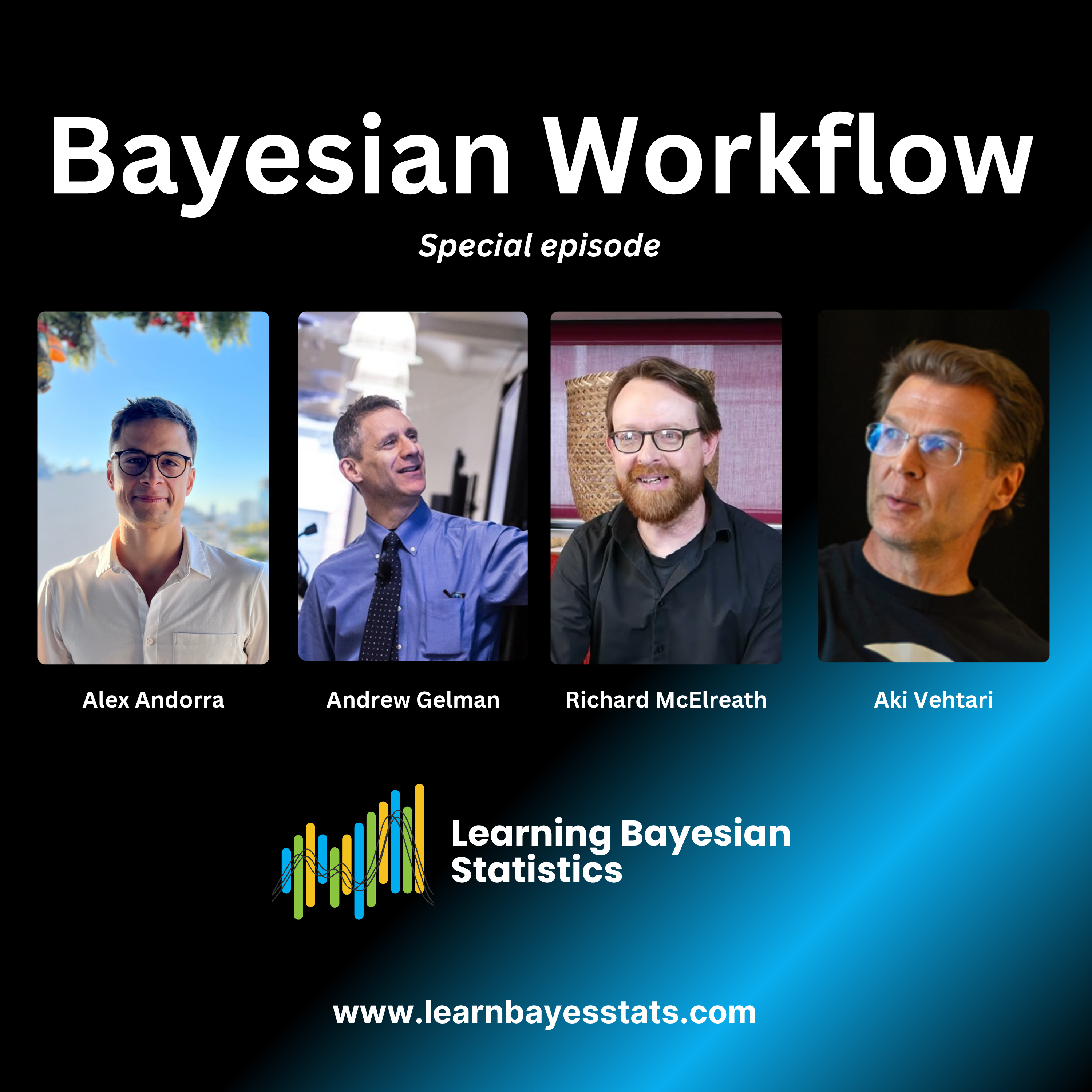
Are you a researcher or data scientist / analyst / ninja? Do you want to learn Bayesian inference, stay up to date or simply want to understand what Bayesian inference is? Then this podcast is for you! You'll hear from researchers and practitioners of all fields about how they use Bayesian statistics, and how in turn YOU can apply these methods in your modeling workflow. When I started learning Bayesian methods, I really wished there were a podcast out there that could introduce me to the methods, the projects and the people who make all that possible. So I created "Learning Bayesian Statistics", where you'll get to hear how Bayesian statistics are used to detect black matter in outer space, forecast elections or understand how diseases spread and can ultimately be stopped. But this show is not only about successes -- it's also about failures, because that's how we learn best. So you'll often hear the guests talking about what *didn't* work in their projects, why, and how they overcame these challenges. Because, in the end, we're all lifelong learners! My name is Alex Andorra by the way. By day, I'm a Senior data scientist. By night, I don't (yet) fight crime, but I'm an open-source enthusiast and core contributor to the python packages PyMC and ArviZ . I also love Nutella, but I don't like talking about it – I prefer eating it. So, whether you want to learn Bayesian statistics or hear about the latest libraries, books and applications, this podcast is for you -- just subscribe! You can also support the show and unlock exclusive Bayesian swag on Patreon !
Pitch Analysis
Required Pod Score for this show. PitchCentric checks your profile against host openness, topical fit, and audience signals before you generate a pitch.
Contact path
Verified email
Booking probability
36%
Guest openness
Selective
Verified email on file
80/100
Required Score
Sign up to generate a grounded pitch for Learning Bayesian Statistics.
Learning Bayesian Statistics is a science podcast hosted by Unknown Host, with 213 episodes on record and a Required Pod Score of 80. PitchCentric scores this show on Booking Probability, Listen Score, and live audience signals refreshed every 24 hours.
About the host
Unknown Host hosts Learning Bayesian Statistics, a science show with 213 episodes published.
Our AI reads these to draft pitches. Use them as grounding for a pitch that cites a real guest and a specific topic.
Episode #163
#163 How to make your models sample faster, with Adrian Seyboldt & Eliot Carlson
Aug 13, 20261h 24mS1
Support & Resources → Support the show on Patreon → Bayesian Modeling Course (first 2 lessons free) Our theme music is « Good Bayesian », by Baba Brinkman (feat MC Lars and Mega Ran). Check out his awesome work Takeaways: Q: What is mass matrix adaptation, in plain terms? A: Mass matrix adaptation is best understood as an automatic, fairly dumb, but very effective reparameterization of your model. The simplest version, the diagonal mass matrix, just rescales each parameter so its posterior standard deviation becomes one, which is exactly what you'd do by hand if you had the patience. Every time you sample a PyMC or Stan model, this kind of reparameterization is happening under the hood. Q: How does Nutpie's approach to mass matrix adaptation differ from Stan and PyMC's default? A: Stan and PyMC's default sampler only use one source of information for diagonal mass matrix adaptation: the posterior standard deviation estimated from warm-up draws. Nutpie also uses the gradients of the log density, which HMC is already computing at every step to build its trajectory. For a standard normal distribution, the covariance of the gradients is exactly the inverse covariance of the draws, so Nutpie takes the geometric mean of the two resulting standard deviations. There's no guarantee it's always better, but in practice it usually is. Q: What problem does "Preconditioning Hamiltonian Monte Carlo by Minimizing Fisher Divergence" actually solve? A: Preconditioning HMC means transforming your target distribution into one that's friendly to sample, but doing that well requires knowing things about the distribution, like its covariance, that sampling itself is supposed to discover. This chicken-and-egg problem is usually handled by sketching a rough estimate from a handful of early warm-up draws, which can burn a large share of total sampling time. Adrian and Eliot's paper formalizes how to make better use of a second signal, the score function, that HMC already computes for free but that Stan-style preconditioning ignores. Chapters: 00:00:00 What is HMC preconditioning? 00:09:03 A more robust low-rank mass matrix 00:11:58 What is mass matrix adaptation? 00:18:06 What does preconditioning HMC mean? 00:20:57 What is normalizing flow adaptation, and when does a linear mass matrix fall short? 00:23:50 When does normalizing flow adaptation actually help, and when is classic mass matrix adaptation enough? 00:27:13 What is Fisher divergence? 00:30:10 Why is HMC's trajectory, not its density, the right target for preconditioning? 00:33:04 What are the diagonal, dense, and low-rank-plus-diagonal versions of mass matrix adaptation? 00:46:25 How much faster is low-rank-plus-diagonal adaptation? 00:51:07 What's the practical recommendation for using Nutpie and its mass matrix adaptation? 00:54:31 Why does low-rank adaptation sometimes fail spectacularly? 01:01:35 Where does this research fit in the bigger picture of HMC? 01:12:12 How could centered vs. non-centered parameterization be chosen automatically? Thank you to my Patrons for making this episode possible! Links from the show here
Today's clip is from episode 160, featuring Vaden Masrani. In this conversation, Vaden explores the tension between Bayesian statistics and Bayesian epistemology, and why he sees them as fundamentally different. He explains why Bayesian epistemology can run into problems when trying to explain where hypotheses themselves come from, and argues that an emphasis on finding supporting evidence can encourage confirmation bias rather than genuine scientific inquiry. He also discusses Hempel's paradox, Popper's idea of falsification, and why these philosophical problems don't necessarily undermine Bayesian statistics itself. Full discussion here Support & Resources → Support the show on Patreon → Bayesian Modeling Course (first 2 lessons free): Our theme music is « Good Bayesian », by Baba Brinkman (feat MC Lars and Mega Ran). Check out his awesome work!
Bayesian Epistemology Is "Bayes' Theorem Without the Data"
Aug 7, 20264 min
Today's clip is from episode 160 , featuring Vaden Masrani. In this conversation, Vaden lays out a sharp critique of Bayesian epistemology - the roughly hundred-year-old philosophical tradition, popular in some Oxford-adjacent circles, that treats subjective probability estimates as legitimate even when there's no data behind them. Vaden's core objection: doing Bayes' theorem on numbers you made up in your head is like fitting a regression line to an empty scatter plot - the math looks rigorous, but there's nothing underneath it. He argues this "math-washing" can trick people into thinking a decision is well-informed simply because it's dressed up in probability language, when frequentists and data-driven Bayesians alike would say the same thing: no data, no model. Get the full discussion here Support & Resources → Support the show on Patreon → Bayesian Modeling Course (first 2 lessons free): Our theme music is « Good Bayesian », by Baba Brinkman (feat MC Lars and Mega Ran). Check out his awesome work!
Today's clip is from episode 162, featuring Chris Krapu. In this conversation, Chris explains why Bayesian thinking remains surprisingly valuable in today's AI landscape - even when the models themselves aren't explicitly Bayesian. Rather than uncertainty estimation, Chris highlights a different advantage: Bayesian training provides a deep intuition for concepts like priors, sampling, rejection sampling, and high-dimensional geometry, making it much easier to understand and apply modern AI research. He also discusses why Bayesian methods are becoming increasingly relevant for evaluating agentic AI systems, where complex workflows and limited evaluation data make hierarchical models and sensible priors especially powerful. Get the full discussion here Support & Resources → Support the show on Patreon → Bayesian Modeling Course (first 2 lessons free): Our theme music is « Good Bayesian », by Baba Brinkman (feat MC Lars and Mega Ran). Check out his awesome work!
#162 Bayesian Hydrology & GPU AI, with Christopher Krapu
Jul 28, 20261h 5mS1
Support & Resources → Support the show on Patreon → Bayesian Modeling Course (first 2 lessons free) Our theme music is « Good Bayesian », by Baba Brinkman (feat MC Lars and Mega Ran). Check out his awesome work Takeaways: Q: How does putting a Gaussian process on unknown coordinates fix noisy location data in mineral prospecting? A: In mining and geostatistics, the classic Gaussian process model, known there as kriging, assumes you know exactly where each sample was taken. Chris’ project broke that assumption on purpose: the recorded coordinates for each core sample were only accurate to within a rough radius. By treating the true locations as latent variables and putting a Gaussian process over them jointly with the measurements, the model could still reconstruct the underlying gold-concentration field, even though the exact sampling locations were never known precisely. It's a demonstration that Gaussian processes can absorb structural uncertainty that looks, at first glance, like it should make the problem impossible. Q: What is "Poverty Bayes," and what did it cost to train a two-million-parameter Bayesian model? A: Poverty Bayes was Chris’ experiment in seeing how cheaply a large Bayesian model could be trained using modern cloud infrastructure. He fit a hierarchical logistic regression with close to two million parameters, using PyMC's Hamiltonian Monte Carlo on a single A100 GPU rented through Modal, a serverless platform that deploys a Python script straight to GPU hardware with almost no setup. He'd originally guessed it would cost around five dollars, the price of a Big Mac, but the real bill came in an order of magnitude lower. A model that would take a Gibbs sampler weeks to run, and that once required a research lab's dedicated GPU, now costs pocket change and a few minutes of setup. Q: What's the current bottleneck in Bayesian-at-scale tooling? A: Chris argues the software has largely caught up: PyMC's JAX backend and NumPyro make GPU-accelerated Bayesian modeling work out of the box for most problems. What's missing is common knowledge. Companies are clearly running large Bayesian models in production, but the results stay behind corporate firewalls. Chris’ proposal is a community benchmark effort: which frameworks handle a million-parameter Markov random field on a given GPU out of the box, since this kind of expensive, slow-running benchmark is a poor fit for standard CI pipelines but valuable for the field to know. Chapters : 22:57 When does GPU acceleration actually pay off for a Bayesian model? 26:33 What did it cost to train a two-million-parameter model on Modal? 30:36 What happened when Chris asked 200 different LLMs to flip a coin? 34:50 Where do Bayesian ideas show up in the agentic AI systems Chris builds at Nvidia? 40:16 Are statisticians being made obsolete by large language models? 41:19 How does putting a Gaussian process on unknown coordinates fix noisy data in mineral prospecting? 58:05 What is Chris looking forward to working on next? Thank you to my Patrons for making this episode possible! Links from the show here
Every question we get asked before someone starts their trial.
If you have a concern about deliverability, AI quality, data privacy, or whether this will actually work for your specific situation, it's probably answered below.
What is the difference between Founder Solo and Founder Pro?
Founder Solo gives you 50 AI pitches per month using the credit model (Standard pitches cost 1 credit, Enriched pitches cost 2). Founder Pro raises that to 200 credits per month and adds full Booking Probability access, unlimited Magic Match, Apollo enrichment credits, and data export capabilities. Both plans use the same credit system, so you can stretch your monthly budget further by using Standard-mode drafting.
How do agency tiers work?
Agency tiers have no base fee. You pay per managed client and per talent profile. Agency Standard is $199 per client per month; Agency Pro is $399 per client per month. Both add $39 per talent profile per month. Your own team's user seats are always free.
What is a talent profile?
A talent profile represents one person (founder, executive, or spokesperson) you are booking onto podcasts. It includes their bio, topics, headshots, and outreach history. Team plans include 5 profiles; agency plans are pay-as-you-go.
Can I switch plans later?
Yes, at any time. Upgrades take effect immediately; downgrades apply at the end of the current billing period. Contact support if you need help migrating between plan families.
Do you offer a free trial?
Every paid plan includes a 15-day free trial. Your card is saved at signup but you will not be charged until day 16. Cancel any time from your dashboard.
What happens if I cancel?
You keep access until the end of your current billing period. No charges after that. Your data is retained for 30 days in case you reactivate.
Is the 20% annual discount automatic?
Yes. Select Annual on the pricing toggle and the discounted price is applied automatically at checkout. The annual price shown is the full year cost.
What if I have more than 50 profiles or 20 clients?
That is our Enterprise tier. Contact our sales team and we will build a custom plan with volume pricing, a dedicated account manager, and SLA guarantees.