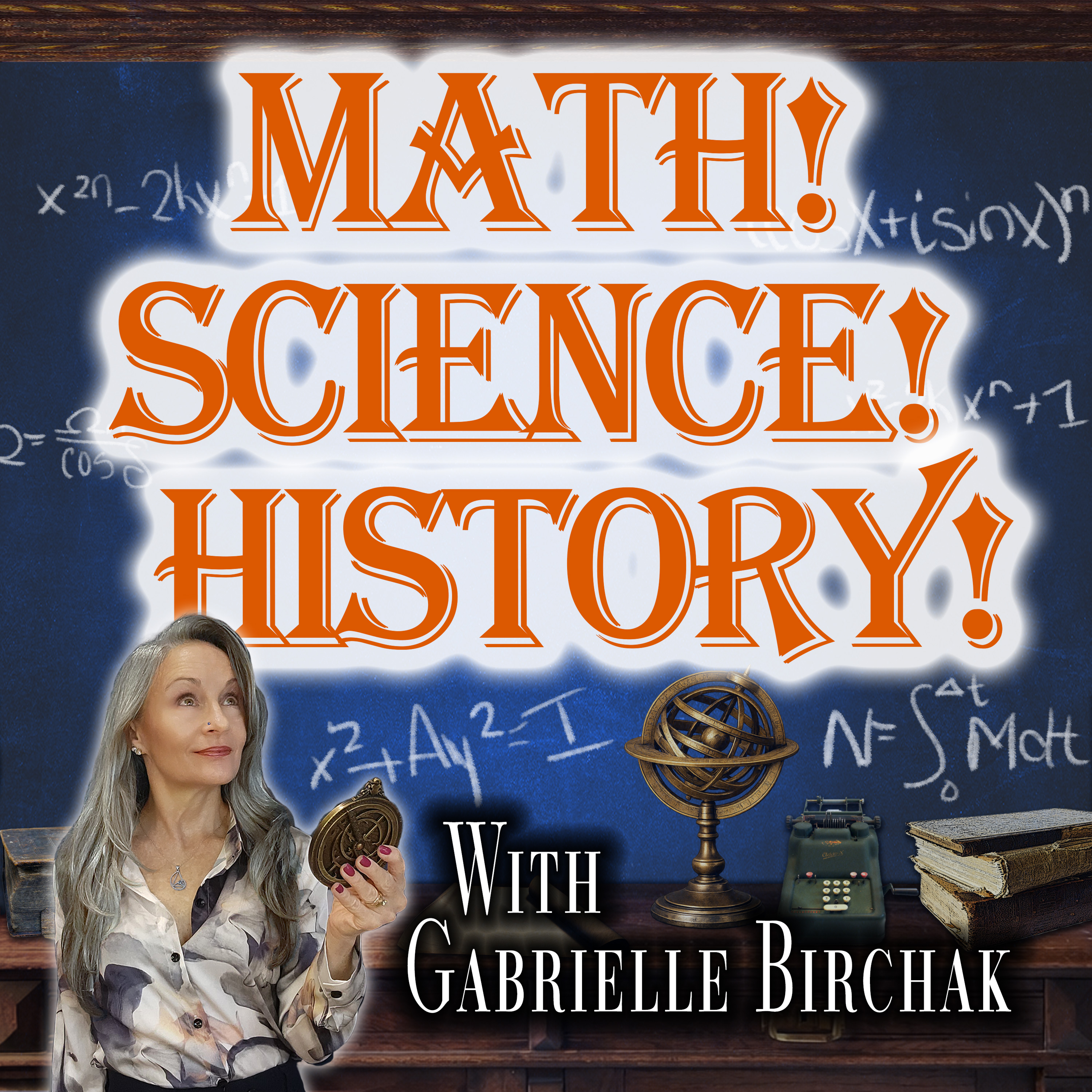
Hosted by Gabrielle Birchak · science · EN · 215 episodes
Audience: 6~906 on YouTube
About this Podcast:
Why do some scientific breakthroughs look different up close than they do in our textbooks? How did math quietly shape the modern world?Math! Science! History! explores the human side of discovery, including the rivalries, the failed attempts, the bold ideas, and the marginalized voices behind the equations and experiments that changed science, technology, and everyday life.Hosted by Gabrielle Birchak, who holds degrees in mathematics and journalism, the show connects codebreaking, astronomy, probability, physics, and innovation to the world we live in today.If you enjoy science stories, historical investigations, and clear math grounded in context, clarity, and research, this show is for you.New episodes twice weekly. Visit www.MathScienceHistory.com for more information.
Pitch Analysis
Required Pod Score for this show. PitchCentric checks your profile against host openness, topical fit, and audience signals before you generate a pitch.
Contact path
Verified email
Booking probability
44%
Guest openness
Selective
Verified email on file
80/100
Required Score
Sign up to generate a grounded pitch for Math! Science! History!.
Math! Science! History! is a science podcast hosted by Gabrielle Birchak, with 215 episodes on record and a Required Pod Score of 80. PitchCentric scores this show on Booking Probability, Listen Score, and live audience signals refreshed every 24 hours.
About the host
Gabrielle Birchak hosts Math! Science! History!, a science show with 215 episodes published.
Our AI reads these to draft pitches. Use them as grounding for a pitch that cites a real guest and a specific topic.
Episode #228
FLASHCARDS! Three Lessons from a Tobacco Engineer on Curiosity and Identity
Aug 21, 20269 minS7
Your job is what you do, not who you are - and that distinction could change your life. Gabrielle Birchak spotlights the astonishing story of Paul Tannery, a daytime engineer in the French tobacco administration whose after-hours curiosity helped reshape the history of mathematics and science.If you've ever felt like your work has started to define your entire identity, this episode offers a powerful reset. Gabrielle makes the case for building a second life around curiosity, hobby, and learning - not as a luxury, but as a source of well-being, purpose, and even legacy.You'll discover: · Why meaningful interests outside work are linked to lower stress and higher life satisfaction · How hobbies and non-work activities can strengthen mental health across cultures · Why curiosity matters even when it never becomes "productive" · The surprising power of sharing what you learn with other people · A simple 20-minute weekly practice to become more than your job title Gabrielle connects Tannery's life to modern research, including findings on psychological detachment from work and global studies on hobby engagement and mental well-being. The result is a short episode with a big message: the things you pursue for joy may end up shaping your life more than the work that pays the bills. Perfect for anyone feeling stuck in their role, hungry for a fuller identity, or looking for permission to follow their curiosity again. If you need a reminder that learning for its own sake still matters, this one will leave you thinking differently about your time, your talents, and your future. Notable Quotes · "Your job is what you do, but it does not have to be who you are." · "Curiosity is not a distraction from life. It is one of the things that makes life richer." · "Knowledge grows when it is shared." Explore more on our website: mathsciencehistory.com To buy my book Hypatia: The Sum of Her Life on Amazon, visit https://a.co/d/g3OuP9h Enjoying the Podcast? Explore more on our website: mathsciencehistory.com ☕ Support the Show : Coffee!! PayPal Subscribe on your favorite podcast platform Check out our merch : https://www.mathsciencehistory.com/the-store Music: All music is public domain and has no Copyright and no rights reserved. Selection is from The Little Prince by Lloyd Rodgers Subscribe on your favorite podcast platform Leave a review! It helps more people discover the show! Share this episode with friends & fellow history buffs! Until next time, carpe diem!
Paul Tannery: The Tobacco Engineer Who Changed the History of Math
Aug 18, 202633 minS7
Paul Tannery didn't begin his career intending to become one of the most influential historians of mathematics. He trained as an engineer at the École Polytechnique and spent much of his professional life working in France's state tobacco administration. But after work, Tannery pursued a very different passion: ancient mathematics, astronomy, philosophy, and the history of science. What began as an intellectual interest became a lifetime of scholarship. 3 TAKEAWAYS: 1. How Paul Tannery transformed a personal passion into groundbreaking scholarship 2. Why Tannery believed historical claims needed evidence, not repetition 3. Why your "side interest" may matter more than you realize RESOURCES: Paul Tannery — MacTutor History of Mathematics Archive René Taton, "Paul Tannery (1843–1904) Palatine Library - Complesso Monumentale della Pilotta Explore more on our website: mathsciencehistory.com To buy my book Hypatia: The Sum of Her Life on Amazon, visit https://a.co/d/g3OuP9h Enjoying the Podcast? ☕ Support the Show : Coffee!! PayPal Leave a review! It helps more people discover the show! Share this episode with friends & fellow history buffs! Subscribe on your favorite podcast platform Check out our merch : https://www.mathsciencehistory.com/the-store Music: All music is public domain and has no Copyright and no rights reserved. Selections from The Little Prince by Lloyd Rodgers Waiting for You by Pawel Feszczuk – from Free Music Archive – CC 4.0 Train by Sergey Cheremisinov -from Free Music Archive – CC 4.0 Serene Sonnet by Oleskii Holubiev from Pixabay – CC 0.0 Until next time, carpe diem!
In this episode of Momentum Monday , I cover how the ancient mathematician Diophantus , who revolutionized problem-solving by focusing on relationships between numbers , can inspire us to rethink our own relationships. Instead of fixating on fixing others, I challenge you to observe, question, and experiment with your connections, just like solving an equation. Whether it's a coworker, family member, or friend, I share how curiosity, pattern recognition, and small changes can shift the momentum in your favor. Plus, I reference research from Albert Bandura , Daniel Kahneman, and B.F. Skinner to ground these ideas in psychology. Sources & Further Reading: Diophantus and the Birth of Algebra Albert Bandura's Social Learning Theory Daniel Kahneman's Thinking, Fast and Slow B.F. Skinner Science and Human Behavior 3 Things You'll Learn How to observe relationships like a mathematician , identify patterns, not just problems. Why questioning your assumptions (e.g., "Are they ignoring me or overwhelmed?") prevents misunderstandings. How to experiment with small changes to shift the dynamic in any relationship. Explore more on our website: mathsciencehistory.com To buy my book Hypatia: The Sum of Her Life on Amazon, visit https://a.co/d/g3OuP9h Enjoying the Podcast? Explore more on our website: mathsciencehistory.com ☕ Support the Show : Coffee!! PayPal Leave a review! It helps more people discover the show! Share this episode with friends & fellow history buffs! Subscribe on your favorite podcast platform Check out our merch : https://www.mathsciencehistory.com/the-store Music: All music is Public Domain Mark 1.0 Universal and has no Copyright and no rights reserved. Selections from Violin Machine: A Deconstruction of the Bach Concerto by Lloyd Rodgers Until next time, carpe diem!
AI may verify proofs, but it can't replace curiosity. In this episode, I travel back nearly 1,800 years to meet Diophantus of Alexandria and explore how his approach to mathematics still shapes modern problem-solving, from Fermat's Last Theorem to today's AI-assisted research. Along the way, we discover why the real value of mathematics isn't finding answers. it's learning how to think. Website: https://www.MathScienceHistory.com ☕ Support the show: https://paypal.com/ncp/payment/PR7F7ST49GDNA • Discover why Diophantus is considered one of history's most influential mathematicians. • Learn how his work inspired Fermat's Last Theorem centuries later. • Explore whether AI is changing mathematics. or simply giving mathematicians better tools. Follow the show, subscribe wherever you listen, and leave a review to help others discover Math! Science! History! Music: All music is public domain and has no Copyright and no rights reserved. Selections from The Little Prince by Lloyd Rodgers Valorium – by It's Trigi – No Copyright and no rights reserved Documentary Background – by MiroMax Music – No Copyright and no rights reserved Blackbook 7/1/01 from On The Sensations of Tone – by Lloyd Rodgers – No Copyright and no rights reserved Galliard á3 in g by Orlando Gibbons - recorded, mixed, and mastered by Dr. Phillip W. Serna - licensed under the Creative Commons Attribution-Share Alike 4.0 International license Cute loop [c major] [93bpm] by deadrobotmusic -- https://freesound.org/s/555708/ -- License: Creative Commons 0 Subscribe on your favorite podcast platform Leave a review! It helps more people discover the show! Share this episode with friends & fellow history buffs! Until next time, carpe diem! - Gabrielle
REPOST: From Ancient Greece to AI: Can Mathematics Really Be Patented?
Jul 29, 202618 minS7
Can mathematics be patented? In this episode, I explore one of the most fascinating questions in mathematics, intellectual property, and computer science by tracing the history of patents from the ancient world to today's software and AI algorithms. Along the way, we'll discover why mathematical ideas themselves remain unpatentable while the innovative ways we apply them can change technology, and the future. Website: https://www.MathScienceHistory.com ☕ Support the show: https://paypal.com/ncp/payment/PR7F7ST49GDNA You'll learn: • Why mathematics itself cannot be patented but mathematical applications sometimes can. • How ancient patent and copyright ideas evolved into modern intellectual property law. • How the MP3, Fourier Series, FFT, and the Alice v. CLS Bank case shaped today's software patents. Follow the show, subscribe on your favorite podcast platform, and leave a review to help more people discover Math! Science! History! Music: All music is public domain and has no Copyright and no rights reserved. Selections from The Little Prince by Lloyd Rodgers Subscribe on your favorite podcast platform! Leave a review! It helps more people discover the show! Share this episode with friends & fellow history buffs! Until next time, carpe diem!
Every question we get asked before someone starts their trial.
If you have a concern about deliverability, AI quality, data privacy, or whether this will actually work for your specific situation, it's probably answered below.
What is the difference between Founder Solo and Founder Pro?
Founder Solo gives you 50 AI pitches per month using the credit model (Standard pitches cost 1 credit, Enriched pitches cost 2). Founder Pro raises that to 200 credits per month and adds full Booking Probability access, unlimited Magic Match, Apollo enrichment credits, and data export capabilities. Both plans use the same credit system, so you can stretch your monthly budget further by using Standard-mode drafting.
How do agency tiers work?
Agency tiers have no base fee. You pay per managed client and per talent profile. Agency Standard is $199 per client per month; Agency Pro is $399 per client per month. Both add $39 per talent profile per month. Your own team's user seats are always free.
What is a talent profile?
A talent profile represents one person (founder, executive, or spokesperson) you are booking onto podcasts. It includes their bio, topics, headshots, and outreach history. Team plans include 5 profiles; agency plans are pay-as-you-go.
Can I switch plans later?
Yes, at any time. Upgrades take effect immediately; downgrades apply at the end of the current billing period. Contact support if you need help migrating between plan families.
Do you offer a free trial?
Every paid plan includes a 15-day free trial. Your card is saved at signup but you will not be charged until day 16. Cancel any time from your dashboard.
What happens if I cancel?
You keep access until the end of your current billing period. No charges after that. Your data is retained for 30 days in case you reactivate.
Is the 20% annual discount automatic?
Yes. Select Annual on the pricing toggle and the discounted price is applied automatically at checkout. The annual price shown is the full year cost.
What if I have more than 50 profiles or 20 clients?
That is our Enterprise tier. Contact our sales team and we will build a custom plan with volume pricing, a dedicated account manager, and SLA guarantees.