

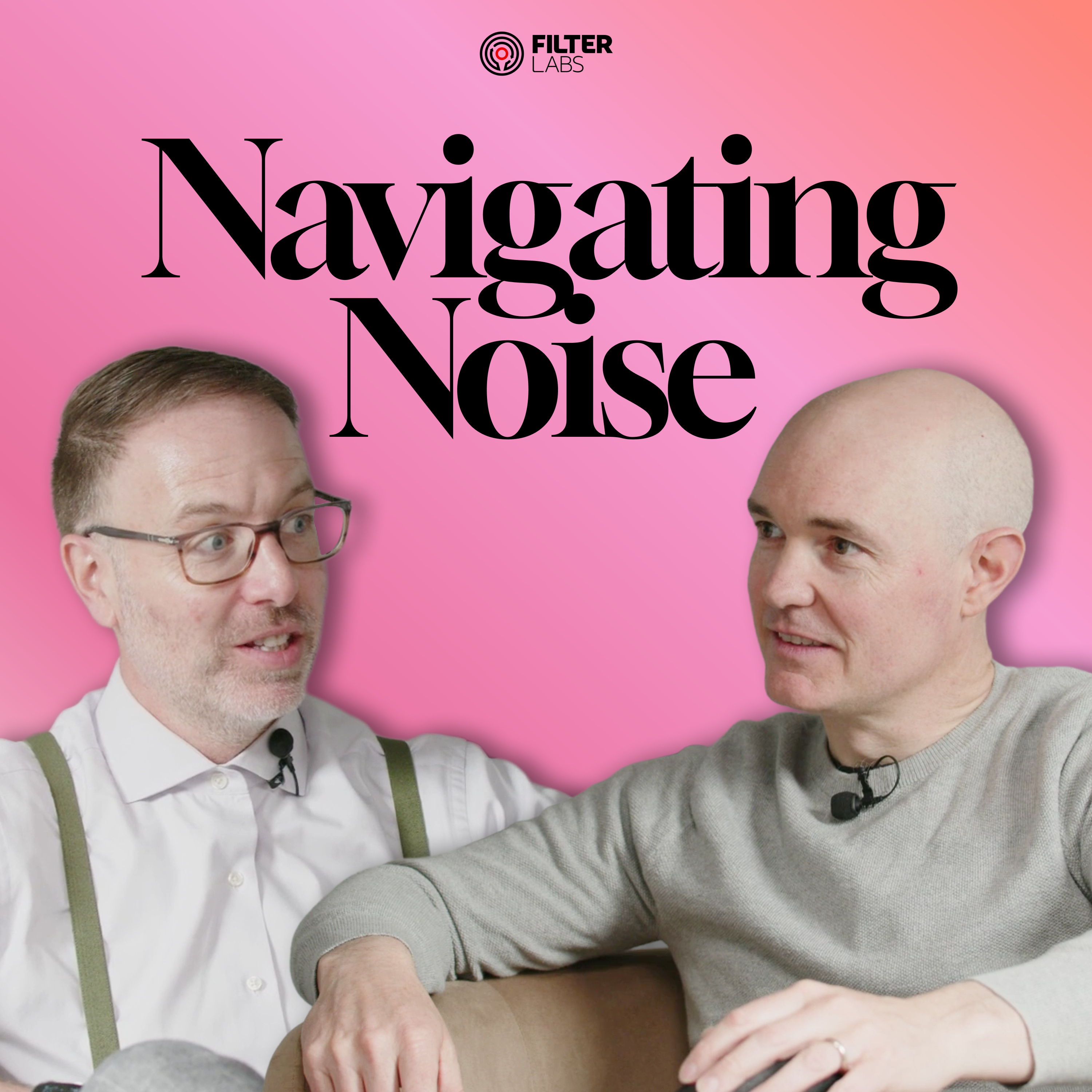
Navigating Noise
Why Influence Operations Still Can't Prove They Work, with Carrick Longley @ ZenithFlow
For two decades, the information operations community has sold activity. Messages disseminated, impressions served, reach and click rates. Carrick Longley spent his career inside that business and came to a blunt conclusion: almost nobody can point to a single decision that changed. Longley is the founder and CEO of ZenithFlow and a former Marine Corps major who spent years in signals intelligence, electronic warfare, and information operations planning before moving into industry. He holds a PhD in Information Sciences from the Naval Postgraduate School, where his dissertation examined how he and a small team pushed a field data collection tool through a change-resistant Department of Defense. He is also a vendor in this space, and he asked to be held to the same standard he holds everyone else to. Erol takes him up on it. The conversation runs from baselines and attribution to why counter-narratives can amplify the thing they're meant to counter, why the risk of inaction almost never makes it into a decision brief, and what it would take for defense contracts to pay for outcomes instead of hours. In this episode: - Why the adage that it's easier to drop a bomb than to send a message still holds - How stacked selection bias makes most social data useless for measurement - The case for judging every operation, kinetic or not, by its cognitive effect - Why information professionals have never had a real training range, and what Range is meant to fix - What outcome-based contracting would require from both sides of the table - How a self-taught engineer with a ham radio license built a 21-person company that ships the same day a customer asks Subscribe to Navigating Noise for new episodes every week. Available on YouTube, Spotify, and Apple Podcasts. Timestamps: 00:00 Intro 01:23 A true or false to start 02:32 The 244-page dissertation almost nobody has read 06:01 Two decades of selling activity instead of outcomes 07:38 Impressions, reach, click rates, and what they miss 10:32 Define the objective first 11:39 Stacked selection bias in social data 14:03 The risk of inaction nobody briefs 14:52 When a counter-narrative amplifies what it counters 17:37 Every action has a cognitive effect 19:34 Information forces never had a training range 22:26 Building Range 24:44 Inside the synthetic environment 26:29 Where the name ZenithFlow came from 29:49 Teaching himself to code in order to teach it 31:53 From one engineer to twenty-one people 35:15 Operational context as the real moat 38:36 Paying for outcomes instead of hours 42:21 The billboard question
