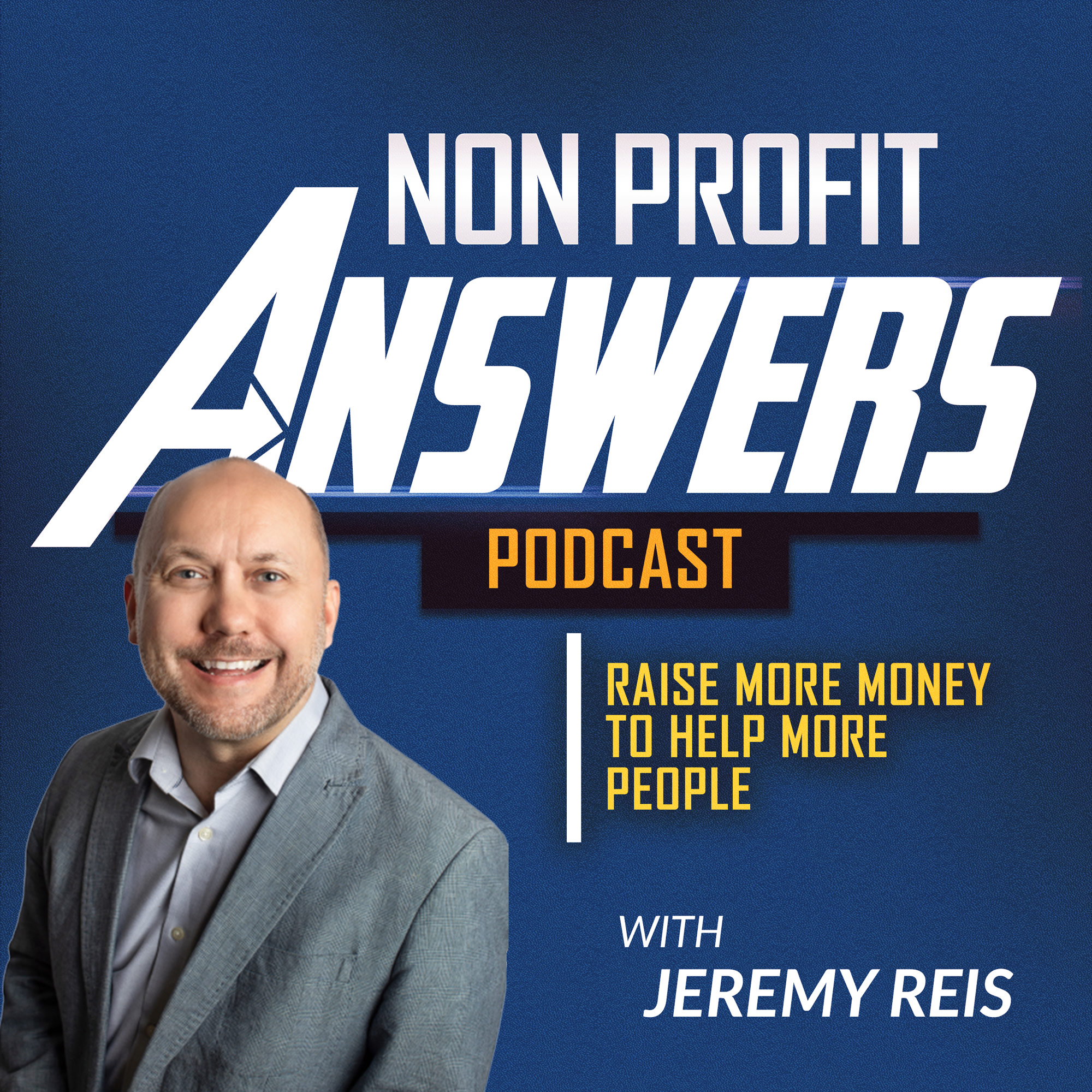
Nonprofit Answers Podcast helps you raise more money to help more people by answering your nonprofit leadership, marketing, and fundraising questions. Learn how to reach more donors with answers to your philanthropy and advancement questions. For Development Directors, Chief Development Officers, CEOs, Nonprofit Leaders, Fundraisers, Marketing Managers, Major Donor Reps, and Nonprofit Board Members. Learn about monthly, annual fund, major, midlevel, grants, planned giving, direct mail, email fundraising, leadership, and more.
Pitch Analysis
Required Pod Score for this show. PitchCentric checks your profile against host openness, topical fit, and audience signals before you generate a pitch.
Contact path
Public web form
Booking probability
22%
Guest openness
Selective
82/100
Required Score
Sign up to generate a grounded pitch for Nonprofit Answers: Nonprofit Fundraising, Marketing, Monthly Giving.
What is Nonprofit Answers: Nonprofit Fundraising, Marketing, Monthly Giving?
Nonprofit Answers: Nonprofit Fundraising, Marketing, Monthly Giving is a business podcast hosted by Jeremy Reis, with 85 episodes on record and a Required Pod Score of 82. PitchCentric scores this show on Booking Probability, Listen Score, and live audience signals refreshed every 24 hours.
About the host
Jeremy Reis hosts Nonprofit Answers: Nonprofit Fundraising, Marketing, Monthly Giving, a business show with 85 episodes published.
Our AI reads these to draft pitches. Use them as grounding for a pitch that cites a real guest and a specific topic.
Episode #93
[AI for Nonprofits] Episode 7: The Efficiency Trap ... When Automation Creates Absence
Jun 11, 202616 min
Here's a scenario that plays out more often than anyone talks about. You automate several things, gain back real time, produce more content, hit your deadlines, and by every measurable metric you're more efficient. And then something shifts. You're busier than ever but feel less connected. Your communications are more frequent but your relationships feel thinner. You have more capacity and somehow less of the thing that capacity was supposed to serve. That's the efficiency trap. And it has nothing to do with AI being bad at its job. It has everything to do with what happens when efficiency becomes the goal instead of the means. In this episode, Jeremy names five specific versions of the trap that show up in nonprofit work — including one that's changing meeting culture in ways most leaders haven't noticed yet, and one that's quietly hollowing out major gift pipelines at organizations that think they're doing well. He also gives you four practical principles for capturing real efficiency gains without paying the costs that usually come with them. The core question this episode keeps coming back to is a simple one: when you automate something, what specifically are you doing with the time you get back? Most people don't have a clear answer. This episode makes the case that answering it deliberately is the difference between AI serving your mission and AI slowly replacing it. Part of the AI for Nonprofits series. Download the free companion workbook at https://nonprofitfundraising.com/ai
[AI for Nonprofits] Episode 6: Content, Communications & Grant Writing
Jun 4, 202616 min
The blank page is one of the most expensive problems in a nonprofit communications shop. Every appeal that goes out late, every grant narrative written in a panic the night before it's due, every newsletter that gets skipped because nobody had time — that's mission capacity sitting on the floor. AI doesn't solve the blank page problem by replacing the writer. It solves it by giving you a starting point that's faster and less painful than staring at a cursor. The discipline is in what comes next. In this episode, Jeremy walks through the human-in-the-loop workflow he uses for every significant piece of AI-assisted content: what you load in at the front, where you check in during the middle, and why a human review at the end is non-negotiable. He covers newsletters, social media, grant narratives, impact reports, and board communications — with specific workflows for each, not just general principles. He also introduces one of the most underused strategies for small nonprofits: the content library. Loading your best past appeals, impact stories, and voice examples into your AI tool as standing context changes the quality of everything it produces. Instead of generic nonprofit language, you get something that actually sounds like your organization. Jeremy shares how he built this at Serving Orphans Worldwide and what it made possible. The episode also addresses the concern communications staff hear most often — what if AI makes us all sound the same? The answer isn't to avoid it. It's to give it strong enough signals that it can't. Part of the AI for Nonprofits series. Download the free companion workbook at https://nonprofitfundraising.com/ai Want to learn more? My new book may have the answers for you! The Christian Leader's Guide to AI: https://amzn.to/3RvXyoA
[AI for Nonprofits] Episode 5: Where AI Actually Helps
Jun 2, 202619 min
Your donors are already using AI. Seventy-six percent of them, according to a March 2026 study from BBS & Associates. They know what AI-generated content feels like. Which means the question of whether to use AI in your fundraising isn't really about hiding anything — it's about knowing where it helps and where it quietly erodes the thing donors are actually giving to. In this episode, Jeremy digs into the BBS Donor Confidence Survey findings and what they actually mean for your development program. The results are more nuanced than most people expect. Donors broadly support AI when it makes their charitable dollars go further operationally. They get noticeably more cautious the closer AI gets to the relationship itself — and the data shows they can often tell the difference. Jeremy covers what AI does well in fundraising: prospect research, donor file analysis, content drafting, versioning appeals for different audiences, and annual planning. He gives you specific workflows, not just concepts. And he's clear about where the line is — the one place in major gift fundraising where AI should never be making the decisions, no matter how good it gets at the output. If you've been wondering how to use AI in your development work without losing the relationships that make your fundraising actually work, this episode is the one to start with. Part of the AI for Nonprofits series. Download the free companion workbook at nonprofitfundraising.com/ai. The Christian Leader's Guide to AI: https://amzn.to/3RvXyoA BBS & Associates: https://servantheart.com
[AI for Nonprofits] Episode 4: Automating the Obstacles, Not the Ministry
May 27, 202619 min
You're busy. The question isn't whether AI can help with that ... it can. The question is which parts of your work should stay yours, and which parts are just getting in the way. In this episode, Jeremy Reis introduces the obstacle versus connection test: a simple, practical framework for deciding what to hand off to AI and what to protect. Some tasks are pure overhead, like formatting, reformatting, scheduling, and data entry. They consume time without connecting you to anything that matters. Others look like overhead but actually keep you attuned to your donors, your clients, and the details that make you good at your job. Hand those off and you get the output. You lose what the doing of them actually gives you. Jeremy shares how Serving Orphans Worldwide used this framework to go from four fundraising appeals a year to four emails a month plus a monthly mailed appeal — with zero new staff — and grow from 300 new donors in 2024 to 1,500 in 2025. The efficiency was real. But the gains came from what the reclaimed time made possible, not from the time saved itself. One framework. One question to ask before you automate anything. And a homework assignment that most people skip but shouldn't. Part of the AI for Nonprofits series. Download the free companion workbook at https://nonprofitfundraising.com/ai The Christian Leader's Guide to AI: https://amzn.to/3RvXyoA Virtuous Study: https://virtuous.org/blog/2026-nonprofit-ai-adoption-report/ BBS & Associates: https://servantheart.com
[AI for Nonprofits] Episode 3: When AI Does Your Thinking
May 27, 202620 min
There's a risk of AI adoption that doesn't make headlines. It's not a data breach or a generated image with extra fingers. You'll find this risk quieter than that, and by the time most leaders notice it clearly, it's been building for a long time. When you consistently hand your hardest cognitive work to a tool, something starts to slip. Your output quality hopefully doesn't change. What slips is the understanding that comes from doing the work yourself. The board member who used to have a firm grip on the details. The development director who lost touch with what made her donor communications feel real. The executive director who realized his most recent strategic presentation was more polished than any he'd done before, and somehow less his. Jeremy calls this cognitive atrophy, and in this episode he makes the case that it's the most underappreciated risk in nonprofit AI adoption. He walks through exactly where it shows up in leadership work: strategy, donor relationships, program evaluation, and the kind of judgment that can't be looked up. He also covers what protecting your thinking actually looks like day to day, and why the answer isn't to avoid AI but to stay deliberate about which work stays yours. Your homework this episode is simple and uncomfortable: pick one thing you've been letting AI handle, and do it yourself this week. Just once. Notice what you find. Download the free companion workbook at https://nonprofitfundraising.com/ai The Christian Leader's Guide to AI: https://amzn.to/3RvXyoA Virtuous Study: https://virtuous.org/blog/2026-nonprofit-ai-adoption-report/ BBS & Associates: https://servantheart.com
Every question we get asked before someone starts their trial.
If you have a concern about deliverability, AI quality, data privacy, or whether this will actually work for your specific situation, it's probably answered below.
What is the difference between Founder Solo and Founder Pro?
Founder Solo gives you 50 AI pitches per month using the credit model (Standard pitches cost 1 credit, Enriched pitches cost 2). Founder Pro raises that to 200 credits per month and adds full Booking Probability access, unlimited Magic Match, Apollo enrichment credits, and data export capabilities. Both plans use the same credit system, so you can stretch your monthly budget further by using Standard-mode drafting.
How do agency tiers work?
Agency tiers have no base fee. You pay per managed client and per talent profile. Agency Standard is $199 per client per month; Agency Pro is $399 per client per month. Both add $39 per talent profile per month. Your own team's user seats are always free.
What is a talent profile?
A talent profile represents one person (founder, executive, or spokesperson) you are booking onto podcasts. It includes their bio, topics, headshots, and outreach history. Team plans include 5 profiles; agency plans are pay-as-you-go.
Can I switch plans later?
Yes, at any time. Upgrades take effect immediately; downgrades apply at the end of the current billing period. Contact support if you need help migrating between plan families.
Do you offer a free trial?
Every paid plan includes a 15-day free trial. Your card is saved at signup but you will not be charged until day 16. Cancel any time from your dashboard.
What happens if I cancel?
You keep access until the end of your current billing period. No charges after that. Your data is retained for 30 days in case you reactivate.
Is the 20% annual discount automatic?
Yes. Select Annual on the pricing toggle and the discounted price is applied automatically at checkout. The annual price shown is the full year cost.
What if I have more than 50 profiles or 20 clients?
That is our Enterprise tier. Contact our sales team and we will build a custom plan with volume pricing, a dedicated account manager, and SLA guarantees.