NTSB News Talk is your go-to podcast for in-depth discussions of aircraft accidents, investigations, and the lessons pilots can’t afford to ignore. Hosted by award-winning aviation journalist Rob Mark and Max Trescott, a flight instructor who has trained as an accident investigator, this show breaks down recent NTSB reports, analyzes accident causes, and explores what every pilot, instructor, and aviation enthusiast can learn from these events.Whether you’re a student pilot, airline captain, or simply fascinated by aviation safety, NTSB News Talk brings you facts, context, and expert commentary—without sensationalism. Rob and Max balance serious safety insights with engaging conversation, making complex investigations accessible and informative.Each episode features real-world scenarios, industry trends, and sometimes, interviews with investigators, subject-matter experts, or those impacted by aviation incidents. Tune in to stay informed, sharpen your safety mindset, and better under
Pitch Analysis
Required Pod Score for this show. PitchCentric checks your profile against host openness, topical fit, and audience signals before you generate a pitch.
Contact path
Public web form
Booking probability
30%
Guest openness
Selective
81/100
Required Score
Sign up to generate a grounded pitch for NTSB News Talk – Aviation Accidents, Safety Investigations & Pilot Lessons.
What is NTSB News Talk – Aviation Accidents, Safety Investigations & Pilot Lessons?
NTSB News Talk – Aviation Accidents, Safety Investigations & Pilot Lessons is a leisure podcast hosted by Unknown Host, with 40 episodes on record and a Required Pod Score of 81.
About the host
Unknown Host hosts NTSB News Talk – Aviation Accidents, Safety Investigations & Pilot Lessons, a leisure show with 40 episodes published.
Our AI reads these to draft pitches. Use them as grounding for a pitch that cites a real guest and a specific topic.
Episode #39
Amazon Prime Air Boeing 767 Crash Update: 120-Knot Go-Around Attempt & More Accidents
Sep 23, 202643 min
New information from the NTSB is filling in the final seconds of the Amazon Prime Air Boeing 767 crash in Miami. The agency’s summary of the cockpit voice recorder shows repeated concerns about excessive speed, followed by touchdown and then, 16 seconds later, a call for a go-around. The brakes were released at a ground speed of 120 knots and go-around thrust was applied before the attempt was abandoned. Recorded data showed no indication that the speed brakes or thrust reversers were deployed. Max Trescott also revisits his ADS-B analysis of Flight 7598 and explains why he believes an automation surprise involving the Boeing 767’s vertical modes may have contributed to the airplane becoming high and fast. Then Max and Rob Mark examine the fatal KNBC AS350B2 helicopter crash in Los Angeles, including ADS-B evidence and reports of a possible low-rotor-RPM warning. Other accidents include N734ZK, a Cessna 172N crash at Montgomery-Gibbs Executive Airport, N9485P, a fatal Piper Comanche accident at a short Alaska runway , N93R, a Lockheed 12A that took off with full flaps , a fuel-exhaustion accident involving N413AW, a Pipistrel Alpha, and N188PC, a Pilatus PC-12 loss of control in IMC . The episode closes with a story from the NASA ASRS Callback newsletter about a Cirrus pilot’s successful recovery from a dangerous distraction in instrument conditions.
Amazon Prime Air Boeing 767 Crash in Miami: Flight 7598 ADS-B Analysis and More Accidents
Sep 6, 202652 min
An Amazon Prime Air Boeing 767 crashes after overrunning Runway 30 at Miami International Airport—and ADS-B data contains an important clue about how the approach became unstable. In this episode, we analyze the September 6 crash of Prime Air Flight 7598, operated by 21 Air with Boeing 767 N1997A. The flight from San Juan initially followed an almost perfect three-degree approach toward Miami. But approximately five miles from the runway, the aircraft unexpectedly leveled near 1,600 feet. The ADS-B data shows that 1,600 feet had been entered as the selected altitude much earlier in the descent. That raises the possibility of an automation surprise, although another possibility is that the crew leveled inadvertently after disconnecting the autopilot to hand-fly. The crew then attempted to recover using a descent approaching twice the normal glide angle. The 767 crossed the displaced threshold around 175 knots, apparently touched down near 160 knots, and was still traveling about 110 knots when it left the runway. We also examine a fatal PC-12 spatial-disorientation accident, new evidence of helicopter wake turbulence in a Cessna 150 collision, and a troubling student-pilot night CFIT accident involving a CFI cross-country endorsement. FAA No Go Over the Counter Medications List
In Episode 37 of NTSB News Talk, Max Trescott and Rob Mark examine accidents illustrating how distraction, spatial disorientation, inadequate briefings, and continuation bias can rapidly turn routine flights into emergencies. Brought to you by AVEMCO aircraft insurance. Support Rob and Max by making a donation at Patreon.com The episode begins with the Cirrus Vision Jet accident at Driggs, Idaho , where a pilot attempted takeoff from a closed portion of Runway 4 and struck a water pipe suspended across the runway. They also discuss the fatal collision at Carlisle, Pennsylvania, between a landing Cessna 150 and a Pennsylvania State Police Bell 407 hovering just above the ground during training. Rob reviews the fatal crash of Cessna 172 N9360E at Provincetown , Massachusetts, while Max analyzes newly released NTSB docket evidence from the January 2025 crash of Learjet 55 XA-UCI near Philadelphia . Flight-path data and the NTSB’s human-performance analysis raise significant questions about spatial disorientation. Final reports include N1850N a Beechcraft Duchess accident during a simulated single-engine approach, a photographer fatally struck by glider N8217W , and two wrong-runway landings near Chicago, N772MR (Envoy 3936) and N1128M Learjet 60 . Those final incidents highlight a recurring human-factors problem: once pilots commit mentally to a plan, contradictory evidence can become surprisingly difficult to recognize.
Cirrus Takes a Swim, Aerostar Night Crash, Twin Comanche VMC Roll & More
Aug 11, 202643 min
In Episode 36 of NTSB News Talk, Max Trescott and Rob Mark examine a series of accidents that illustrate how quickly routine flights can unravel when pilots continue after the warning signs begin to accumulate. Brought to you by AVEMCO aircraft insurance. Support Rob and Max by making a donation at Patreon.com A Cessna 172, N1166F, crashes at night at Blackfoot, Idaho, after what appears to have been a go-around. A Cirrus SR22T, N625LK, crashes near Bend, Oregon, after remaining airborne for more than five hours in an unusual flight that authorities say ended intentionally. An Aerostar 601P, N800AA, barely climbs after a nighttime departure from Adirondack Regional Airport, raising the possibility of somatogravic illusion. They also discuss a Beech Baron, N202DK , lost after apparently continuing VFR into instrument weather, and a Piper Twin Comanche, N8154Y, that rolls inverted during a go-around following an earlier engine abnormality. Final reports include a Diamond DA42, N705JP , that lands long with a tailwind and insufficient runway remaining; an unregistered Piper PA-18 that stalls during a low-altitude predator-control flight; a Cirrus SR22T, N778WT damaged on an unfamiliar grass runway; and a Gulfstream G600, N600WE , that loses visual reference in heavy rain during landing. Plus, Rob reflects on the 45th anniversary of the PATCO strike and the warning he published shortly before it began. He talks about it on his Stories About Flying podcast .
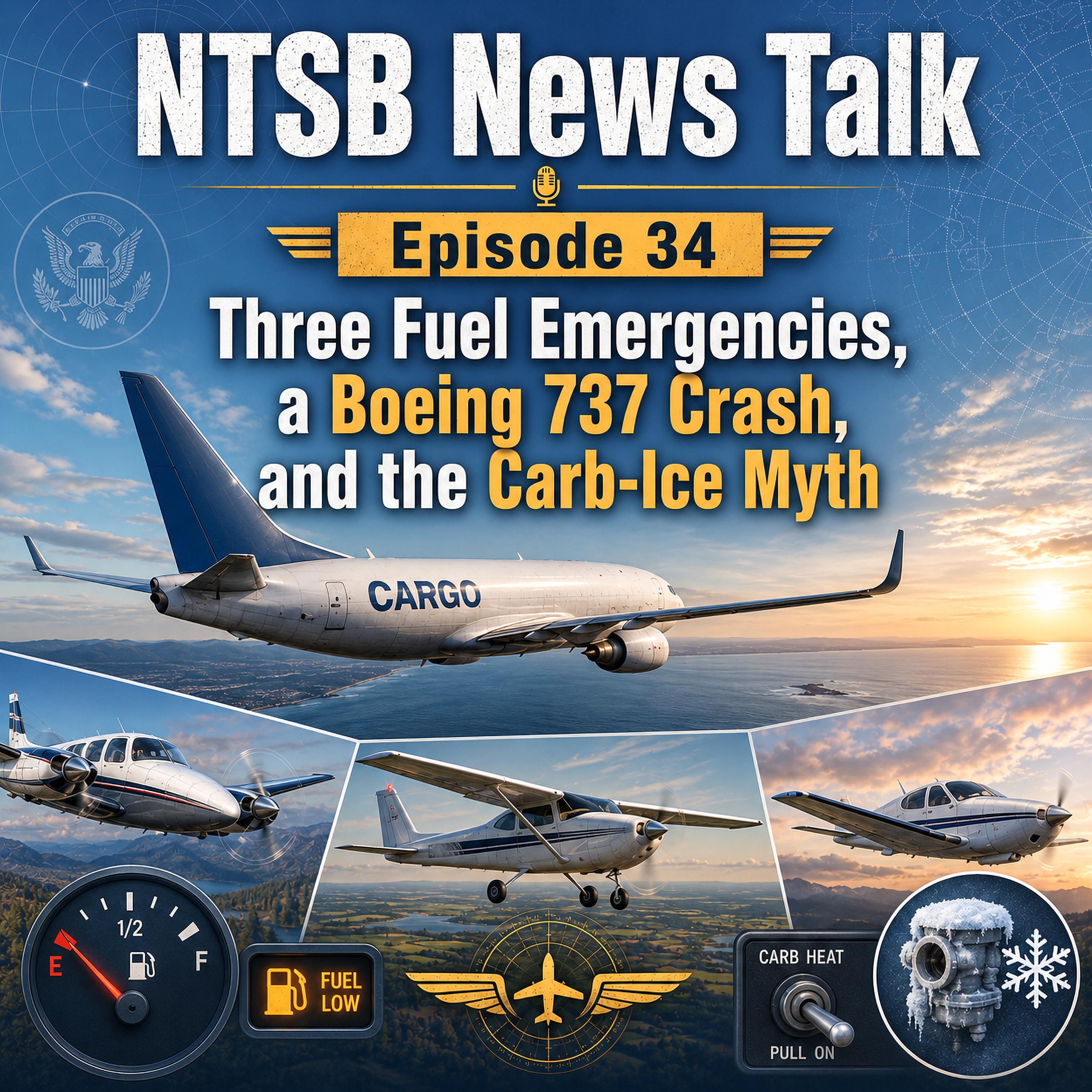
Three Fuel Emergencies, a Boeing 737 Crash, and the Carb-Ice Myth
Jul 14, 202636 min
Max Trescott and Rob Mark review a mysterious Boeing 737 cargo crash, several fuel-related accidents, loss of control, and a dangerous carb-ice misconception. K2 Airways Flight KTA1732 , Boeing 737-400F AP-BOI, reported a navigation problem before plunging into the Arabian Sea. The hosts analyze Beechcraft 95-A55 Baron N7501S after an apparent dual-engine failure near Lancaster, South Carolina, following an 18-hour flying day, raising questions about fuel endurance, fatigue, and nighttime hypoxia. Preliminary reports include Cessna 150L N156KA , where the instructor tried to select a nonexistent right-tank position and investigators found a striking fuel imbalance; Cessna P210N N54CC , which stalled and spun above a 9,550-foot runway; Pacific Aerospace 750XL N221BN , whose engine was producing power before a fatal skydiving crash; and experimental Piper PA-20 N7635K , which struck mountainous terrain while flying toward instrument conditions with a suspended certificate and expired medical. Final reports cover Cessna 172M N4464R , whose seat slid aft during takeoff, and Cessna 182 N8580T , which lost power on final after the left tank ran dry despite fuel remaining in the right tank. Listener Sam Dawson closes with a warning that no carbureted airplane should be assumed immune from carb ice or what its POH may imply alone.
Every question we get asked before someone starts their trial.
If you have a concern about deliverability, AI quality, data privacy, or whether this will actually work for your specific situation, it's probably answered below.
What is the difference between Founder Solo and Founder Pro?
Founder Solo gives you 50 AI pitches per month using the credit model (Standard pitches cost 1 credit, Enriched pitches cost 2). Founder Pro raises that to 200 credits per month and adds full Booking Probability access, unlimited Magic Match, Apollo enrichment credits, and data export capabilities. Both plans use the same credit system, so you can stretch your monthly budget further by using Standard-mode drafting.
How do agency tiers work?
Agency tiers have no base fee. You pay per managed client and per talent profile. Agency Standard is $199 per client per month; Agency Pro is $399 per client per month. Both add $39 per talent profile per month. Your own team's user seats are always free.
What is a talent profile?
A talent profile represents one person (founder, executive, or spokesperson) you are booking onto podcasts. It includes their bio, topics, headshots, and outreach history. Team plans include 5 profiles; agency plans are pay-as-you-go.
Can I switch plans later?
Yes, at any time. Upgrades take effect immediately; downgrades apply at the end of the current billing period. Contact support if you need help migrating between plan families.
Do you offer a free trial?
Every paid plan includes a 15-day free trial. Your card is saved at signup but you will not be charged until day 16. Cancel any time from your dashboard.
What happens if I cancel?
You keep access until the end of your current billing period. No charges after that. Your data is retained for 30 days in case you reactivate.
Is the 20% annual discount automatic?
Yes. Select Annual on the pricing toggle and the discounted price is applied automatically at checkout. The annual price shown is the full year cost.
What if I have more than 50 profiles or 20 clients?
That is our Enterprise tier. Contact our sales team and we will build a custom plan with volume pricing, a dedicated account manager, and SLA guarantees.