
Episode #1474
Winning Hearts, Minds, and Policy with Strategic Communications | PBM Reform
Aug 24, 202642 min
Many pharmacy leaders focus on legislation and lobbying. Why is strategic communication on social media equally important?

Loading…
Pharmacy benefit managers were created as middlemen to reduce administrative costs for insurers, validate a patient’s eligibility, administer plan benefits, and negotiate costs between pharmacies and health plans. Over time, PBMs have been allowed to operate virtually unchecked. A lack of transparency in PBM practices has led several states to implement licensure/registration, fair pharmacy audit, or generic drug pricing legislation to try to level the playing field for pharmacies and patients. by the NCPA https://www.ncpanet.org/advocacy/state-advocacy/pbm-reform This Podcast is focusing on discussions & interviews about PBM Reform & those and Business of Pharmacy professionals leading this much needed reform.
Required Pod Score for this show. PitchCentric checks your profile against host openness, topical fit, and audience signals before you generate a pitch.
Contact path
Public web form
Booking probability
39%
Guest openness
Selective
Sign up to generate a grounded pitch for PBM Reform Podcast.
Signup to Generate a PitchPBM Reform Podcast is a news podcast hosted by Pharmacy Podcast Network, with 60 episodes on record and a Required Pod Score of 80. PitchCentric scores this show on Booking Probability, Listen Score, and live audience signals refreshed every 24 hours.
Pharmacy Podcast Network hosts PBM Reform Podcast, a news show with 60 episodes published.
Our AI reads these to draft pitches. Use them as grounding for a pitch that cites a real guest and a specific topic.
Episode #1474
Many pharmacy leaders focus on legislation and lobbying. Why is strategic communication on social media equally important?

Episode #1473
The PBM Reform Podcast, sponsored by APCI, welcomes John Vinson, PharmD, Chief Executive Officer of the Arkansas Pharmacists Association, for a timely conversation with host Greg Reybold about the management of the TRICARE pharmacy benefit. Express Scripts administers pharmacy benefits for TRICARE, the Department of Defense healthcare program serving more than 9 million active-duty service members, military retirees, and family members. In fiscal year 2023 alone, TRICARE spent more than $8 billion on prescription medications. Greg and John examine concerns surrounding Express Scripts’ administration of the program, including shrinking pharmacy networks, reduced patient choice, questionable contractor reporting, specialty-drug delivery oversight, and the consequences for independent and rural pharmacies. A 2025 Government Accountability Office investigation found that: TRICARE’s minimum network requirement fell from 50,000 to 35,000 pharmacies. The network had approximately 13,165 fewer pharmacies in late 2024 than in late 2022. An estimated 380,000 beneficiaries may have been forced to find another pharmacy. The Defense Health Agency relied heavily on contractor-submitted reports that contained inaccuracies. DHA had not consistently audited the data used to evaluate beneficiary access. GAO’s two corrective recommendations remain open as of August 2026, although DHA has begun adding reporting and auditing requirements. The episode also addresses higher 2026 prescription copayments. For most non-active-duty beneficiaries, home-delivery copays are now $14 for generic formulary drugs, $44 for brand-name drugs, and $85 for non-formulary medications. At retail network pharmacies, the corresponding 30-day copays are $16, $48, and $85. Greg and John discuss whether PBM-driven network reductions represent true savings—or simply transfer costs, inconvenience, and access barriers to military families and the community pharmacies serving them. Key discussion points Express Scripts’ role in administering the TRICARE pharmacy benefit Pharmacy network contraction and beneficiary disruption Access challenges facing rural communities and military families Inaccurate contractor data and insufficient federal oversight Specialty-pharmacy delivery and monitoring concerns Rising 2026 copayments and pressure toward mail order Arkansas’ leadership in challenging PBM vertical integration The need for transparency, accountability, adequate reimbursement, and patient choice Important clarification: TRICARE is administered by the Department of Defense and is distinct from healthcare and pharmacy services operated by the Department of Veterans Affairs. Sponsored by APCI — American Pharmacy Cooperative, Inc. Sources: U.S. Government Accountability Office , TRICARE’s 2026 pharmacy-benefit update , official 2026–2027 pharmacy costs .

Episode #1472
PBM Reform Podcast Sponsored by American Pharmacy Cooperative, Inc. (APCI) Host: Greg Reybold Special Guest: Ben Mudd, PharmD, Executive Director, Kentucky Pharmacists Association Momentum for meaningful pharmacy benefit manager reform is building in Washington. In this episode of the PBM Reform Podcast, host Greg Reybold welcomes Dr. Ben Mudd, Executive Director of the Kentucky Pharmacists Association, to examine the bipartisan Pharmacists Fight Back Act, H.R. 6610, and what its advancement could mean for patients, pharmacists, employers, and the future of independent pharmacy. On July 22, 2026, the House Committee on Oversight and Government Reform reported the legislation favorably following a committee markup. Introduced by Chairman James Comer of Kentucky and Representative Jake Auchincloss of Massachusetts, the bill would establish new requirements for pharmacy benefit managers participating in the Federal Employees Health Benefits Program. The proposed reforms would require participating PBMs to provide fair pharmacy reimbursement, apply manufacturer rebates toward reducing beneficiaries’ prescription drug costs, prohibit patient steering to PBM-affiliated pharmacies, increase transparency, and establish penalties for noncompliance. Greg and Ben discuss why the Federal Employees Health Benefits Program could become an important proving ground for broader PBM accountability and how federal action may influence commercial plans, state legislation, and future healthcare policy. Episode Discussion The conversation explores: Why H.R. 6610 has attracted bipartisan support How PBM reimbursement practices threaten independent pharmacy sustainability The impact of patient steering and PBM-affiliated pharmacy networks Why manufacturer rebates should directly reduce patients’ prescription costs What “fair reimbursement” must include to protect pharmacy access How enforcement provisions and financial penalties could improve accountability Kentucky’s role in advancing pharmacy and PBM reform The connection between federal legislation and state-level advocacy What pharmacists should communicate to legislators and patients The remaining steps required before H.R. 6610 can become law Dr. Mudd brings the perspective of a practicing community pharmacist and association executive who has worked extensively in pharmacy advocacy. A graduate of the University of Kentucky College of Pharmacy, he practiced in both chain and independent pharmacy settings before assuming leadership of the Kentucky Pharmacists Association. Ben is running for Kentucky State Senate position this November. Lear more about his platform and issues most important: https://www.votemudd.com/meet-ben Key Takeaway PBM reform is no longer simply an industry debate. It is a patient-access, healthcare-affordability, pharmacy-choice, and community-infrastructure issue. The Pharmacists Fight Back Act represents a significant federal effort to separate PBM compensation from practices that may increase drug costs, restrict patient choice, and financially disadvantage independent pharmacies. The legislation’s advancement is an important milestone—but pharmacists must remain informed, engaged, and vocal as the bill moves through the legislative process. Subscribe to the PBM Reform Podcast for continuing coverage of legislation, regulation, litigation, and advocacy shaping the future of pharmacy benefit management and community pharmacy. The PBM Reform Podcast is sponsored by American Pharmacy Cooperative, Inc., supporting independent pharmacies and advocating for a more transparent, competitive, and patient-centered prescription drug marketplace.
Episode #1471
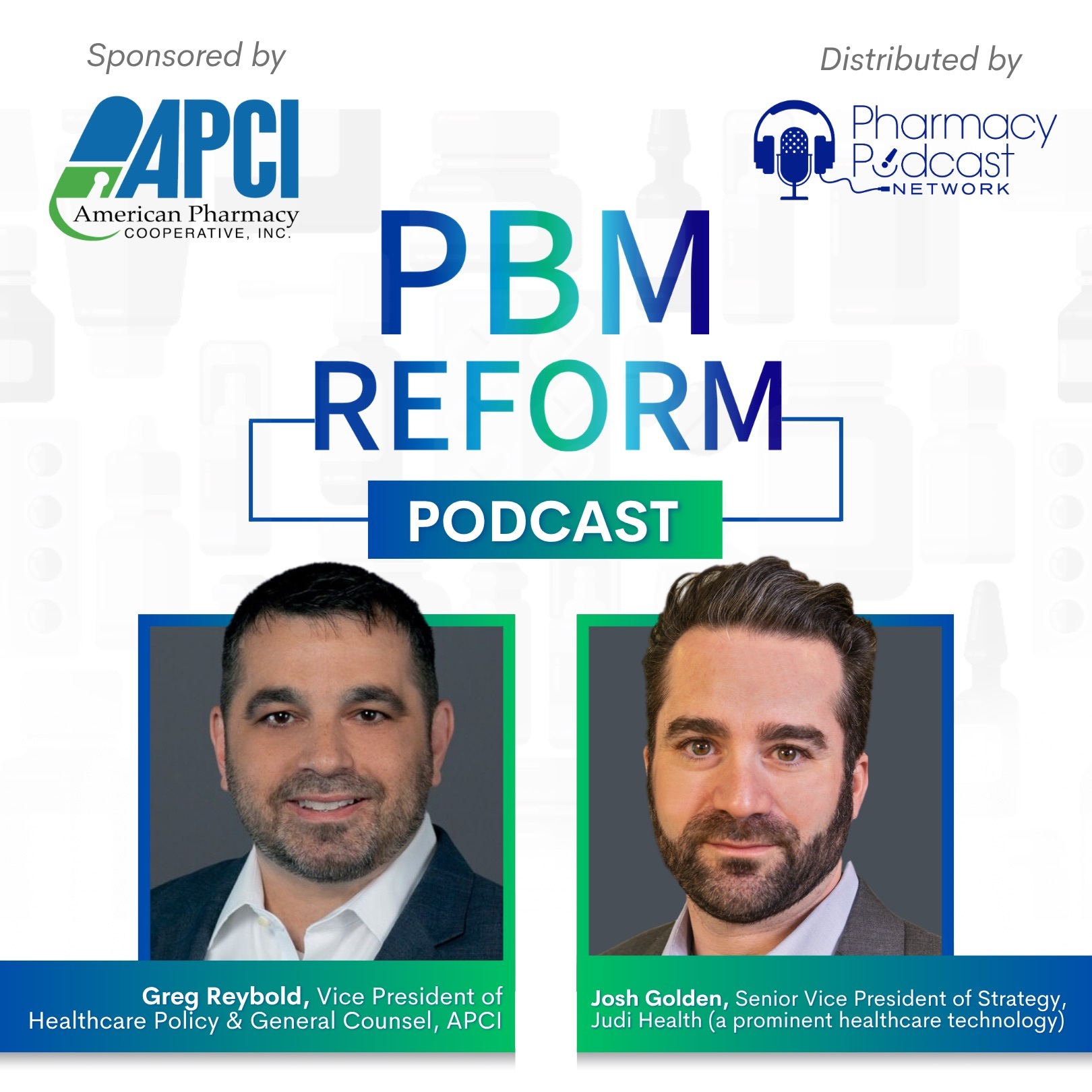
In this episode of the PBM Reform Podcast, host Greg Reybold, Vice President and General Counsel at APCI, welcomes Josh Golden, Senior Vice President of Strategy at Judi Health and a nationally recognized voice in Pharmacy Benefit Manager reform. With more than 20 years of healthcare consulting experience, Golden brings deep expertise in vendor procurement, contract negotiation, plan design, and benefit strategy for large employers, government entities, and unions. Together, Reybold and Golden examine the financial models behind today’s PBM industry and why true transparency remains so difficult for employers, plan sponsors, patients, and pharmacies. The conversation explores how current PBM arrangements often benefit the PBMs more than the employers paying for coverage or the patients relying on their prescription benefits. Golden explains why auditing PBM contracts, rebate structures, spread pricing, administrative fees, pharmacy networks, and formulary decisions is essential to understanding the real economics of prescription drug benefits. This episode also addresses a growing concern in healthcare: PBM steering behavior. Are patients being quietly pushed toward specific formularies, specific pharmacies, and restricted networks that operate like closed networks without being clearly disclosed? Reybold and Golden discuss how this behavior can limit patient choice, disadvantage independent pharmacies, and distort the stated goal of lowering drug costs. The discussion also tackles the role of federal reform efforts, including whether the Appropriations Act represents meaningful PBM accountability or whether it risks becoming another layer in the broader shell game surrounding PBM reform. Finally, the episode asks one of the most important questions in pharmacy policy today: should PBMs own pharmacies? If vertical integration is promoted as a way to lower drug costs, where is the proof — and who actually benefits? Transparency, Auditing, and the PBM Shell Game | PBM Reform Josh Golden is the Senior Vice President of Strategy at Judi Health (a prominent healthcare technology and benefit management firm closely associated with Capital Rx) and a nationally recognized thought leader in Pharmacy Benefit Manager (PBM) reform. With over 20 years of healthcare consulting experience, Golden specializes in vendor procurement, contract negotiation, and plan design consultation for large employers, government entities, and unions.

Episode #1470
Tennessee lawmakers have passed a major pharmacy reform bill aimed at pharmacy benefit managers, or PBMs, by barring companies from owning both a PBM and a pharmacy. The legislation is widely seen as targeting CVS Health, which owns Caremark and operates pharmacies across the state. Supporters say the bill is designed to curb vertical integration, restore fair competition, and protect independent pharmacies from reimbursement practices they view as harmful to patient access and community pharmacy survival. CVS has pushed back hard, warning that the new law could force it to shut down its 134 Tennessee pharmacy locations and trigger a legal challenge. The company argues the measure would reduce access for patients and does not directly address broader PBM issues like pricing or formularies. This Tennessee fight reflects a larger national battle over PBM reform, pharmacy ownership, market power, and the future of prescription drug access.
Sponsor detection runs nightly. Check back soon.
Based on semantic analysis of episode topics and host coverage, this show is a strong guest fit for executives in:
Industry fit is computed by PitchCentric using vector embeddings of the show's episode catalog.
Is this podcast yours and you'd like to remove or correct details? Request removal or email privacy@pitchcentric.com.
FAQs
If you have a concern about deliverability, AI quality, data privacy, or whether this will actually work for your specific situation, it's probably answered below.
Founder Solo gives you 50 AI pitches per month using the credit model (Standard pitches cost 1 credit, Enriched pitches cost 2). Founder Pro raises that to 200 credits per month and adds full Booking Probability access, unlimited Magic Match, Apollo enrichment credits, and data export capabilities. Both plans use the same credit system, so you can stretch your monthly budget further by using Standard-mode drafting.
Agency tiers have no base fee. You pay per managed client and per talent profile. Agency Standard is $199 per client per month; Agency Pro is $399 per client per month. Both add $39 per talent profile per month. Your own team's user seats are always free.
A talent profile represents one person (founder, executive, or spokesperson) you are booking onto podcasts. It includes their bio, topics, headshots, and outreach history. Team plans include 5 profiles; agency plans are pay-as-you-go.
Yes, at any time. Upgrades take effect immediately; downgrades apply at the end of the current billing period. Contact support if you need help migrating between plan families.
Every paid plan includes a 15-day free trial. Your card is saved at signup but you will not be charged until day 16. Cancel any time from your dashboard.
You keep access until the end of your current billing period. No charges after that. Your data is retained for 30 days in case you reactivate.
Yes. Select Annual on the pricing toggle and the discounted price is applied automatically at checkout. The annual price shown is the full year cost.
That is our Enterprise tier. Contact our sales team and we will build a custom plan with volume pricing, a dedicated account manager, and SLA guarantees.
