Episode #21
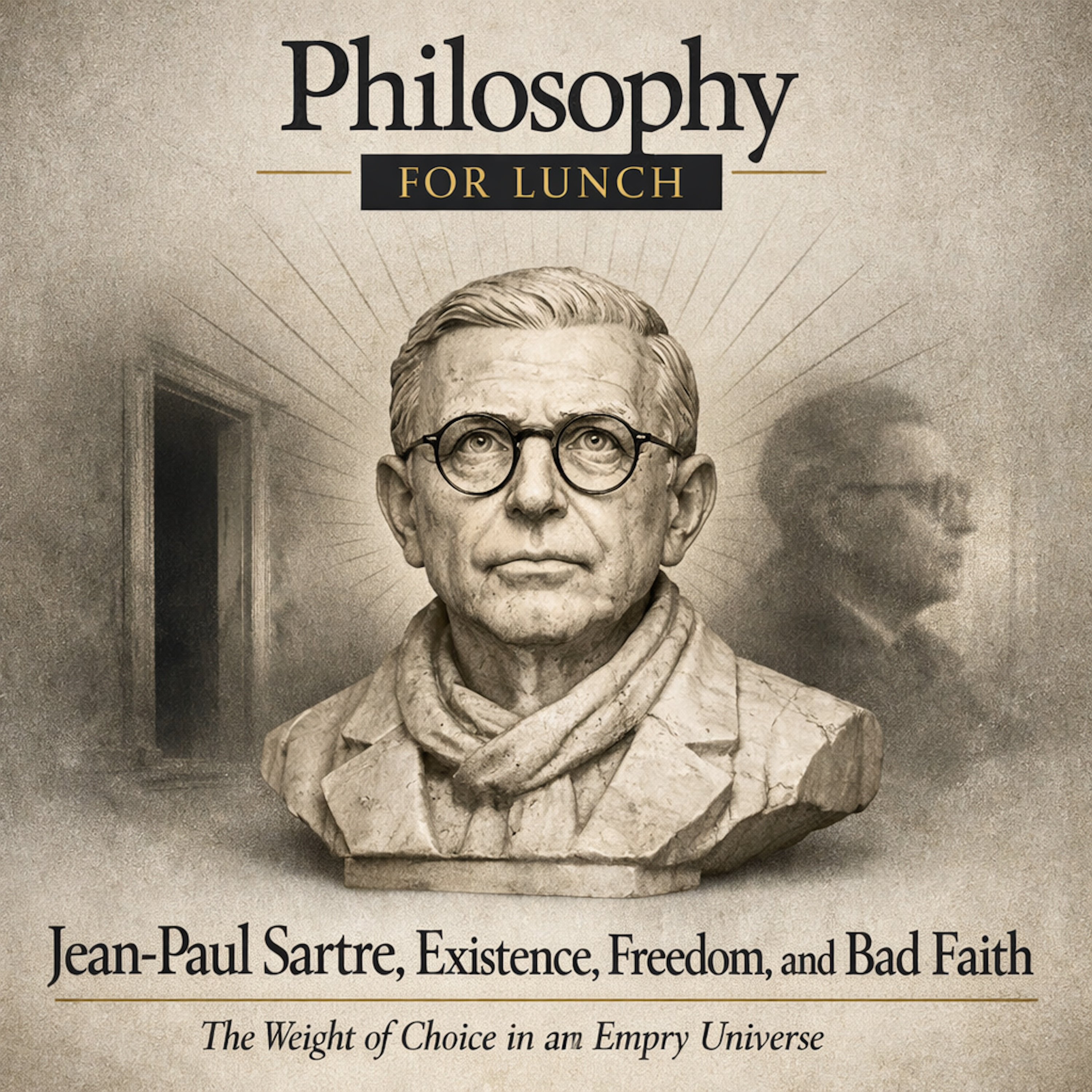
Episode #021 - Sartre: Existence, Freedom, and Bad Faith
There is a sentence that sounds simple and turns out to be one of the most destabilizing claims in the history of philosophy. Existence precedes essence. Four words. The argument embedded in them upends centuries of thinking about what human beings are and what kind of freedom we have. In this episode, Shawn and Claire give Sartre the fullest treatment of the show — the philosopher who gave existentialism its most systematic and most demanding form. They cover bad faith: the attempt to deny your own freedom by pretending to be a thing with a fixed nature rather than a subject with open possibilities. The waiter who has so thoroughly identified with his role that he seems to have become it. The person who says I cannot help it, that is just who I am — and in doing so, evades the responsibility that Sartre insists cannot finally be escaped. They also cover the Look — Sartre's account of how the gaze of another person transforms you, momentarily, into an object — and why, for Sartre, other people are simultaneously the source of our greatest threat and the only mirror in which genuine self-knowledge is possible. Hell is other people. But other people are also the point. The episode places Sartre in dialogue with de Beauvoir's correction — that freedom is always situated, always conditioned — and with what cognitive science has added to the picture of how much of what we do is shaped by processes outside conscious awareness. What survives all that is still one of the most powerful and personally demanding frameworks in the tradition. Shawn and Claire together. No prior philosophy required. SHOW NOTES Primary Sources Sartre, J.-P. (1992). Being and Nothingness: A Phenomenological Essay on Ontology (H. Barnes, Trans.). Washington Square Press. (Original work published 1943) Sartre, J.-P. (2007). Existentialism Is a Humanism (C. Macomber, Trans.). Yale University Press. (Original work published 1945) (The best short entry point — a single lecture that covers the core arguments accessibly.) Sartre, J.-P. (1989). No Exit and Three Other Plays (S. Gilbert, Trans.). Vintage. (Original work published 1944) Sartre, J.-P. (2007). Nausea (L. Alexander, Trans.). New Directions. (Original work published 1938) Biographical & Contextual Cohen-Solal, A. (1987). Sartre: A Life (A. Cancogni, Trans.). Pantheon Books. Rowley, H. (2005). Tête-à-Tête: Simone de Beauvoir and Jean-Paul Sartre. HarperCollins. Works Referenced in This Episode Heidegger, M. (2010). Being and Time (J. Stambaugh, Trans., rev. D. J. Schmidt). SUNY Press. (Original work published 1927) de Beauvoir, S. (2011). The Second Sex (C. Borde & S. Malovany-Chevallier, Trans.). Knopf. (Original work published 1949) Kierkegaard, S. (1980). The Concept of Anxiety (R. Thomte & A. B. Anderson, Trans.). Princeton University Press. (Original work published 1844) Accessible Starting Points Flynn, T. R. (2006). Existentialism: A Very Short Introduction. Oxford University Press. Wartenberg, T. E. (2008). Existentialism: A Beginner's Guide. Oneworld Publications. New episodes every Monday. Philosophy for Lunch · Big ideas. Human conversations.