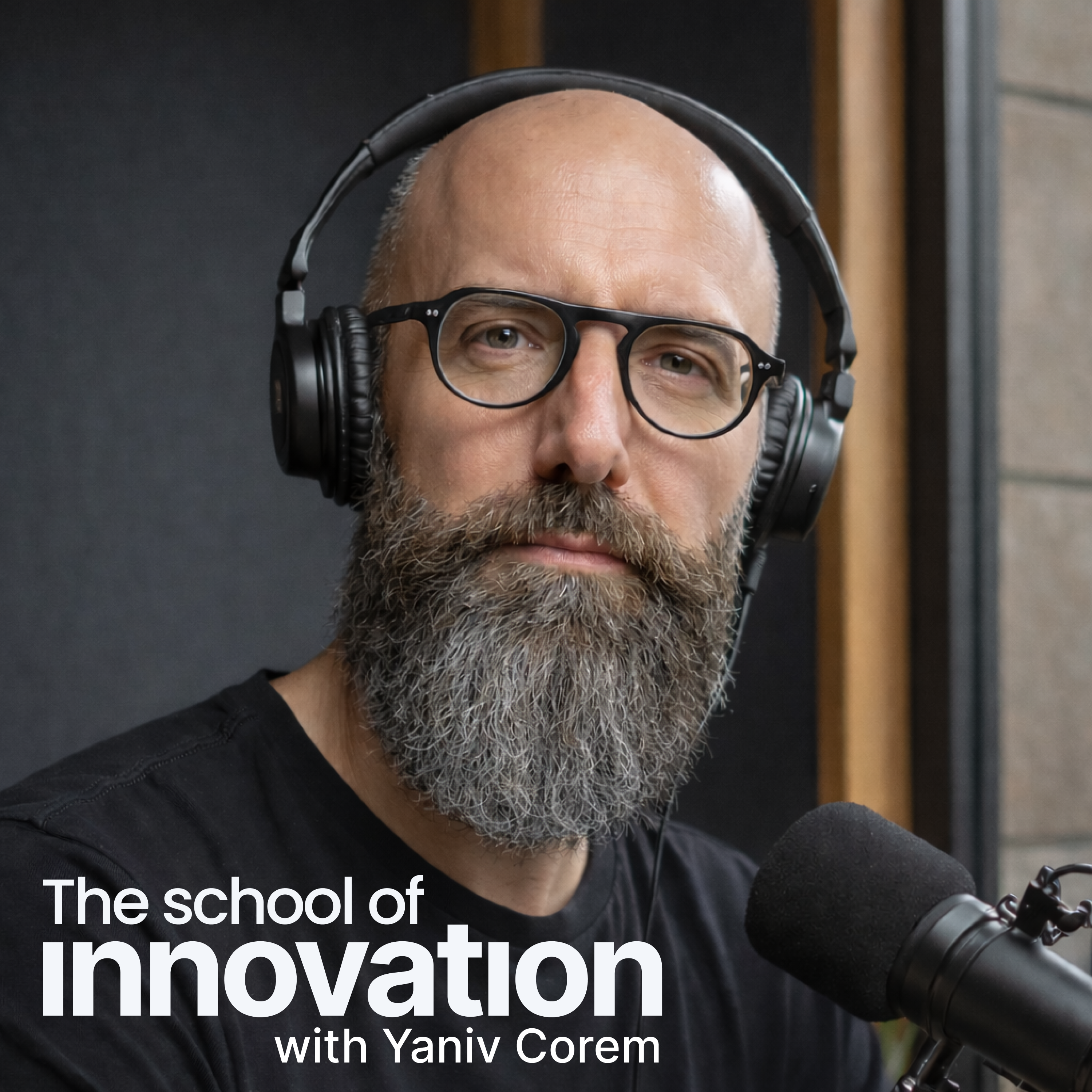
Most innovation content is junk food: flashy, addictive, and nutritionally empty. The School of Innovation is the opposite. Think less TED Talk, more operating manual. This podcast dissects how innovation actually works — inside accelerators, corporates, venture studios, and research labs — not how keynote speakers pretend it works. Because the uncomfortable truth is that most “innovation programs” aren’t engines of growth. They’re theater. Budget justification wrapped in sticky notes. Each episode features founders, operators, investors, and ecosystem builders who have the scars to prove they’ve done the work. Together, they unpack why good ideas die, why incentives matter more than vision, and why culture eats strategy, then hires consultants to explain the meal. You’ll hear conversations about: • Why most accelerators optimize for demo day, not outcomes • Why corporate innovation teams often exist to protect the core, not disrupt it • Why translating research into startups is less about technology and more about power, timing, and narrative • Why founders don’t need more inspiration — they need better systems This show is for people who build, fund, or manage innovation and are tired of motivational posters masquerading as strategy. Because innovation isn’t magic. It’s capital allocation, incentives, and execution — with a thin layer of storytelling on top. If you want inspiration, there are thousands of podcasts for that. If you want to understand how innovation really works, welcome to The School of Innovation .
Pitch Analysis
Required Pod Score for this show. PitchCentric checks your profile against host openness, topical fit, and audience signals before you generate a pitch.
Contact path
Verified email
Booking probability
28%
Guest openness
Selective
Verified email on file
80/100
Required Score
Sign up to generate a grounded pitch for The School of Innovation.
The School of Innovation is a general podcast hosted by Unknown Host, with 42 episodes on record and a Required Pod Score of 80. PitchCentric scores this show on Booking Probability, Listen Score, and live audience signals refreshed every 24 hours.
About the host
Unknown Host hosts The School of Innovation, a general show with 42 episodes published.
Our AI reads these to draft pitches. Use them as grounding for a pitch that cites a real guest and a specific topic.
Episode #42
Finding Success with Startup-Corporate Experiments
May 10, 202158 minS1
<p>Running a proof of concept between a startup and a corporate is notoriously hard. What does it take to make these experiments actually work? Jenny Wu and Roland Osborne from 500 Startups share their playbook for designing, running, and scaling successful startup-corporate POCs.</p><p></p><p><b>About Jenny Wu & Roland Osborne</b></p><p>Jenny Wu and Roland Osborne work at 500 Startups, one of the world's most active global venture capital firms and startup accelerators, with over 35 batch programs and a portfolio spanning more than 75 countries.</p><p></p><p><b>What We Cover</b></p>What makes...
<p>Why is innovation so natural when we’re kids — and so unnatural inside large organizations? That’s the central question Scott Anthony set out to answer in Eat Sleep Innovate. Scott breaks down what an innovation culture actually is, why habits matter more than beliefs, and how companies like DBS Bank and Singtel have built cultures where curious, collaborative behavior happens naturally.</p><p></p><p><b>About Scott Anthony</b></p><p>Scott Anthony is a Senior Partner at Innosight, the growth strategy firm co-founded by Clayton Christensen, and co-author of Eat Sleep Innovate. Based in Singapore since 2010, he has...
<p>2020 was a lot of things. For Yaniv, it was the year he stopped moving long enough to actually notice what he'd been missing — and the year he built something new from scratch. In this unedited solo episode, he shares three things COVID taught him, what it really takes to run a weekly podcast, and where the School of Innovation is headed in 2021.</p><p></p><p><b>What We Cover</b></p>Three things COVID taught Yaniv — about stillness, connection, and familyWhy boredom is a muscle worth training (even if he never practiced what he preached)How solitude made peop...
<p>When COVID-19 hit New York City in March 2020, Marcel Botha and a small consortium built a low-cost ventilator — SpiraWave — in just 30 days, shipping 3,000 units to the city. Marcel and Yaniv talk about compressing 18 months of product development into one month, and the philosophy behind building products that are technically bold and commercially viable.</p><p></p><p><b>About Marcel Botha</b></p><p>Marcel Botha is an entrepreneur, engineer, architect, and investor. Through his firm 10X Beta, he has helped medical professionals develop and commercialize products ranging from electronic stethoscopes to surgical instruments. He holds a master’s from M...
<p>In 2020, the UN World Food Programme won the Nobel Peace Prize — and its Innovation Accelerator was named by Fast Company as the best workplace for innovators. Yaniv speaks with Hila Cohen about how the WFP accelerator finds, funds, and scales innovations to fight global hunger across 88 countries.</p><p></p><p><b>About Hila Cohen</b></p><p>Hila Cohen is Head of Business Development and Chief of Staff at the WFP Innovation Accelerator. She joined WFP in 2012 and has been with the accelerator since 2015. Before WFP, she was a corporate lawyer in Tel Aviv. She holds an MBA fr...
Every question we get asked before someone starts their trial.
If you have a concern about deliverability, AI quality, data privacy, or whether this will actually work for your specific situation, it's probably answered below.
What is the difference between Founder Solo and Founder Pro?
Founder Solo gives you 50 AI pitches per month using the credit model (Standard pitches cost 1 credit, Enriched pitches cost 2). Founder Pro raises that to 200 credits per month and adds full Booking Probability access, unlimited Magic Match, Apollo enrichment credits, and data export capabilities. Both plans use the same credit system, so you can stretch your monthly budget further by using Standard-mode drafting.
How do agency tiers work?
Agency tiers have no base fee. You pay per managed client and per talent profile. Agency Standard is $199 per client per month; Agency Pro is $399 per client per month. Both add $39 per talent profile per month. Your own team's user seats are always free.
What is a talent profile?
A talent profile represents one person (founder, executive, or spokesperson) you are booking onto podcasts. It includes their bio, topics, headshots, and outreach history. Team plans include 5 profiles; agency plans are pay-as-you-go.
Can I switch plans later?
Yes, at any time. Upgrades take effect immediately; downgrades apply at the end of the current billing period. Contact support if you need help migrating between plan families.
Do you offer a free trial?
Every paid plan includes a 15-day free trial. Your card is saved at signup but you will not be charged until day 16. Cancel any time from your dashboard.
What happens if I cancel?
You keep access until the end of your current billing period. No charges after that. Your data is retained for 30 days in case you reactivate.
Is the 20% annual discount automatic?
Yes. Select Annual on the pricing toggle and the discounted price is applied automatically at checkout. The annual price shown is the full year cost.
What if I have more than 50 profiles or 20 clients?
That is our Enterprise tier. Contact our sales team and we will build a custom plan with volume pricing, a dedicated account manager, and SLA guarantees.