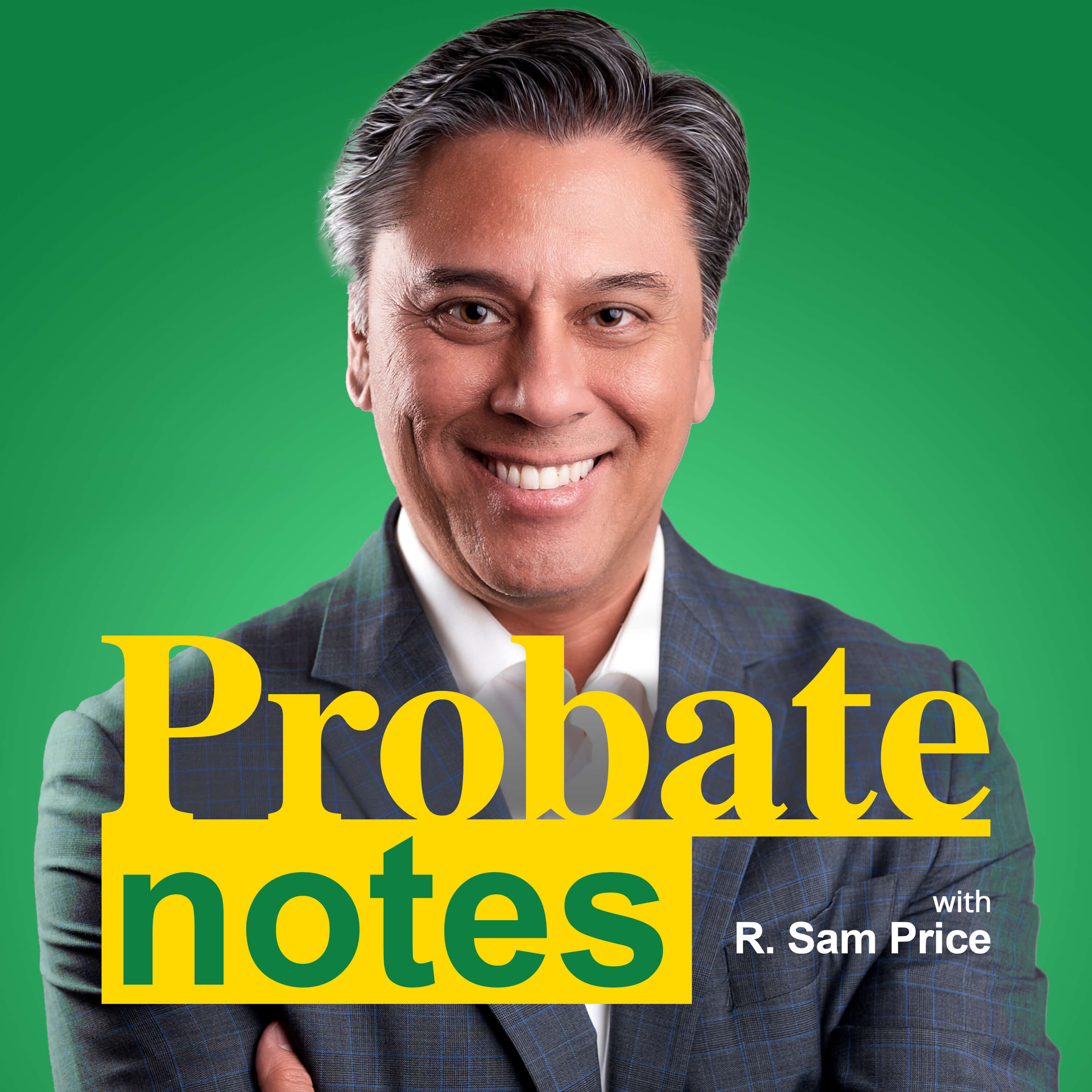
Welcome to Probate Notes, your go-to podcast for navigating the complexities of California probate law. Hosted by R. Sam Price, a seasoned probate attorney, Certified Specialist in Estate Planning, Trust, and Probate Law by the State Bar of California Board of Legal Specialization, and author of The 6-Stage Probate Process, this podcast breaks down probate practice with expert insights, practical strategies, and real-world solutions for attorneys, paralegals, fiduciaries, and professionals in the probate industry.Each episode dives into key topics, from foundational probate concepts to advanced litigation strategies, helping you master the nuances of probate practice. Whether it's fixing court examiner deficiencies, tackling probate litigation, or staying ahead of legislative updates, you'll get actionable guidance to streamline your cases and elevate your expertise.Expect guest interviews with top probate attorneys, fiduciaries, and legal experts, as well as a dedicated segment answ
Pitch Analysis
Required Pod Score for this show. PitchCentric checks your profile against host openness, topical fit, and audience signals before you generate a pitch.
Contact path
Verified email
Booking probability
33%
Guest openness
Selective
Verified email on file
80/100
Required Score
Sign up to generate a grounded pitch for Probate Notes: Your Guide to Navigating California Probate Law.
What is Probate Notes: Your Guide to Navigating California Probate Law?
Probate Notes: Your Guide to Navigating California Probate Law is a education podcast hosted by R. Sam Price, with 59 episodes on record and a Required Pod Score of 80.
About the host
R. Sam Price hosts Probate Notes: Your Guide to Navigating California Probate Law, a education show with 59 episodes published.
Our AI reads these to draft pitches. Use them as grounding for a pitch that cites a real guest and a specific topic.
Episode #58
058: How Law Firms Can Use Full-Time Virtual Assistants to Handle Intake, Drafting, and Litigation Support with Matthew Crider
Sep 22, 202639 min
Hiring help does not have to blow up your margins or your sanity. We hear how estate planning attorney Matthew Crider turned early frustrations with outsourced reception and bookkeeping into a deliberate system for working with virtual assistants, and eventually into co-founding Traba Legal. He and Sam walk through the real cost pressures of hiring in California, the challenges of finding qualified local staff, and why overseas VAs can be a strong fit for law firms when handled thoughtfully. Listeners learn how to think through the right first role for a VA, how to integrate remote team members into firm culture, and how a clear hiring and management structure can free lawyers to focus on higher‑value legal work. In this episode, you will hear: Cost pressures and hiring challenges for small California law firms Moving from agencies and platforms to directly managed virtual assistants Why Traba Legal focuses on full-time VAs based in the Philippines Traba Legal's five-step vetting and skills testing process for candidates Building culture and accountability with remote team members through daily huddles and meetings Resources from this Episode https://trabalegal.com https://legacylawsolutions.net/matthew-crider The 6-Stage Probate Process: How to Navigate California Probate: https://a.co/d/82310Rw Follow and Review: We'd love for you to follow us if you haven't yet. Click that purple '+' in the top right corner of your Apple Podcasts app. We'd love it even more if you could drop a review or 5-star rating over on Apple Podcasts . Simply select "Ratings and Reviews" and "Write a Review" then a quick line with your favorite part of the episode. It only takes a second and it helps spread the word about the podcast. Episode Credits If you like this podcast and are thinking of creating your own, consider talking to my producer, Emerald City Productions. They helped me grow and produce the podcast you are listening to right now. Find out more at https://emeraldcitypro.com . Let them know we sent you.
057: Understanding the Uniform Prudent Investor Act with Jeremy Lau
Sep 15, 202642 min
Sam Price sits down with Jeremy Lau of Prudent Investors to unpack what happens the moment a successor trustee inherits an investment portfolio. Most fiduciaries know they have a job to do. Few understand the Uniform Prudent Investor Act actually governs how they do it, from diversification to tax sensitivity to monitoring costs that never show up on a brokerage statement. Jeremy walks through the hidden expense ratios buried inside mutual funds, why a trading program with hundreds of tiny positions can quietly balloon trust accounting fees into the tens of thousands, and what separates a financial advisor who protects a fiduciary from one who leaves them exposed. He also breaks down risk tolerance as two distinct factors, not one, and explains why an investment policy statement matters more than most successor trustees realize. This episode hands fiduciaries a checklist they didn't know they needed. In this episode, you will hear: What a successor trustee actually inherits when a settlor passes away The Uniform Prudent Investor Act and why it applies to fiduciaries, not financial advisors Risk tolerance as two separate factors, ability and willingness, not one Hidden costs inside mutual funds and ETFs that never appear on a brokerage statement How a trading program with hundreds of tiny positions can balloon trust accounting fees Why an investment policy statement protects a fiduciary who delegates investment decisions What to look for when choosing a financial advisor to manage trust assets Resources from this Episode https://www.prudentinvestors.com The 6-Stage Probate Process: How to Navigate California Probate: https://a.co/d/82310Rw Follow and Review: We'd love for you to follow us if you haven't yet. Click that purple '+' in the top right corner of your Apple Podcasts app. We'd love it even more if you could drop a review or 5-star rating over on Apple Podcasts . Simply select "Ratings and Reviews" and "Write a Review" then a quick line with your favorite part of the episode. It only takes a second and it helps spread the word about the podcast. Episode Credits If you like this podcast and are thinking of creating your own, consider talking to my producer, Emerald City Productions. They helped me grow and produce the podcast you are listening to right now. Find out more at https://emeraldcitypro.com . Let them know we sent you.
056: Isolation, Undue Influence, and Elder Financial Abuse with Tim Abrahams
Sep 9, 202642 min
Tim Abrahams, a retired Los Angeles County Sheriff's investigator who now runs Silver Bison Consulting, joins Sam Price to unpack how elder financial abuse actually unfolds. Tim spent years chasing fraud and title theft cases, and he explains why so many families get turned away at the police counter with the words "this is a civil matter." That single phrase, he says, has let countless cases die before they ever reach a detective's desk. Tim walks through the real patterns behind these crimes: isolation, sudden spending spikes, forged deeds, stolen notary stamps. He shares specific case details, including a stolen vacant lot sold through a fake ID, and explains how his reports help families get law enforcement to actually listen. Families dealing with suspected elder abuse will find a clear roadmap here, straight from someone who investigated these cases for thirty years. In this episode, you will hear: Tim Abrahams' path from LA County Sheriff's investigator to founding Silver Bison Consulting Why "this is a civil matter" sends so many elder abuse cases nowhere The common thread in these cases isolation from family and friends How caretakers escalate from small withdrawals to full financial control Red flags in bank records, deed transfers, and sudden spending changes A real case involving a stolen notary stamp and a fraudulent property sale How Tim builds reports that give families a real shot with law enforcement Resources from this Episode The 6-Stage Probate Process: How to Navigate California Probate: https://a.co/d/82310Rw silverbison.net linkedin.com/in/timothy-abrahams-666309288/ Follow and Review: We'd love for you to follow us if you haven't yet. Click that purple '+' in the top right corner of your Apple Podcasts app. We'd love it even more if you could drop a review or 5-star rating over on Apple Podcasts . Simply select "Ratings and Reviews" and "Write a Review" then a quick line with your favorite part of the episode. It only takes a second and it helps spread the word about the podcast. Episode Credits If you like this podcast and are thinking of creating your own, consider talking to my producer, Emerald City Productions. They helped me grow and produce the podcast you are listening to right now. Find out more at https://emeraldcitypro.com . Let them know we sent you.
055: What Really Happens to Retirement Accounts in Probate with Ryan Holloway
Aug 11, 202647 min
Probate planning gets much more complicated once retirement accounts and real families enter the picture. Financial advisor Ryan Holloway, AWMA® explains how beneficiary designations control where the accounts go, what happens when a spouse rolls funds into her own IRA, and how required minimum distributions and age rules (59½ and 73) affect withdrawals and penalties. Ryan breaks down traditional vs. Roth accounts, why the IRS only cares when money goes in or comes out, and how tax-deferred growth can significantly extend wealth. We also cover the 10-year payout rule for non-spouse beneficiaries, key exceptions, and how poor planning can push children into higher tax brackets. Listeners come away with a clearer picture of how retirement accounts, step-up in basis, and trust planning all fit together in real probate work. In this episode, you will hear: How retirement accounts pass from a deceased spouse to a surviving spouse Rolling employer plans into an IRA and what that changes for control and taxes Traditional vs. Roth retirement accounts and how contributions and withdrawals are taxed Required minimum distributions, age rules, and early withdrawal penalties How capital gains work inside retirement accounts vs. taxable accounts Non-spouse beneficiaries, the 10-year rule, and key exceptions for minors and disabled heirs Using trusts, step-up in basis, and planning for real estate and cash accounts as part of an overall inheritance plan Resources from this Episode https://www.edwardjones.com/us-en/financial-advisor/ryan-holloway The 6-Stage Probate Process: How to Navigate California Probate: https://a.co/d/82310Rw Follow and Review: We'd love for you to follow us if you haven't yet. Click that purple '+' in the top right corner of your Apple Podcasts app. We'd love it even more if you could drop a review or 5-star rating over on Apple Podcasts . Simply select "Ratings and Reviews" and "Write a Review" then a quick line with your favorite part of the episode. It only takes a second and it helps spread the word about the podcast. Episode Credits If you like this podcast and are thinking of creating your own, consider talking to my producer, Emerald City Productions. They helped me grow and produce the podcast you are listening to right now. Find out more at https://emeraldcitypro.com . Let them know we sent you.
054: Avoiding Problems When Naming Charities in Your California Probate Plan with Brie Griset Smith
Aug 4, 202635 min
Most clients know which causes they love — but not how to make that generosity work for decades after they're gone. In this conversation, we hear guest Brie Griset Smith, CSPG, Chief Development Officer at the Inland Empire Community Foundation (IECF), explain how community foundations turn charitable wishes into long-term, workable plans. We explore why naming a specific charity in a will or trust can backfire if the organization — or even the cause — disappears, and how IECF's variance power keeps gifts aligned with donor intent without going back to court. We walk through donor options such as scholarship funds, field-of-interest funds, and endowed funds with a 4% spending policy, plus how memoranda of intent and successor advisors help families involve future generations. Listeners learn how attorneys and IECF can team up so clients gain deeper, more flexible charitable plans while professionals expand the level of service they provide. In this episode, you will hear: Risks of naming specific charities in estate planning if the nonprofit or cause disappears How the Inland Empire Community Foundation uses variance power to honor donor intent Comparing direct charitable bequests to using funds at a community foundation Scholarship, field-of-interest, donor advised, and endowed funds as options for clients Memoranda of intent as living documents that capture detailed charitable wishes Successor advisors and involving children or grandchildren in ongoing family giving IECF's 85th anniversary goals and its partnerships with nonprofits and legal professionals Resources from this Episode https://www.iegives.org/ The 6-Stage Probate Process: How to Navigate California Probate: https://a.co/d/82310Rw Follow and Review: We'd love for you to follow us if you haven't yet. Click that purple '+' in the top right corner of your Apple Podcasts app. We'd love it even more if you could drop a review or 5-star rating over on Apple Podcasts . Simply select "Ratings and Reviews" and "Write a Review" then a quick line with your favorite part of the episode. It only takes a second and it helps spread the word about the podcast. Episode Credits If you like this podcast and are thinking of creating your own, consider talking to my producer, Emerald City Productions. They helped me grow and produce the podcast you are listening to right now. Find out more at https://emeraldcitypro.com . Let them know we sent you.
Every question we get asked before someone starts their trial.
If you have a concern about deliverability, AI quality, data privacy, or whether this will actually work for your specific situation, it's probably answered below.
What is the difference between Founder Solo and Founder Pro?
Founder Solo gives you 50 AI pitches per month using the credit model (Standard pitches cost 1 credit, Enriched pitches cost 2). Founder Pro raises that to 200 credits per month and adds full Booking Probability access, unlimited Magic Match, Apollo enrichment credits, and data export capabilities. Both plans use the same credit system, so you can stretch your monthly budget further by using Standard-mode drafting.
How do agency tiers work?
Agency tiers have no base fee. You pay per managed client and per talent profile. Agency Standard is $199 per client per month; Agency Pro is $399 per client per month. Both add $39 per talent profile per month. Your own team's user seats are always free.
What is a talent profile?
A talent profile represents one person (founder, executive, or spokesperson) you are booking onto podcasts. It includes their bio, topics, headshots, and outreach history. Team plans include 5 profiles; agency plans are pay-as-you-go.
Can I switch plans later?
Yes, at any time. Upgrades take effect immediately; downgrades apply at the end of the current billing period. Contact support if you need help migrating between plan families.
Do you offer a free trial?
Every paid plan includes a 15-day free trial. Your card is saved at signup but you will not be charged until day 16. Cancel any time from your dashboard.
What happens if I cancel?
You keep access until the end of your current billing period. No charges after that. Your data is retained for 30 days in case you reactivate.
Is the 20% annual discount automatic?
Yes. Select Annual on the pricing toggle and the discounted price is applied automatically at checkout. The annual price shown is the full year cost.
What if I have more than 50 profiles or 20 clients?
That is our Enterprise tier. Contact our sales team and we will build a custom plan with volume pricing, a dedicated account manager, and SLA guarantees.