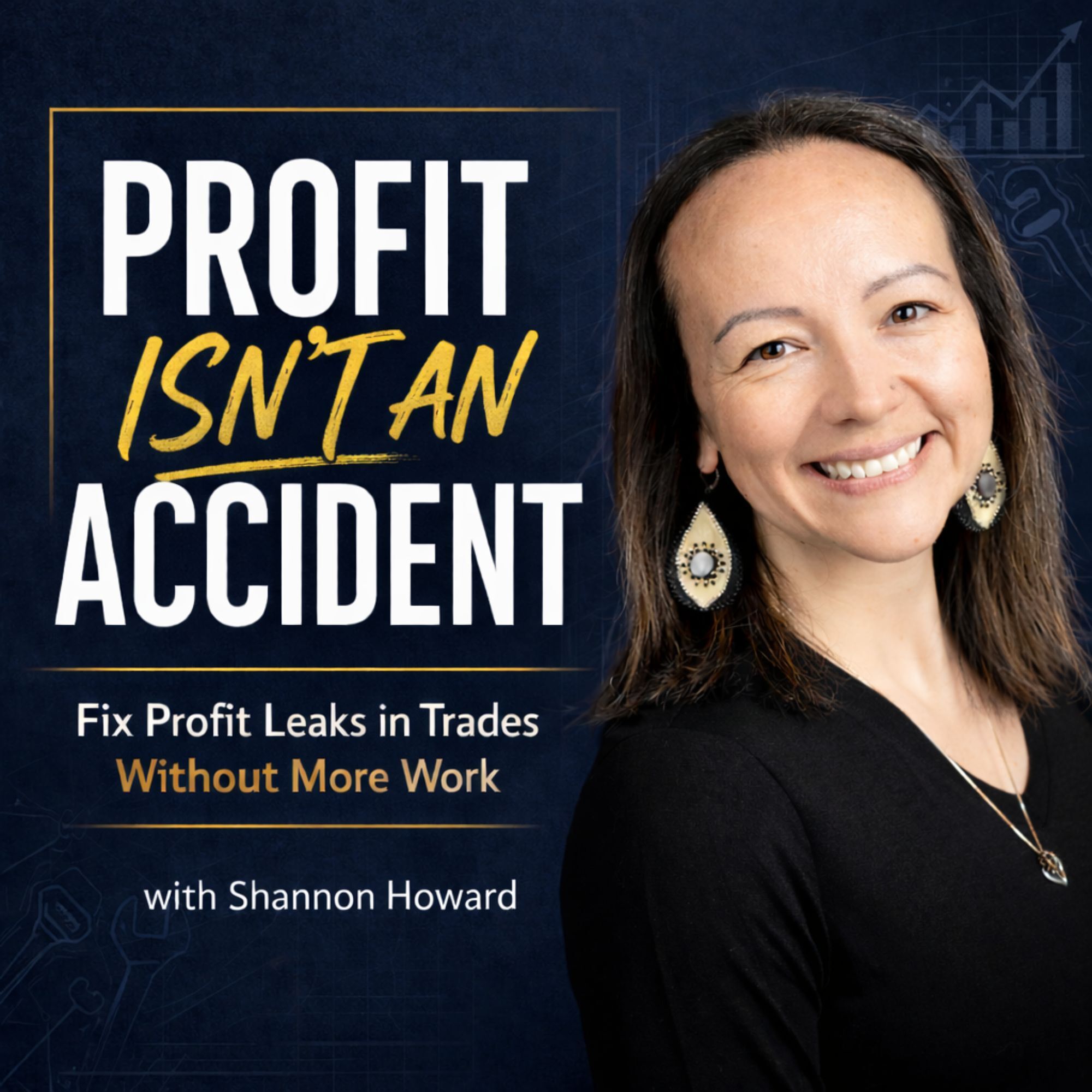
Most trades businesses aren’t struggling because of a lack of work. They’re struggling because they can’t see where their money is going. Profit Isn’t an Accident is for HVAC, electricians, plumbers, and contractors who are busy, booked out, and still not seeing the money reflect the effort. Shannon Howard helps trades business owners find hidden profit, fix money leaks, and make better financial decisions without working more or chasing more jobs. If your business feels busy but not profitable, this show will help you understand why; and what to do about it.
Pitch Analysis
Required Pod Score for this show. PitchCentric checks your profile against host openness, topical fit, and audience signals before you generate a pitch.
Contact path
Public web form
Booking probability
31%
Guest openness
Selective
80/100
Required Score
Sign up to generate a grounded pitch for Profit Isn’t an Accident | Contractor Profitability, Cash Flow Management, Job Costing , Business Growth, Small Business Finance.
What is Profit Isn’t an Accident | Contractor Profitability, Cash Flow Management, Job Costing , Business Growth, Small Business Finance?
Profit Isn’t an Accident | Contractor Profitability, Cash Flow Management, Job Costing , Business Growth, Small Business Finance is a business podcast hosted by Unknown Host, with 50 episodes on record and a Required Pod Score of 80.
About the host
Unknown Host hosts Profit Isn’t an Accident | Contractor Profitability, Cash Flow Management, Job Costing , Business Growth, Small Business Finance, a business show with 50 episodes published.
Our AI reads these to draft pitches. Use them as grounding for a pitch that cites a real guest and a specific topic.
Episode #51
051. $1 Million in Revenue and Still Broke? Where the Money Actually Goes in a Contractor Business
Sep 29, 202622 min
You hit $1 million in revenue. The crews are busy. The trucks are moving. Jobs are getting completed. So why does the bank account still feel empty? In this episode of Profit Isn’t an Accident, we break down where the money actually goes inside a contractor business and why strong revenue does not automatically mean strong cash flow. We walk through a real-world $1 million contractor example and follow the money through direct job costs, gross profit, overhead, debt payments, taxes, accounts receivable, retainage, and owner compensation. You’ll also learn why a business can show a profit on paper and still feel cash-starved, how growth can actually make the problem worse, and why job costing and collections matter just as much as sales. This episode is for the contractor who is doing real revenue, staying busy, and still wondering where the money went. Your homework: Pull your year-to-date numbers and look at your revenue, gross profit, gross margin, overhead, accounts receivable, cash balance, monthly debt payments, and tax reserves. Then review your last five completed jobs and compare what you expected to make against what you actually made. If you’re tired of doing strong revenue and still feeling like cash is always tight, book a free Profit Acceleration Session with Denali Edge Consulting: www.denaliedgeconsulting.com/pas Own your business. Live your life.
050. If You Can’t Leave Your Business for a Week, You Don’t Own a Business Yet
Sep 24, 202610 min
Your business is making money. You have employees. Customers are calling. From the outside, it looks successful. But what happens if you leave for seven days? If your phone blows up, decisions stop getting made, jobs get held up, and nobody knows what to do without you, your business has a bigger problem than needing better delegation. In this episode of Profit Isn’t an Accident, Shannon Howard breaks down how business owners accidentally build companies that depend entirely on them and why simply growing revenue won't fix it. You'll learn how owner dependency shows up through your people, processes, decisions, and financial visibility, plus a simple Seven-Day Test you can do this week to uncover exactly where your business still depends on you. The goal isn't to build a business that doesn't need an owner. It's to build one that doesn't need you every minute of every day. Your homework: Pretend you're leaving tomorrow for seven days with no phone or laptop. Write down everything that makes you nervous about leaving. Pick one thing from that list and start there. Own your business. Live your life. If this episode hit home, follow Profit Isn’t an Accident, leave a rating or review, and share this episode with another business owner who needs to hear it. Ready to figure out what's keeping you stuck? Book a Profit Acceleration Session with Denali Edge Consulting.
049. Your Best Customer Might Be Costing You Money
Sep 22, 202610 min
Your Best Customer Might Be Costing You Money Your biggest customer may not actually be your best customer. A customer can keep your crews busy, bring in hundreds of thousands of dollars in revenue and still quietly drain your profit and cash. In this episode of Profit Isn’t an Accident, Shannon breaks down the five things every business owner should examine before calling someone a great customer: Their actual margin How quickly they pay How much extra work you give away How much of your capacity they control What better opportunities they may be keeping you from taking You will also hear the one question that can completely change how you evaluate your largest accounts: If this customer disappeared tomorrow, would you need to replace their revenue or replace their profit? Those are two very different numbers. If you are busy, bringing in revenue and still wondering where the money is going, there may be profit leaks hiding inside the customers, jobs and decisions you assume are helping your business. Ready to find out what is actually happening inside your business? Book a complimentary Profit Acceleration Session with Denali Edge Consulting. We will look at where your business stands today, what may be holding back your profit and cash, and what needs to change next. Book your Profit Acceleration Session here: www.denaliedgeconsulting.com/pas Own your business. Live your life.
048. Booked Out for Months? That Doesn’t Mean Your Business Is Healthy
Sep 17, 202615 min
Being booked out for months sounds like success. The trucks are moving. The schedule is packed. Revenue is climbing. Customers are waiting weeks to get on the calendar. But what if all that work is actually making your business weaker? In this episode of Profit Isn’t an Accident, Shannon breaks down why a full schedule does not automatically mean you have a healthy business. You’ll hear how being booked out can hide pricing problems, bad job margins, cash flow issues, an overloaded team, poor customer experience, and a business that depends way too much on the owner. Shannon also walks you through a simple Backlog Health Check so you can look at the work already on your books and ask five important questions: Is it profitable? Do you actually have the capacity to deliver it? Do you have enough cash to fund it? Are your customers still getting a great experience? And how much of it still depends on you? Because being busy is not the goal. Building a healthy, profitable business that gives you income, freedom, time, and your life back is. Own your business. Live your life.
047. How Much Cash Should a Contractor Keep in the Bank?
Sep 15, 20269 min
How much cash should your contracting business actually keep in the bank? $10,000? $50,000? Three months of expenses? There isn’t one magic number that works for every contractor. Your ideal cash reserve depends on how quickly customers pay, your overhead, payroll, seasonality, upcoming obligations, and how much risk your business needs to absorb. In this episode of Profit Isn’t an Accident, Shannon breaks down how to determine your business’s cash floor and why the number you see in your bank account is NOT necessarily the amount of cash you actually have available. You’ll learn: • Why a healthy bank balance can give contractors a false sense of security • The difference between cash in the bank and cash that is actually available • How accounts receivable impacts your true cash position • Why your cash cycle matters when setting a reserve • How payroll, materials, debt, taxes, and overhead affect your cash needs • Why two to three months of core operating expenses can be a useful starting point, but not a universal rule • How to establish a cash floor for your business • When taking owner distributions makes sense and when it can create a cash problem YOUR HOMEWORK: Calculate your true monthly core operating expenses. Determine your cash cycle. How long is it from the time you spend money doing the work until the customer's money actually reaches your bank account? Establish your cash floor. Decide how much cash your business should maintain before you stop, evaluate, and make intentional decisions about spending. Cash reserves aren't about hoarding money. They're about buying yourself time to make good decisions when something doesn't go according to plan. Because desperate business owners make expensive decisions. If your business is generating serious revenue but you're still worried about payroll, cash flow, or where all the money is going, Denali Edge Consulting helps business owners uncover what's actually happening beneath the numbers. Own your business. Live your life.
Recent guests on Profit Isn’t an Accident | Contractor Profitability, Cash Flow Management, Job Costing , Business Growth, Small Business Finance. Study who booked and why before you pitch.
Best industries to pitch Profit Isn’t an Accident | Contractor Profitability, Cash Flow Management, Job Costing , Business Growth, Small Business Finance for
Based on semantic analysis of episode topics and host coverage, this show is a strong guest fit for executives in:
Businessstrong
Industry fit is computed by PitchCentric using vector embeddings of the show's episode catalog.
Podcasts like Profit Isn’t an Accident | Contractor Profitability, Cash Flow Management, Job Costing , Business Growth, Small Business Finance
Every question we get asked before someone starts their trial.
If you have a concern about deliverability, AI quality, data privacy, or whether this will actually work for your specific situation, it's probably answered below.
What is the difference between Founder Solo and Founder Pro?
Founder Solo gives you 50 AI pitches per month using the credit model (Standard pitches cost 1 credit, Enriched pitches cost 2). Founder Pro raises that to 200 credits per month and adds full Booking Probability access, unlimited Magic Match, Apollo enrichment credits, and data export capabilities. Both plans use the same credit system, so you can stretch your monthly budget further by using Standard-mode drafting.
How do agency tiers work?
Agency tiers have no base fee. You pay per managed client and per talent profile. Agency Standard is $199 per client per month; Agency Pro is $399 per client per month. Both add $39 per talent profile per month. Your own team's user seats are always free.
What is a talent profile?
A talent profile represents one person (founder, executive, or spokesperson) you are booking onto podcasts. It includes their bio, topics, headshots, and outreach history. Team plans include 5 profiles; agency plans are pay-as-you-go.
Can I switch plans later?
Yes, at any time. Upgrades take effect immediately; downgrades apply at the end of the current billing period. Contact support if you need help migrating between plan families.
Do you offer a free trial?
Every paid plan includes a 15-day free trial. Your card is saved at signup but you will not be charged until day 16. Cancel any time from your dashboard.
What happens if I cancel?
You keep access until the end of your current billing period. No charges after that. Your data is retained for 30 days in case you reactivate.
Is the 20% annual discount automatic?
Yes. Select Annual on the pricing toggle and the discounted price is applied automatically at checkout. The annual price shown is the full year cost.
What if I have more than 50 profiles or 20 clients?
That is our Enterprise tier. Contact our sales team and we will build a custom plan with volume pricing, a dedicated account manager, and SLA guarantees.