Episode #10
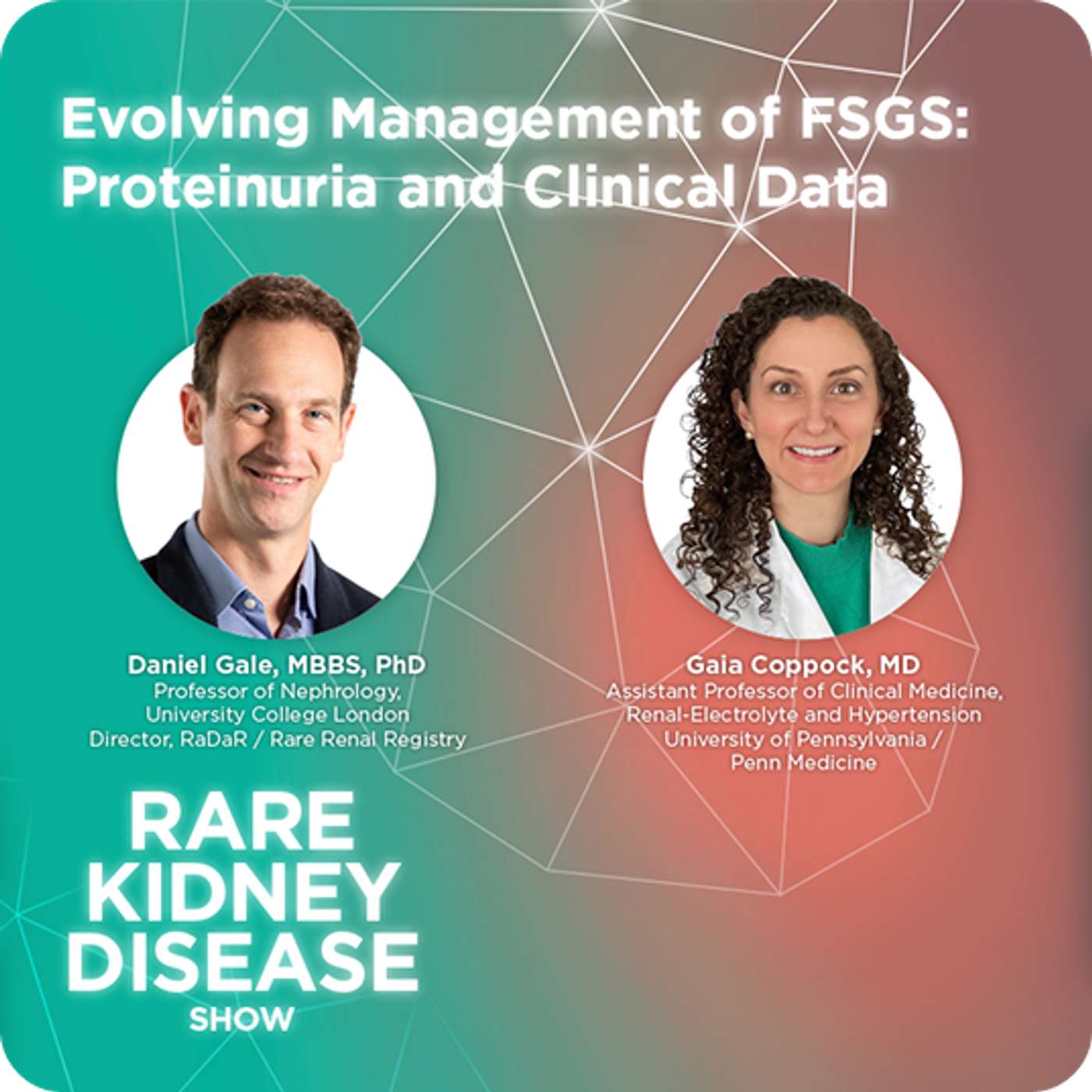
Evolving Management of FSGS: Proteinuria and Clinical Data with Drs. Daniel Gale and Gaia Coppock
Welcome to Travere Therapeutics’ Rare Kidney Disease Show podcast, where rare kidney disease gets a spotlight. Host Dr. Chris Gisler, Senior Medical Director at Travere Therapeutics, is joined by Dr. Daniel Gale and Dr. Gaia Coppock for a practical and evidence driven conversation on FSGS, proteinuria, and what recent evidence means for clinical decision-making. In this episode, Dr. Gaia Coppock reflects on how the heterogeneous nature of focal segmental glomerular sclerosis (FSGS) has historically been challenging for clinicians and highlights we are working towards a new era of research, diagnosis, and therapeutics. From there, the discussion focuses on FSGS as a podocytopathy, outlining different triggering events that converge on podocyte injury and shared downstream pathways. Dr. Daniel Gale goes on to discuss how RaDaR, PARASOL, and other real-world datasets have helped clarify the relationship between proteinuria remission, and long-term kidney outcomes. The conversation also explores the clinical implications of the Phase 3 DUPLEX study. Dr. Coppock reviews the study design and key findings, including rapid and sustained reductions in proteinuria, data on complete remission, safety profiles, and the challenges of interpreting estimated glomerular filtration rate (eGFR) slope in a complex and heterogeneous condition like FSGS. Together, experts reflect on where FSGS care is heading, underscoring the importance of targeting lower proteinuria thresholds, improving diagnostic precision, and adopting multi-targeted approaches. Speakers: Dr. Chris Gisler is a medical director at Travere Therapeutics and an adult Nephrologist Dr. Daniel Gale, MBBS, PhD (Professor of Nephrology, University College London. Director, RaDaR/Rare Renal Registry) Dr. Gaia Coppock, MD (Assistant Professor of Clinical Medicine, Renal-Electrolyte and Hypertension. University of Pennsylvania/Penn Medicine) Key Takeaways: FSGS is a heterogeneous pattern of injury, not a single condition. FSGS can arise from multiple causes, which has historically made diagnosis, treatment, and clinical trial design difficult Proteinuria is one of the most important clinical signals in FSGS. RaDaR and PARASOL have helped validate what clinicians have long suspected: lower proteinuria targets matter, and proteinuria can serve as a meaningful predictor of disease activity and response DUPLEX helped clarify how proteinuria reduction in a clinical trial can be interpreted in FSGS, especially in a condition where eGFR slope can be difficult to assess because of heterogeneity, hyperfiltration, and variability in kidney function The future of FSGS care depends on pushing to achieve the lowest proteinuria targets possible while becoming more precise in diagnosis and treatment. The speakers highlight a shift toward multi-targeted approaches and a future where clinicians move beyond using FSGS as a broad label and toward more biology-driven care Key Quotes: “With podocyte-based diseases or diseases where the kidney damage is really focused on the filtration barrier, proteinuria really represents a very strong biomarker of disease activity, rather than simply a readout of how much damage has occurred in the kidney.” (6:06) “I think that clinicians should push harder with FSGS. You know, don't stop until you've exhausted all options and really push to get to the lowest proteinuria target possible.” (25:59) "I think the use of FSGS as a disease label is now really established to be doing more harm than good for many patients. It's the start of the diagnostic journey, not the end of it.” (26:27) Disclaimer: Guest speakers of the Rare Kidney Disease Show may be paid consultants of Travere Therapeutics. This podcast episode was recorded on June 9, 2026. Please always consult updated sources for the latest information, as information discussed may have changed since the recording date.