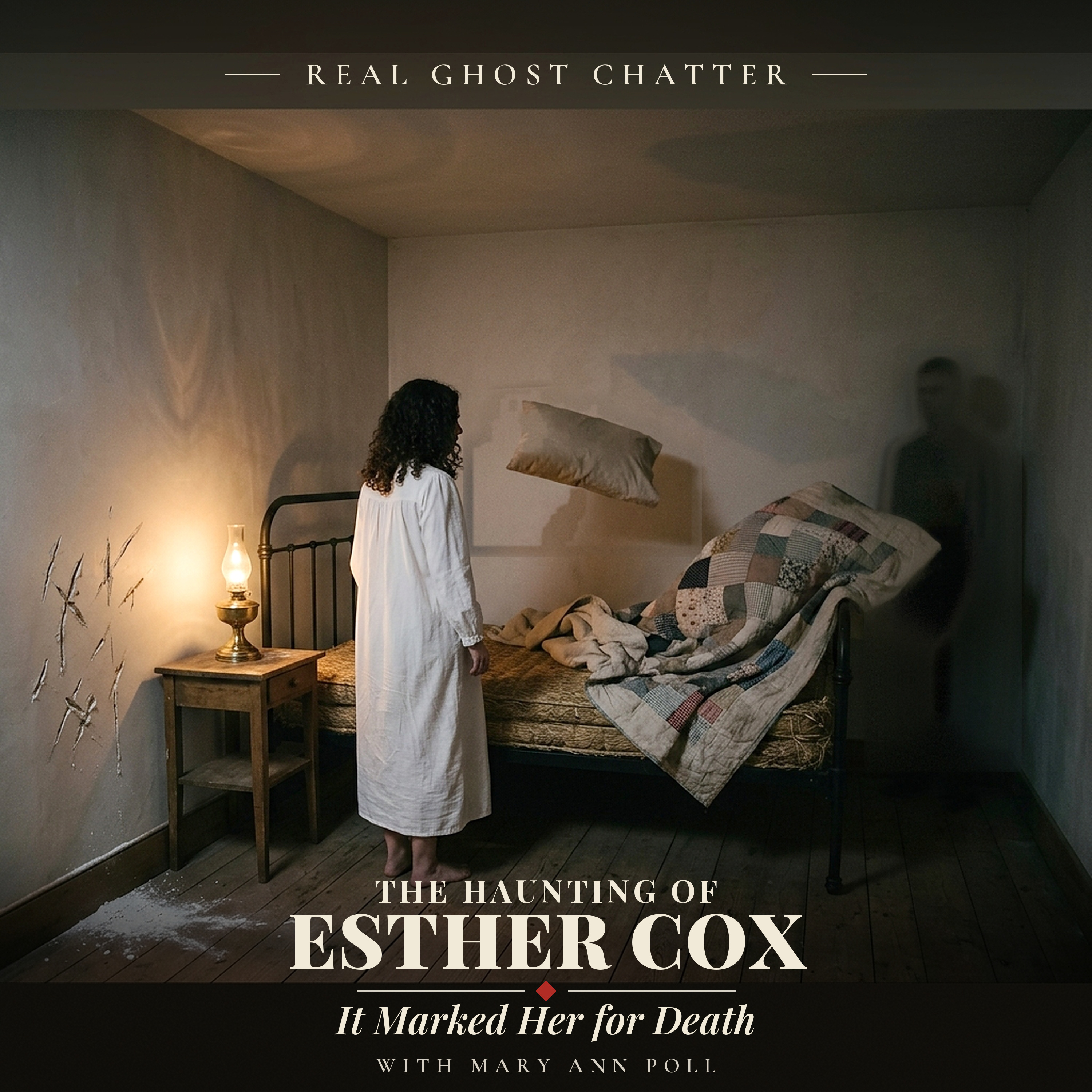
Episode #93
Episode 93: The Esther Cox Haunting: It Marked Her for Death
In September 1878, in a shoemaker's cottage on Princess Street in Amherst, Nova Scotia, something began to torment 18-year-old Esther Cox. It started with straw moving inside her mattress and a box that leaped off the floor. Within weeks the town doctor sat beside her bed and watched words appear, scored a foot high into the plaster of her wall: Esther Cox, you are mine to kill. What followed was set down by the people who lived through it, by that doctor, by two ministers and a newspaper editor, and by an actor who moved into the house to expose it as a fraud and kept a journal instead. Mary Ann Poll tells it as it happened, scene by scene, from the first night to the day it stopped. EPISODE NOTES ● Esther Cox is the through-line, followed from a frightening buggy ride in late August 1878 through the first night on September 4, the doctor's visits, the fires, her expulsion from the house, and the weeks Walter Hubbell spent living under the same roof in June 1879. ● Phenomena covered: straw shifting inside the mattress, a box of patchwork leaping a foot into the air, Esther's body swelling until she screamed she would burst, explosions under the bed that shook the floor, bedclothes torn off and flung into the corner, the writing on the wall, pounding that climbed onto the roof and followed Dr. Carritte 200 yards down the street, and a bucket of cold water that boiled in front of a minister. ● Then came the fires: eight to ten burning matches falling out of empty air, Esther's dress rolling itself under the bed and catching fire, a barrel of shavings blazing in the cellar, and a figure only Esther could see, laughing in the parlor corner, threatening to burn the house down if she stayed. ● It followed her to John White's dining saloon, where a stove door tore off its hinges in front of a provincial inspector of fisheries and a clasp knife twice drove itself into her back. ● Walter Hubbell came to put her on stage and expose the trick. Instead the knocks read out his watch number and a coin date he did not know himself, and a paperweight struck the sofa three inches from his head. The entity gave its name, Bob Nickle, a shoemaker, dead and not in heaven. ● The skeptical case is given its due: psychical researcher Walter Prince concluded Esther did it herself in a dissociated state, noting the ghost called Bob appeared a week after Bob McNeal drew his pistol on her. Against that stand the witnesses who were in the house before Hubbell ever arrived, and the 1888 statement signed by Amherst's citizens. ● After an arson conviction and a month in jail, it stopped for good. Esther married, raised two sons, and died in her own bed in Brockton, Massachusetts, on November 8, 1912. Bob Nickle never kept his promise. Approximately 3,030 spoken words. SCRIPTURE Isaiah 43:1 (NIV) — 'But now, this is what the Lord says, he who created you, Jacob, he who formed you, Israel: Do not fear, for I have redeemed you; I have summoned you by name; you are mine.' SOURCES ● Walter Hubbell, The Great Amherst Mystery: A True Narrative of the Supernatural (1879; tenth edition, Brentano's, 1916), including his journal kept in the Teed cottage, the 1888 affidavit, Dr. Carritte's letter, and the statement signed by the citizens of Amherst ● The Amherst Gazette and the Moncton Daily Times, 1878 to 1879, as reprinted in Hubbell ● Hereward Carrington, Personal Experiences in Spiritualism (1913), witness statements taken in 1907 ● Walter F. Prince, 'A Critical Study of The Great Amherst Mystery,' Proceedings of the American Society for Psychical Research, vol. 13 (1919)