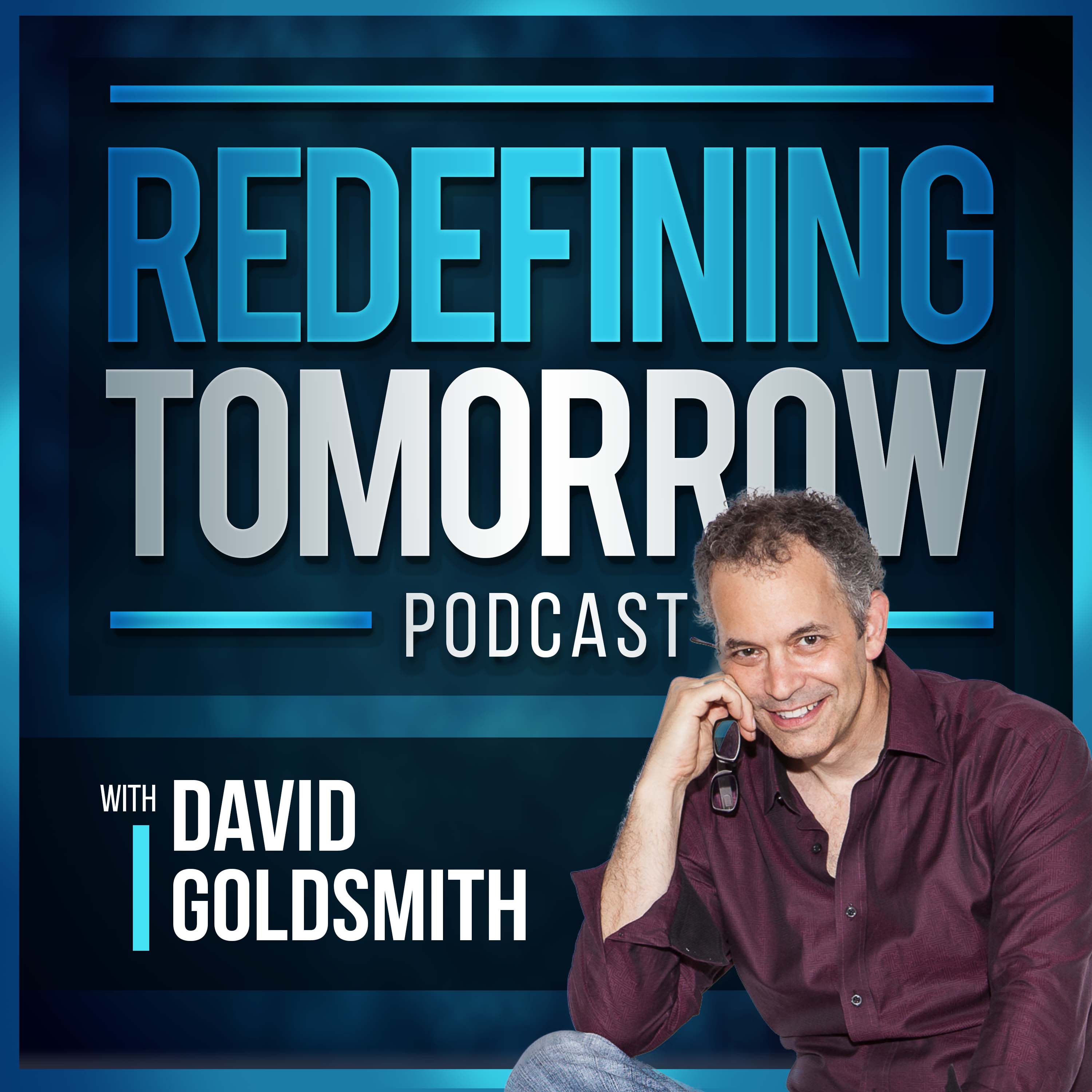
Redefining Tomorrow
Architecting Society’s Future with Michael Potter #33
Sep 20, 20262h 27m

Loading…
business
Hosted by David Goldsmith · business · EN · 29 episodes
Interviews with Amazing Individuals who are shaping the future and as a result they are Redefining Tomorrow
Required Pod Score for this show. PitchCentric checks your profile against host openness, topical fit, and audience signals before you generate a pitch.
Contact path
Public web form
Booking probability
19%
Guest openness
Selective
Sign up to generate a grounded pitch for Redefining Tomorrow.
Signup to Generate a PitchRedefining Tomorrow is a business podcast hosted by David Goldsmith, with 29 episodes on record and a Required Pod Score of 80.
David Goldsmith hosts Redefining Tomorrow, a business show with 29 episodes published.
Our AI reads these to draft pitches. Use them as grounding for a pitch that cites a real guest and a specific topic.
Redefining Tomorrow
Redefining Tomorrow
In This Episode In this episode of Redefining Tomorrow, Lawrence Williams joins David Goldsmith for a wide-ranging conversation about curiosity, career reinvention, and the unexpected paths that connect government, telecommunications, commercial space, autonomous aviation, and artificial intelligence. Rather than following a carefully planned career, Lawrence describes how each opportunity built upon the last—from Capitol Hill and the White House Office of Science and Technology Policy, to helping shape satellite communications, becoming one of SpaceX's earliest executives, supporting Tesla during its formative years, advancing life-saving drone delivery with Zipline, and now applying AI, computer vision, and sensor fusion to the future of mobility. Along the way, the discussion explores innovation, entrepreneurship, public policy, commercial space, autonomous systems, leadership, and why remaining curious often opens doors that careful planning alone never could. Episode Outlines How curiosity shaped an unexpected career Building a foundation in government and public policy The Information Superhighway and the early telecommunications revolution Helping build commercial space during SpaceX's formative years Working with NASA, the Department of Defense, and Washington Lessons from helping disruptive technologies become real businesses Zipline and using autonomous aircraft to save lives Artificial intelligence, computer vision, and the future of mobility Why regulation and innovation must evolve together Connecting purpose, opportunity, and lifelong learning Biography of the Guest Lawrence Williams has spent much of his career working at the intersection of emerging technology, government, entrepreneurship, and the challenge of turning ambitious ideas into businesses and systems that create real-world impact. His career began in Washington, D.C., where he served as a legislative assistant to U.S. Representative Ray Thornton on the House Committee on Science, Space and Technology. He later became a Special Assistant to the Administrator of the National Telecommunications and Information Administration and served on a Presidential Transition Team supporting the White House Office of Science and Technology Policy. Williams went on to become Vice President of International and Government Affairs for Teledesic, the satellite communications venture backed by Craig McCaw and Bill Gates, before serving as Senior Vice President of Business Development at ICO Global Communications. He subsequently joined SpaceX as one of its earliest executives, serving as Vice President for Strategic Relations, where he helped the company navigate NASA, the U.S. Department of Defense, Washington, and the emerging commercial space marketplace during its transformation from a startup into a major aerospace company. He also served as an advisor to Tesla Motors. Following SpaceX, Williams founded Capture10 and later helped lead global market development for Zipline, whose autonomous aircraft deliver blood, medicines, vaccines, and other essential medical supplies to remote communities around the world. He later founded Merlin Mobility, applying artificial intelligence, computer vision, and sensor fusion to improve vehicle safety and accessibility. Across government, telecommunications, commercial space, autonomous aviation, and mobility, a common thread runs through Williams' career: working where emerging technologies intersect with regulation, markets, infrastructure, and opportunities to solve problems at scale. He holds a bachelor's degree from the University of Colorado and an MBA with honors from Georgetown University. This is an episode of the Redefining Tomorrow podcast. Listen now on Podbean, Spotify, Apple Podcasts, and other major podcast platforms. Learn more at https://mearth.com , where we're expanding human thinking by exploring the ideas, people, and innovations shaping tomorrow.
Episode #31
In This Episode In this episode of Redefining Tomorrow, Zoltan Istvan joins David Goldsmith for a bold and wide-ranging conversation on transhumanism, the future of humanity, and the role of science and technology in reshaping what it means to be human. Zoltan brings his perspective as a futurist, author, and political candidate to explore how advancements in artificial intelligence, biotechnology, and human enhancement are challenging long-held assumptions about life, death, and identity. The discussion moves beyond surface-level futurism into the deeper philosophical and societal implications of extending human capability and lifespan. Together, they examine the tension between technological progress and ethical responsibility, and what it means to consciously design the future of civilization rather than react to it. Episode Outlines What transhumanism actually means beyond the headlines Technology as a force for redefining human limits The future of life extension and human enhancement Ethics, identity, and the boundaries of being human From journalism to futurism: Zoltan’s path The role of politics in shaping technological futures Fear vs. possibility in emerging science Artificial intelligence and human evolution Designing the future vs. inheriting it Civilization at an inflection point Biography of the Guest Zoltan Istvan is a futurist, author, entrepreneur, and political figure known for advancing the global conversation around transhumanism and the role of science and technology in shaping humanity’s future. With a background as a journalist for National Geographic and a career spanning over 100 countries, Zoltan has explored the intersection of technology, philosophy, and human potential. He is the author of The Transhumanist Wager, a #1 bestseller in philosophy, and has spoken at institutions including the World Bank, World Economic Forum, and UK Parliament. Zoltan has advised organizations ranging from the U.S. Navy to international governments, and continues to write for major publications such as The New York Times, Newsweek, Vice, and Wired. He is currently running for California Governor in 2026 and remains a leading voice in the movement to rethink human capability, longevity, and the future of civilization. This is an episode of the Redefining Tomorrow podcast. 🎧 Listen now: Spotify 🔗 Learn more at: www.projectmoonhut.org — where the future is being built.
Episode #30
In This Episode In this episode of Redefining Tomorrow, Dr. Olivia Ly Lesslar joins David Goldsmith for a deep exploration into the intelligence of the human body, the limits of conventional diagnosis, and the idea that the body is not broken but often trying to communicate. As an Australian medical doctor working across psychoneuroimmunology, longevity, functional medicine, and complex-condition medicine, Olivia brings a systems-level view of health. She explains why symptoms are not always failures in the body, but signals shaped by environment, history, nervous system state, lifestyle, stress resilience, and evolutionary biology. Together, David and Olivia explore what happens when medicine becomes too specialized, when patients lose agency, and when diagnosis becomes a label rather than a path to understanding. The conversation moves through the nervous system, placebo and nocebo, chronic illness, environmental toxicity, fertility, stress resilience, and the deeper question of how we learn to listen to the body before assuming it needs to be fixed. Episode Outlines Why listening may matter more than diagnosis The loss of patient agency in modern medicine Psychoneuroimmunology and the mind-body feedback loop Placebo, nocebo, belief, and biological chemistry Stress, eustress, resilience, and the language we use around health Why history-taking is becoming a lost medical skill How genetics, lifestyle, environment, and behavior interact Lactose intolerance, chronic disease, and the misunderstanding of “faults” The nervous system’s role in healing and performance Fight, flight, rest, digest, and the biology of recovery Environmental toxicity, microplastics, food systems, and modern disease Sex, safety signals, intimacy, and nervous system regulation Evolutionary biology and why ancient survival responses can become maladaptive today Why sustainable health may require curiosity, autonomy, and trust in the body Biography of the Guest Dr. Olivia Lesslar is an Australian medical doctor internationally recognized for her work in psychoneuroimmunology, longevity, and complex-condition medicine. With formal training in medicine and international relations, she brings an interdisciplinary perspective that bridges neuroscience, immunology, behavioral science, functional medicine, and systems-level thinking. Often described as a “medical Sherlock Holmes,” Dr. Lesslar is known for her ability to investigate complex, multi-system health conditions that do not fit neatly into conventional diagnostic categories. Her work combines scientific rigor, pattern recognition, clinical intuition, and a patient-centered approach to understanding the deeper roots of chronic and multifactorial illness. She is Director of Functional and Longevity Medicine at Cingulum Health in Sydney and holds academic appointments at Griffith University’s National Centre for Neuroimmunology and Emerging Diseases and the Geneva College of Longevity Science. Her advisory work spans biotechnology, neurotechnology, longevity medicine, and integrative health organizations across multiple countries. This is an episode of the Redefining Tomorrow podcast. 🎧 Listen now: Spotify 🔗 Learn more at: www.projectmoonhut.org — where the future is being built.
Episode #29
In This Episode <p>In this deep and exploratory episode of Redefining Tomorrow, James Arbib joins David Goldsmith for a journey into the roots of civilization, the illusions we’ve inherited, and how they shape the futures we’re building. As co-founder of RethinkX and the Stellar World Initiative, James walks us through thousands of years of societal evolution—from the Neolithic revolution to today’s techno-environmental narratives—and asks us to consider whether we truly understand the systems we’re trying to fix.</p> <p>They explore why scarcity thinking dominates global policy making, how civilizations have mirrored each other throug...
Recent guests on Redefining Tomorrow. Study who booked and why before you pitch.
Sponsor detection runs nightly. Check back soon.
Based on semantic analysis of episode topics and host coverage, this show is a strong guest fit for executives in:
Industry fit is computed by PitchCentric using vector embeddings of the show's episode catalog.
Is this podcast yours and you'd like to remove or correct details? Request removal or email privacy@pitchcentric.com.
FAQs
If you have a concern about deliverability, AI quality, data privacy, or whether this will actually work for your specific situation, it's probably answered below.
Founder Solo gives you 50 AI pitches per month using the credit model (Standard pitches cost 1 credit, Enriched pitches cost 2). Founder Pro raises that to 200 credits per month and adds full Booking Probability access, unlimited Magic Match, Apollo enrichment credits, and data export capabilities. Both plans use the same credit system, so you can stretch your monthly budget further by using Standard-mode drafting.
Agency tiers have no base fee. You pay per managed client and per talent profile. Agency Standard is $199 per client per month; Agency Pro is $399 per client per month. Both add $39 per talent profile per month. Your own team's user seats are always free.
A talent profile represents one person (founder, executive, or spokesperson) you are booking onto podcasts. It includes their bio, topics, headshots, and outreach history. Team plans include 5 profiles; agency plans are pay-as-you-go.
Yes, at any time. Upgrades take effect immediately; downgrades apply at the end of the current billing period. Contact support if you need help migrating between plan families.
Every paid plan includes a 15-day free trial. Your card is saved at signup but you will not be charged until day 16. Cancel any time from your dashboard.
You keep access until the end of your current billing period. No charges after that. Your data is retained for 30 days in case you reactivate.
Yes. Select Annual on the pricing toggle and the discounted price is applied automatically at checkout. The annual price shown is the full year cost.
That is our Enterprise tier. Contact our sales team and we will build a custom plan with volume pricing, a dedicated account manager, and SLA guarantees.
