Revise and Resubmit - The Mayukh Show
The Power of Proximity to Coworkers (Emanuel et al 2026) | FT50 QJE
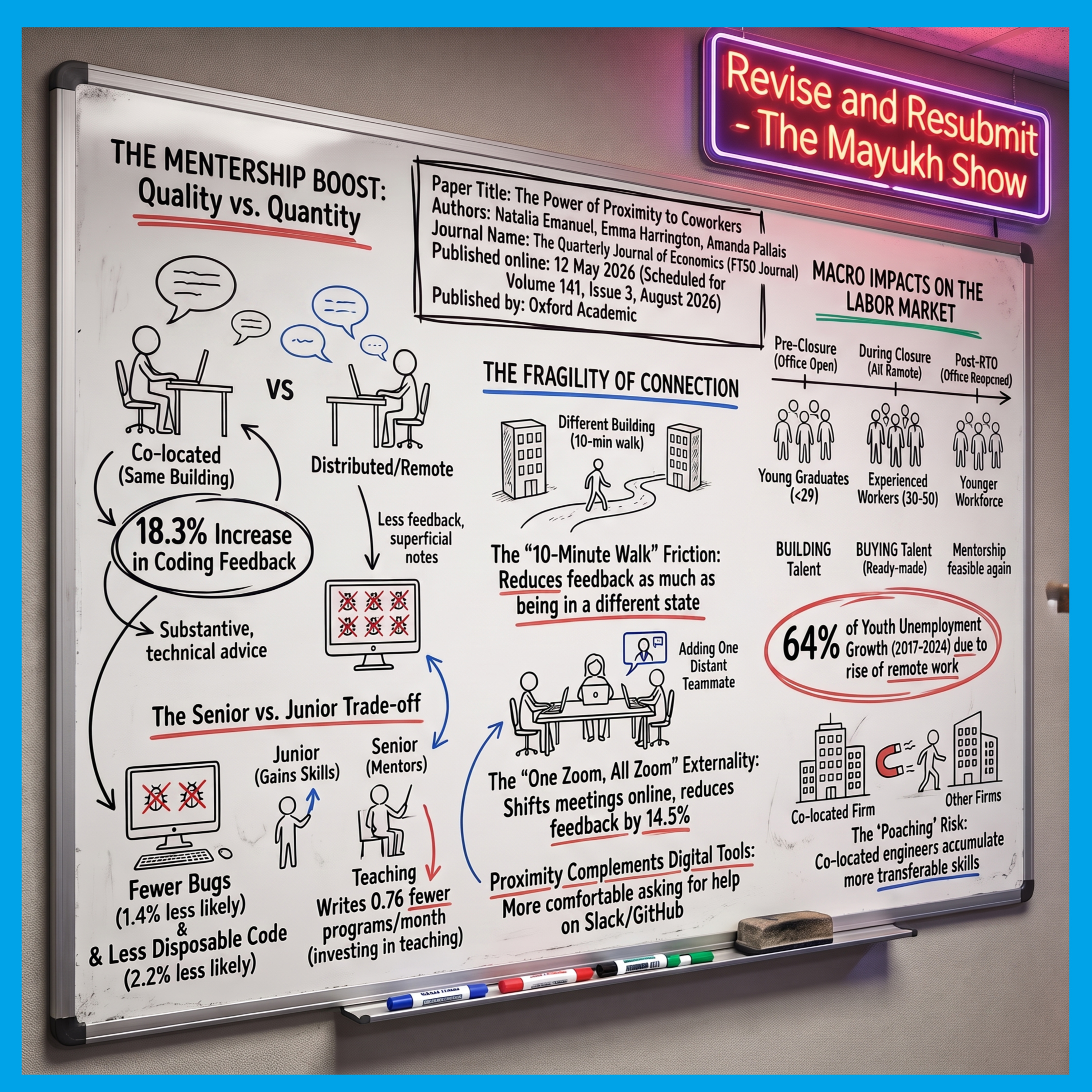
English Podcast Starts at 00:00:00 Bengali Podcast Starts at 00:50:20 Hindi Podcast Starts at 01:11:59 Danish Podcast Starts at 01:28:39 Reference Emanuel, N., Harrington, E., & Pallais, A. (2026). The Power of Proximity to Coworkers. The Quarterly Journal of Economics, 141(3), 1825–1870. https://doi.org/10.1093/qje/qjag027 Youtube Channel https://www.youtube.com/@weekendresearcher Podcast Website https://mayukhmukhopadhyay.com/reviseandresubmit Academy of Management PDW on Space Economy Registration Flyer https://cto.aom.org/discussion/flagship-aom-2026-pdw-space-economy-consolidating-a-research-agenda-8 AOM SIM Curriculum Committee https://sim.aom.org/curriculum/curriculum-committee AOM SIM-Bytes Curriculum Lessons https://sim.aom.org/curriculum/simbytes ️✨ Welcome to Revise and Resubmit . I am truly delighted that you've chosen to spend this moment with me. There are some ideas that arrive quietly, almost unnoticed, and yet they linger long after the conversation has ended. They remind us that the spaces we share are never merely spaces. They become part of who we are becoming. Today, we explore a fascinating paper, "The Power of Proximity to Coworkers," by Natalia Emanuel, Emma Harrington, and Amanda Pallais , published online on 12 May 2026 in The Quarterly Journal of Economics . This is one of the world's most prestigious academic journals and proudly belongs to the FT50 journal list , where groundbreaking research continues to shape our understanding of economics, organizations, and society. Not so long ago, many of us discovered that work could happen almost anywhere. Kitchen tables became offices. Bedrooms became meeting rooms. Conversations became little glowing squares on a screen. And somewhere along the way, we began asking a quiet question. What, if anything, had been left behind? This study does not answer that question with nostalgia. Instead, it listens carefully to the evidence. Following software engineers through office closures, remote work, and the gradual return to shared workplaces, the authors uncover something beautifully subtle. Sitting close to colleagues does more than shorten the distance between desks. It shortens the distance between experience and curiosity. Junior employees receive more feedback. Their work improves. Skills that might have taken years to develop begin to emerge through countless small conversations that rarely appear on a calendar. And yet, the story is not without its quiet complexity. Senior engineers often produce more code when they work remotely, free from the interruptions that mentoring naturally brings. Productivity, it seems, wears more than one face. Perhaps that is what makes this paper feel so deeply human. It reminds us that learning is rarely dramatic. More often, it happens in passing. A brief suggestion. An unexpected question. A glance at someone else's work. These moments are so ordinary that we hardly notice them, until one day we realize they have gently shaped the people we have become. ❤️ As we journey through this remarkable research together, I hope you'll think not only about offices or remote work, but about your own life. Who helped shape you simply by being nearby, and how much of who you are today was learned without either of you ever realizing it? ✨ My heartfelt thanks to Natalia Emanuel, Emma Harrington, and Amanda Pallais , and to Oxford Academic , for publishing this exceptional contribution in the prestigious FT50-listed The Quarterly Journal of Economics . If you enjoy thoughtful conversations where research meets the quiet truths of everyday life, please subscribe to Revise and Resubmit on Spotify , and subscribe to Weekend Researcher on YouTube . You can also listen on Amazon Prime and Apple Podcasts . Thank you for being here, and for bringing your curiosity with you.