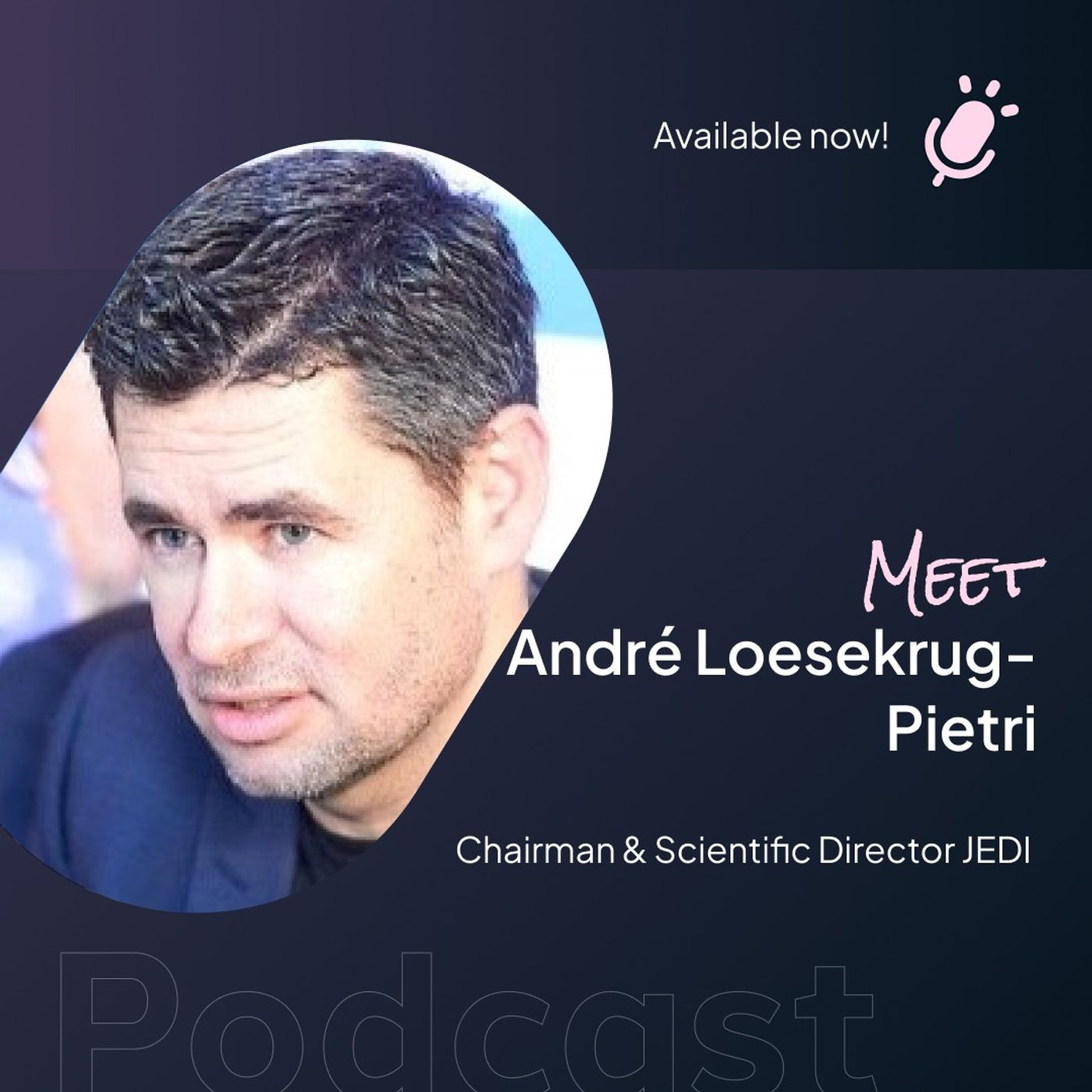
Episode #120
André Loesekrug-Pietri
From private equity to building Europe's ARPA Loesekrug-Pietri moved through private equity, entrepreneurship, and government, including a stint as special advisor to the French Minister of Defense, before co-founding JEDI in 2017. About 20 people set up the organization, split roughly into thirds: industrialists, heads of large research bodies such as Germany's DLR and France's CNRS, and deep tech founders. Former astronaut and French research minister Claudie Haigneré picked the JEDI name, betting that Europe could act as an underdog rather than a fast follower. Loesekrug-Pietri said the founders built JEDI outside EU institutions after concluding that working through the European Commission would consume 90 percent of their time on bureaucracy. A DARPA model built around one accountable program manager JEDI borrows its structure from the US Defense Advanced Research Projects Agency, which Loesekrug-Pietri credits with GPS, stealth technology, and autonomous vehicles after the US responded to the Sputnik shock. Each JEDI moonshot sets one quantitative goal and assigns a single program manager, rather than a scientific committee, to make calculated bets across disciplines. Loesekrug-Pietri contrasted this with France's 40 billion euro France 2030 program, which funded 7,500 projects and, in his view, has not yet produced a single world-leading company. JEDI's own network spans more than 7,500 technology and science leaders across 30 countries and 43 hubs, according to the organization's bio. Funding from philanthropies, 150 CEOs, and three EU states JEDI's funding comes from three sources, Loesekrug-Pietri said. It started with two philanthropic donors, a family foundation in France and an insurance-linked philanthropy in Germany, both focused on Europe's industrial future. More than 150 CEOs of large industrial groups and startups now support JEDI, including companies such as Thales, Siemens Energy, Schaeffler, and Renault, in exchange for quarterly technology foresight briefings across roughly 40 topics. JEDI also has three EU member states backing it directly, smaller countries that Loesekrug-Pietri said see lighthouse programs, such as one on robotics in an Eastern European country and one on quantum sensing in a Scandinavian country, as tools for their own competitiveness. Moonshots on rare earths, lasers, and antibiotics One active JEDI program targets refining critical minerals with 10 to 100 times less environmental impact, aiming to cut Europe's reliance on China, which Loesekrug-Pietri said now refines 90 percent of the magnets used in missile guidance systems and offshore wind turbines. A second program is developing all-weather laser communication, since low earth orbit satellites currently have only a nine-minute window to downlink data and clouds block laser links; the same technology could let forces down drones for about 2 euros per shot instead of firing million-dollar missiles. A third program targets antimicrobial resistance, which Loesekrug-Pietri said could kill 10 to 20 million people by 2050 without new antibiotics, none of which have reached the market in 20 years. How the money flows, and what's ahead JEDI typically reviews 50 to 150 teams per program and funds three to seven of them in parallel for nine to 18 months, paying half the grant upfront and the rest only if a team reaches a working prototype, Loesekrug-Pietri said. Teams keep their IP, and JEDI steps back once a prototype is ready to attract venture or seed funding. JEDI's formal organization is two years and 10 months old, Loesekrug-Pietri said, with one program complete, a Covid-19 treatment effort that produced 26 molecules now in clinical trials, two more programs in evaluation, and nine additional programs active. He said JEDI's defense ties reflect ministries' long-term planning horizons and concern with strategic surprise, not an intent to build weapons. Be sure to follow Sesamers on Instagram , LinkedIn , and X for more cool stories from the people we catch during the best Tech events!