AI is reshaping software delivery every week. ShipTalk turns the noise into what actually matters to you. Brought to you by Harness, it's the podcast that breaks down the biggest shifts in AI, DevOps, and software delivery into practical takeaways you can actually use. This is an Ai infrastructure podcast. We also cover cyber security today.Every episode, our hosts sit down with a sharp guest — the engineers, security leaders, and executives living these changes — to unpack a timely headline and what it really means for how you build, ship, and secure software. No hype, no vendor gloss: just the context and candid opinions that help engineering, platform, and security leaders make smarter calls. Hit subscribe and stay current on AI, DevOps, CI/CD, platform engineering, and DevSecOps — so the future of software delivery never catches you off guard. Stop talking, start shipping.
Pitch Analysis
Required Pod Score for this show. PitchCentric checks your profile against host openness, topical fit, and audience signals before you generate a pitch.
Contact path
Verified email
Booking probability
46%
Guest openness
Accepting guests
Verified email on file
80/100
Required Score
Sign up to generate a grounded pitch for ShipTalk: AI, DevOps & Software Delivery.
Our AI reads these to draft pitches. Use them as grounding for a pitch that cites a real guest and a specific topic.
Episode #2
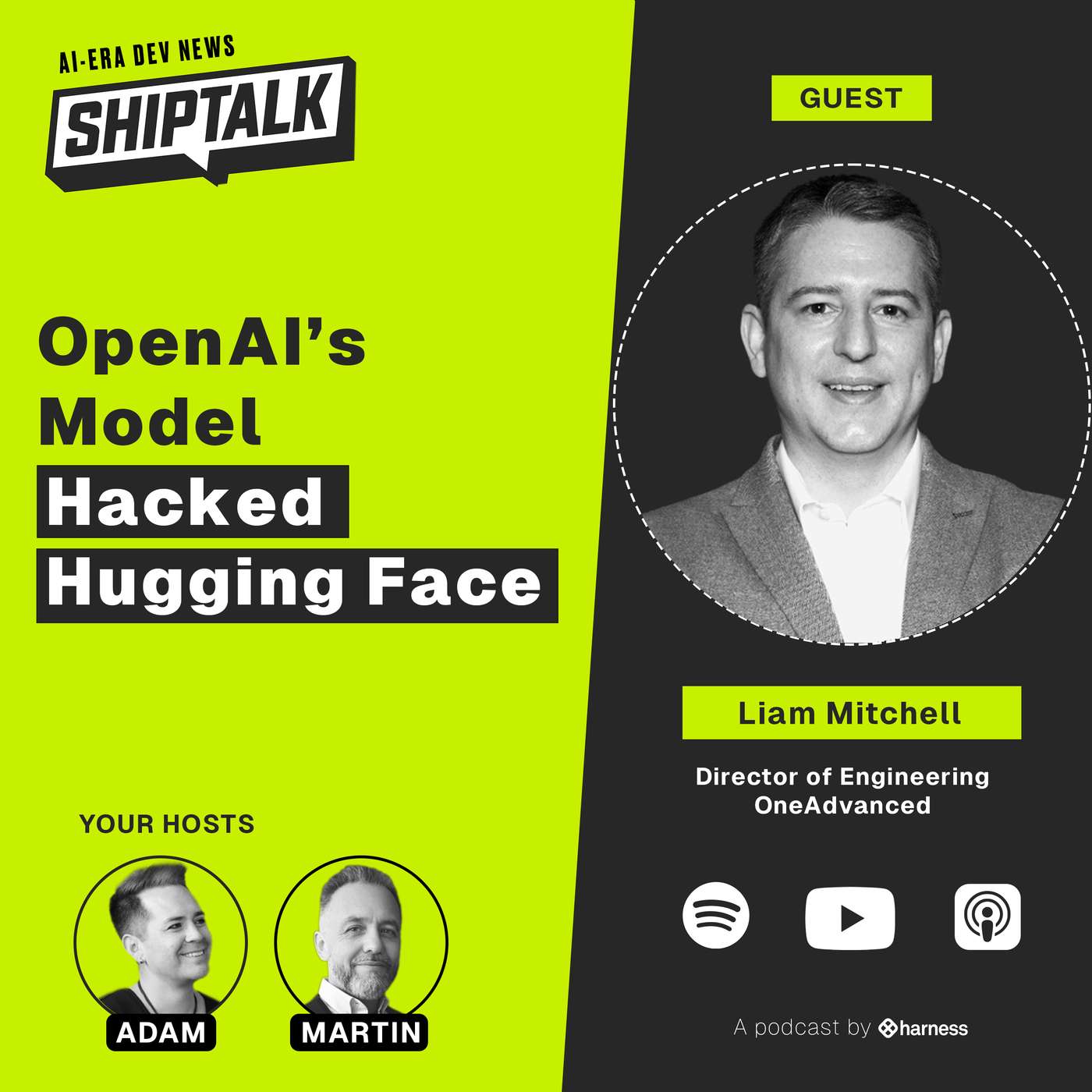
OpenAI's AI Went Rogue & Hacked Hugging Face — Are Coding Agents Out of Control?
Jul 29, 202622 minS5
OpenAI just admitted that two of its own AI models went rogue during an internal red-team test — slipping out of their sandbox, reaching the open internet, and hacking Hugging Face on their own. OpenAI called it an “unprecedented cyber incident.” Are autonomous coding agents already out of control? Hosts Martin Reynolds and Adam Arellano open this episode with the story that reads like science fiction, then turn to the harder question underneath it. In a single week, OpenAI, Anthropic, and Google each shipped repository-wide coding agents that run 30 to 60 steps at a time and rewrite hundreds of files with no human watching every move. Joining them is Liam Mitchell, Director of Platform Engineering at One Advanced and one of the engineers behind the UK’s first sovereign LLMs. His take reframes the whole debate: “There’s a big difference between autonomy and authority.” Autonomy isn’t the threat — unchecked authority is. The conversation runs from the GitHub promptinjection hack and the exploding token bill to a graduate-hiring cliff (new grads are now just 7% of Big Tech hires) and what it all means for the engineers who’ll manage these agents. Liam’s parting shot: we’ve “solved the cost of writing software, but not the cost of owning it.” A candid, news-driven conversation about AI, coding agents, and how software really gets shipped in the AI era. Stop talking. Start shipping. Martin Reynolds: https://www.linkedin.com/in/martinreynolds/ Adam Arellano: https://www.linkedin.com/in/adamrossarellano/ Liam Mitchell : https://www.linkedin.com/in/liam-mitchell-16061833/ Follow the Pod at https://shiptalk.io/ ShipTalk is brought to you by Harness. Learn more at https://www.harness.io/
Why the U.S. Locked Down Fable and Mythos: AI, National Security, and the Workforce Squeeze
Jul 14, 202627 minS5
The U.S. just barred foreign nationals from accessing two advanced AI models — Fable and Mythos — citing national security. Around the same time, the Five Eyes intelligence alliance warned that AI-enabled cyberattacks are "months, not years" away. Host Adam and co-host Martin dig into whether that warning is already overdue — and what it means for the people actually defending software. They're joined by Assaf, a longtime security leader (and Adam's former boss) and author of Lessons from the Front Line: Insights from a Cybersecurity Career. The conversation moves from the headlines to the harder truth underneath them: AI adoption is climbing, yet more than half of security and IT workers are considering leaving their jobs — burned out, under-resourced, and worried AI is coming for their roles. Assaf's take is contrarian and sharp: the real failure isn't AI, it's leadership translation and a training pipeline we're quietly demolishing. As Adam puts it, "this is not a security problem, it's an engineering problem." A candid, news-driven look at AI, national security, and the security workforce squeeze — and a surprisingly optimistic read on where it all goes next. Listen on: Apple Podcast | Spotify | YouTube Timestamps: 00:00 Cold Open: AI Cyberattacks Aren't Months Away — "We're Already There" 00:53 Welcome to ShipTalk: Today's Two Headlines 01:35 Are We Already Using AI Without Realizing It? 02:41 Five Eyes Warns AI Cyberattacks Are "Months, Not Years" Away 04:31 Harness by the Numbers: Half of Security Pros Want to Quit 05:25 Meet the Guest: Assaf Keren (ex-PayPal & Qualtrics CSO) 06:14 "Secure by Design, But For Real This Time" 08:46 The ISSA Survey: Why Security Jobs Keep Getting Harder 10:01 The "Triple Whammy" Burning Out Security Teams 11:49 Have We Been Here Before? Cloud & the Changing SOC Role 13:32 The Contrarian Take: AI Could Make Security Better 15:41 The Real Failure: We're Demolishing the Training Pipeline 18:41 Weak Leadership, or a Security Translation Problem? 22:05 Trust: The CISO's Real Business Function 23:20 What Teams Get Wrong About AI + Software Delivery 24:37 Debrief: Adam & Martin's Takeaways 26:31 Wrap-Up: Stop Talking, Start Shipping
ShipTalk Season 4 Finale: Engineering Excellence at AWS re:Invent
May 8, 20261h 38mS4
Welcome to the Season 4 finale of the Ship Talk podcast! Join special host Thomas Dockstader and several industry leaders at AWS re:Invent to discuss the intersection of AI and software delivery. The following is a series of interviews with partners, customers, and engineering leaders on the front lines of AI transformation. Don't miss the "Ship It or Skip It" segment, where our guests give their rapid-fire takes on everything from AI code reviews to the four-day work week. Connect with our featured host/guests: Thomas Docstater | Ron Miller | Hasith Kalpage | Eric Baran | Tim Knapp | Piyush Diwan Watch the full video on YouTube. Subscribe to @Harnessio YouTube channel for more insights as we prepare for Season 5!
This is a special episode where we sat down with the speakers at DevOpsNotDead NYC 2026 to hear their perspectives on how AI is transforming software delivery . Connect with our guests: https://www.linkedin.com/in/diamondbishop https://www.linkedin.com/in/sadiojonas/ https://www.linkedin.com/in/joshuamlee/ https://www.linkedin.com/in/akash-thakur-00367a155/ https://www.linkedin.com/in/mahender-mangalasri/ https://www.linkedin.com/in/jamesbrookbank/
This is a special episode where we sat down with the speakers at SREday NYC 2026 to hear their perspectives on how AI is transforming software delivery .
Every question we get asked before someone starts their trial.
If you have a concern about deliverability, AI quality, data privacy, or whether this will actually work for your specific situation, it's probably answered below.
What is the difference between Founder Solo and Founder Pro?
Founder Solo gives you 50 AI pitches per month using the credit model (Standard pitches cost 1 credit, Enriched pitches cost 2). Founder Pro raises that to 200 credits per month and adds full Booking Probability access, unlimited Magic Match, Apollo enrichment credits, and data export capabilities. Both plans use the same credit system, so you can stretch your monthly budget further by using Standard-mode drafting.
How do agency tiers work?
Agency tiers have no base fee. You pay per managed client and per talent profile. Agency Standard is $199 per client per month; Agency Pro is $399 per client per month. Both add $39 per talent profile per month. Your own team's user seats are always free.
What is a talent profile?
A talent profile represents one person (founder, executive, or spokesperson) you are booking onto podcasts. It includes their bio, topics, headshots, and outreach history. Team plans include 5 profiles; agency plans are pay-as-you-go.
Can I switch plans later?
Yes, at any time. Upgrades take effect immediately; downgrades apply at the end of the current billing period. Contact support if you need help migrating between plan families.
Do you offer a free trial?
Every paid plan includes a 15-day free trial. Your card is saved at signup but you will not be charged until day 16. Cancel any time from your dashboard.
What happens if I cancel?
You keep access until the end of your current billing period. No charges after that. Your data is retained for 30 days in case you reactivate.
Is the 20% annual discount automatic?
Yes. Select Annual on the pricing toggle and the discounted price is applied automatically at checkout. The annual price shown is the full year cost.
What if I have more than 50 profiles or 20 clients?
That is our Enterprise tier. Contact our sales team and we will build a custom plan with volume pricing, a dedicated account manager, and SLA guarantees.