
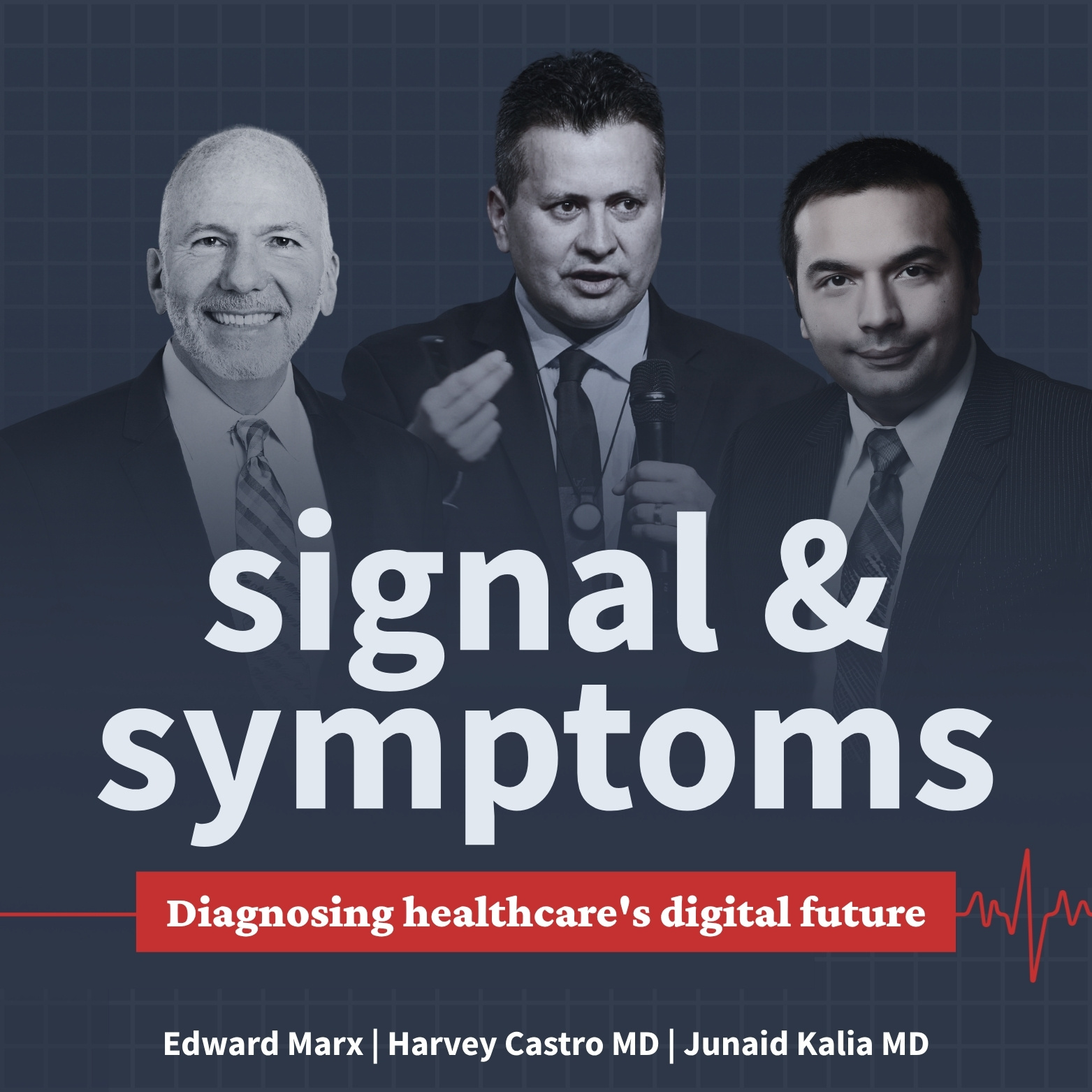
Episode #52
Will AI Replace the Doctor? The Empathy Debate, with Dr. Alan Weiss
“Medicine is fundamentally a relationship, and I don’t think AI replaces that.” That is where Dr. Alan Weiss plants his flag, seconds before Dr. Junaid Kalia throws down the provocation the whole episode circles: what if 65% of patients soon get 85% of their primary care through AI agents? This is the empathy debate, and it is not the one you expect. Dr. Alan Weiss, Senior Vice President of Clinical Advancement at Banner Health and a physician-informaticist who describes himself as “a nerd turned doctor, gone back to being a nerd,” joins host Dr. Junaid Kalia with co-hosts Dr. Isha Mannering, DR GPT™ Harvey Castro, and Edward Marx. Together they work through the uncomfortable middle of the AI-versus-doctor question: the crushing admin load AI could lift, the timeline for when it actually will, the danger of trusting a model that quietly misses a sepsis case, and the studies suggesting AI can already sound more empathetic than a physician. It ends on a story that will stay with you: an AI that remembered a patient loved soccer, and comforted her about missing the World Cup, better than most humans would have. What You Will Discover: [00:00] Cold open: “medicine is a relationship” vs “65% of care through AI agents” [00:46] Meet Dr. Alan Weiss: “a nerd turned doctor, gone back to being a nerd” [01:16] What still drives him, and AI as augmentation, not replacement [02:04] Dr. Isha Mannering on pediatrics and the joy in medicine [02:55] The admin crush: documentation, billing, and the inbox [04:17] When will AI actually handle it? The timeline (refills, 2029, the Utah pilot) [05:28] The liability tipping point [05:53] What if you disagree with the AI? Alan on the sepsis it can miss [06:33] Can AI fake empathy? Genuine connection vs mimicry [06:53] Ambient AI that hears 100 emotions in your voice [07:33] Fatigue vs empathy: why a clinician’s energy runs out (Alan) [08:40] The World Cup moment: when AI out-empathized the doctor (Edward Marx) Referenced in the show: ️ JAMA Internal Medicine (2023): AI chatbot responses rated more empathetic than physicians’ ️ The Epic Sepsis Model shortfall: an AI that missed most sepsis cases in external validation ️ Ambient AI scribes: hearing “100 emotions” in a clinician’s voice, and easing documentation ️ Wearables, the admin inbox, and the “augment, don’t replace” thesis Dr. Junaid Kalia, Neurocritical Care Specialist and Founder of SaveLife.AI™ (host) LinkedIn — https://www.linkedin.com/in/junaidkaliamd Website — https://www.junaidkalia.com/ YouTube — https://www.youtube.com/@junaidkaliamd Edward Marx, CEO, Advisor (co-host) LinkedIn — https://www.linkedin.com/in/edwardmarx/ Website — https://www.marxadvisory.com/ YouTube — https://www.youtube.com/@EdwardMarx DR GPT™ Harvey Castro, ER Physician, #DrGPT™ (co-host) LinkedIn — https://www.linkedin.com/in/harveycastromd/ Website — https://www.harveycastromd.com/ Visit our website: https://signalandsymptoms.com/ Dr. Isha Mannering (co-host) LinkedIn: https://www.linkedin.com/in/isha-mannering Special Guest: Dr. Alan M. Weiss, MD, MBA, FACP, Senior Vice President of Clinical Advancement, Banner Health (physician-informaticist; former CMIO) LinkedIn: https://www.linkedin.com/in/dralanmweiss/ Visit our website: https://signalandsymptoms.com/ Get advisory insights about Healthcare AI, at zero cost: https://junaidkaliamd.substack.com/ Medical disclaimer: This conversation is for general informational purposes and is not medical advice. Listening does not create a doctor and patient relationship. Views expressed by the guest and co-hosts are their own and do not represent their employers. AI tools discussed are decision-support with a clinician in the loop, not autonomous or cleared diagnostic devices. No PHI is shared.
