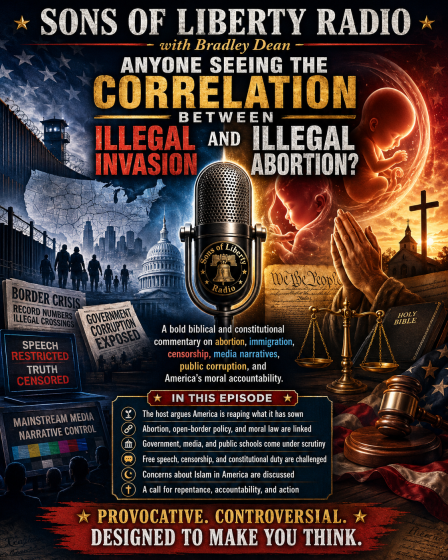
Sons of Liberty Radio with Bradlee Dean
Sons of Liberty Radio, August 15, 2026
Aug 15, 20261h 50m
SONS of LIBERTY Radio with Bradlee Dean Part 1: Mike Lindell Joins Bradlee Dean Live Part 2: Anyone Seeing The Correlation?

Loading…
government
Hosted by Bradlee Dean · government · EN-US · 20 episodes
Tired of hearing all of the gloom and doom and talking around the issues? Equip yourself with the truth that is protecting our liberty for generations to come. Get your daily dose of news and history the mainstream media doesn't want you to hear.He is educating and equipping America with the knowledge of what our nation was truly founded upon – As President Andrew Jackson rightly proclaimed, “The Bible is the Rock upon which our republic rests.”As Bradlee has stated many times across the nation, "America, there would not be a left if the right was doing the right thing all of the time, we still have the freedom to do the right thing, and the right time to do the right thing is right now!" 1John 3:18
Required Pod Score for this show. PitchCentric checks your profile against host openness, topical fit, and audience signals before you generate a pitch.
Contact path
Verified email
Booking probability
30%
Guest openness
Selective
Sign up to generate a grounded pitch for Sons of Liberty Radio with Bradlee Dean.
Signup to Generate a PitchSons of Liberty Radio with Bradlee Dean is a government podcast hosted by Bradlee Dean, with 20 episodes on record and a Required Pod Score of 80. PitchCentric scores this show on Booking Probability, Listen Score, and live audience signals refreshed every 24 hours.
Bradlee Dean hosts Sons of Liberty Radio with Bradlee Dean, a government show with 20 episodes published.
Our AI reads these to draft pitches. Use them as grounding for a pitch that cites a real guest and a specific topic.
Sons of Liberty Radio with Bradlee Dean
SONS of LIBERTY Radio with Bradlee Dean Part 1: Mike Lindell Joins Bradlee Dean Live Part 2: Anyone Seeing The Correlation?
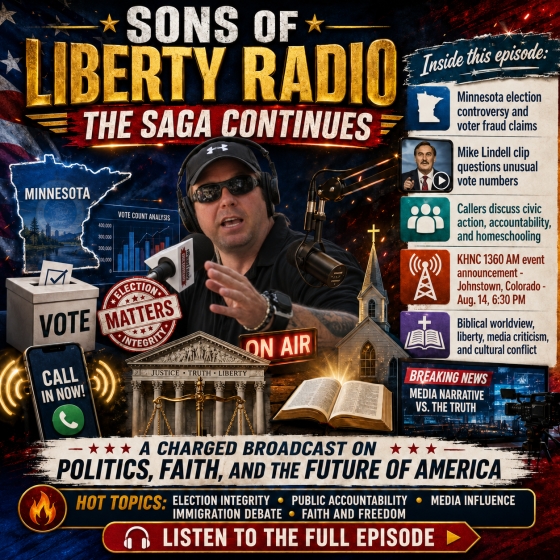
Sons of Liberty Radio with Bradlee Dean
SONS of LIBERTY Radio with Bradlee Dean The Saga Continues Election Claims, Cultural Conflict, and a Call to Biblical Action Summary Minnesota Election Results and Fraud Allegations The host centers much of the episode on Minnesota politics and repeatedly alleges that recent election results were fraudulent. He discusses Lisa DeMuth, Peggy Flanagan, Ilhan Omar, Amy Klobuchar, Keith Ellison, and other political figures, often arguing that the public did not genuinely choose the candidates who prevailed. He also cites state financial figures and accuses political leaders of participating in or benefiting from large-scale fraud, while presenting those allegations as his own conclusions. Throughout this discussion, he criticizes both Democratic and Republican establishments and argues that political accountability and prosecution are necessary. The episode treats election integrity as part of a broader struggle over government legitimacy and public responsibility. Mike Lindell Clip and Election Numbers The host introduces a prerecorded clip of Mike Lindell discussing election results and polling numbers. In the clip, Lindell refers to polling percentages, a sudden block of 36,000 votes, 6,000 votes attributed to him, and data connected to Edison Research, while saying that certain numbers do not make sense to him. Lindell says he is not yet claiming that something improper happened and that the numbers will be checked before a fuller report is issued. The host interprets the media description of Lindell as "defiant" as an example of people being criticized for questioning election outcomes. He then argues that challenges to election administration should be treated as demands for truth and accountability rather than automatically characterized as attacks on constitutional government. Caller Discussion, Discouragement, and Civic Action Caller Margie says the election results were disheartening and defends Mike Lindell against accusations that he was simply a sore loser. She discusses his relationship with Donald Trump, his position on homeschooling, and her concern about the political direction of Minnesota. The host responds by urging persistence, saying people must remain steadfast and should not become weary or surrender to political discouragement. Margie also describes a city-council-related conversation in which a local adviser said he would watch for a volunteer position for her, which she interprets as a positive sign. The host uses the exchange to emphasize action, service, and being "doers of the word" rather than merely passive listeners. Immigration, Islam, Media Attention, and Cultural Conflict A major portion of the episode presents the host's strongly negative views about Muslim immigration, Islamic political influence, Sharia law, and the media's treatment of Muslim political candidates. He argues that certain immigrants are not assimilating and portrays political and religious developments in Minnesota, Michigan, Texas, Dearborn, and other locations as evidence of a larger effort to gain power. He plays or references clips involving Abdul El-Sayed and a woman identified as Jessica Holsey, and he reads or paraphrases several Quran passages to support his interpretation of Islam. The host also attributes quotations to Muslim political and religious figures and cites mosque-growth statistics, while none of those claims are independently verified within the transcript. His language is frequently condemnatory and includes broad claims about Muslims, Zionists, transgender issues, and political figures that remain the speaker's expressed views rather than established facts. Christian Worldview, Scripture, and Historical Framing The program repeatedly grounds its political arguments in a Christian biblical worldview. The opening material includes a religious historical quotation, a statement about the Christian ethic and American government, and references to figures such as William Booth, Andrew Jackson, George Washington, Benjamin Franklin, and Harry S. Truman. The host invokes scripture while discussing political responsibility, perseverance, citizenship, national judgment, and what he sees as the moral obligations of Americans. Later, he compares people who say they are "just doing their job" with a crucifixion-themed meme and uses the image to argue against passive compliance with wrongdoing. The episode closes with biblical language about covenant, judgment, God's sovereignty, and the consequences of what a society tolerates. Promotions, Events, Church Messages, and Network Information The episode includes repeated promotional and station segments that were preserved because they appear to be part of the recording. The host promotes an August 14 event connected with KHNC in Johnstown, Colorado, where he says he will be the main speaker, although portions of the event address and Jason's phone description are unclear. Prerecorded material promotes the Content Media Conference, financial support for the program, Sunday church services, Wisconsin Christian News, Liberty Sentinel, community event bookings, and BBS Radio TV. Testimonials from Tom Raymond and Lisa Mead praise the host's Christian ministry and church teaching. The BBS Radio TV promotion describes the network's history, international distribution, on-demand syndication, production volume, and the work of Douglas and Donald Newsom.
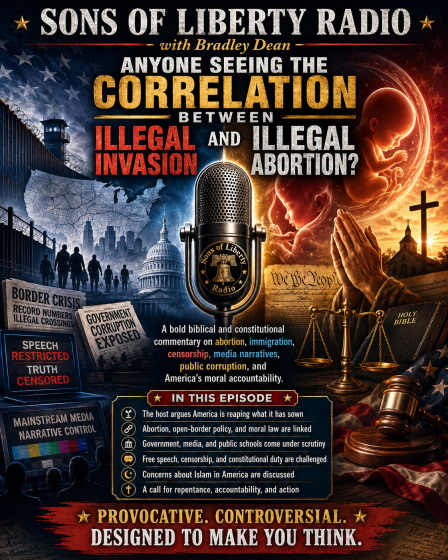
Sons of Liberty Radio with Bradlee Dean
SONS of LIBERTY Radio with Bradlee Dean Anyone Seeing The Correlation Between Illegal Invasion & Illegal Abortion? Me Too! Reaping What We Sow: Abortion, Immigration, and the Call to National Accountability Summary The Episode's Central Correlation Bradley Dean frames the episode around what he describes as a moral and spiritual correlation between abortion in the United States and immigration that he characterizes as an illegal invasion. He argues that Americans who tolerate abortion are collectively responsible for the shedding of innocent blood and will, in his biblical interpretation, reap consequences resembling the violence they have allowed against unborn children. Throughout the program, he repeatedly invokes the principle of reaping what one sows and presents national events as divine recompense. He urges listeners not to view the subject as a message of fear, but as a warning intended to produce repentance and action. The argument remains explicitly rooted in Dean's Christian biblical worldview and in his interpretation of Scripture. Immigration, Islam, and Government Responsibility A large portion of the episode focuses on Dean's claims about Islam, Muslim immigration, Sharia law, fraud, political candidates, schools, and government officials. He plays several prerecorded clips that he says demonstrate ambitions to expand Islamic influence, while also discussing the Muslim Brotherhood and CAIR. Dean accuses elected officials, government agencies, and the mainstream media of enabling or concealing what he describes as a coordinated threat to American sovereignty. He repeatedly characterizes immigration policy and certain public officials' actions as treasonous and argues that Americans have a duty to hold those officials accountable under constitutional and biblical law. These claims are presented by Dean and the inserted clips as part of the episode's broader argument about national responsibility. Abortion, Innocent Blood, and Biblical Recompense Dean repeatedly returns to abortion as the core moral offense from which he believes national judgment flows. He cites passages including Exodus 20:13, 2 Kings 24:4, Galatians 6:7-9, Proverbs 28, Deuteronomy 28, and Leviticus 26 to support his argument that the shedding of innocent blood brings consequences upon a people. He criticizes political leaders and citizens who celebrate or tolerate abortion and argues that responsibility extends beyond those directly obtaining or performing abortions. A story about a woman asking why God allows abortion becomes a vehicle for Dean's claim that Americans should ask why they themselves allow it. He connects this theme to his repeated insistence that prayer without confronting wrongdoing is insufficient. Censorship, Media, and Controlled Opposition Another major theme is Dean's belief that censorship and media promotion are used to shape political opposition. He says his own work and the work of others like him are throttled or deplatformed, while prominent media personalities and political figures are elevated as controlled opposition. He names Dennis Prager, Alex Jones, Andrew Tate, Russell Brand, Elon Musk, and several political figures while making a series of sharply critical allegations about them. Dean also argues that mainstream media attention creates legitimacy for politicians he believes are being installed rather than genuinely elected. Across these segments, he urges listeners to distrust media-created heroes and judge public figures by whether justice and accountability actually follow from their actions. Personal Responsibility, Law, and the Caller Segment Dean repeatedly tells listeners that the country's central problem is refusal to accept personal responsibility. He illustrates the point with a story about a young intoxicated driver who, in his telling, killed a newlywed woman and then focused on what had happened to herself rather than on the victim. Later, Bob from Texas calls to discuss a process he says can be used to confront commissioners, council members, school-board officials, and others over violations of their oaths of office. Although parts of Bob's remarks are garbled in the automated transcript, the clear thrust is that citizens should document alleged oath violations, put them on the record, and replace officials who refuse to correct their conduct. Dean agrees with the emphasis on action and criticizes churches and preachers that he believes remain passive. Closing Warnings and Call to Repentance In the closing portion, Dean discusses Texas, Florida, Greg Abbott, Ken Paxton, Ron DeSantis, Byron Donalds, AIPAC, and other political subjects through the same framework of distrust, alleged corruption, and national judgment. He warns listeners not to assume that conservative branding or media popularity proves that a public figure is trustworthy. The religious conclusion is direct: he says judgments increase when people refuse correction and that their purpose is to drive people toward repentance. He closes with the message, "repent, for the kingdom of heaven is at hand," promotes his book Children of the Apostate, and encourages listeners to support the ministry through Sons of Liberty Media. The episode ends by reiterating his longstanding theme that prevention, repentance, and personal responsibility are preferable to suffering consequences later.
Sons of Liberty Radio with Bradlee Dean
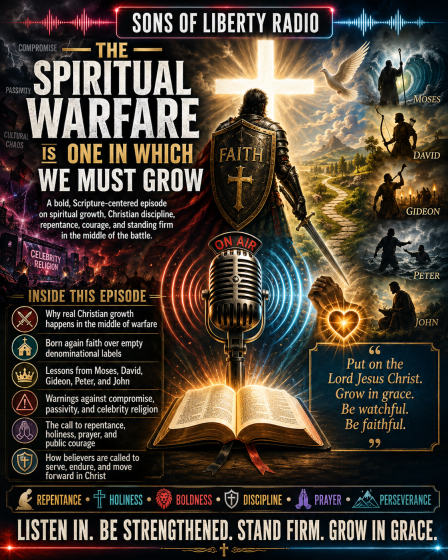
SONS of LIBERTY Radio with Bradlee Dean The Spiritual Warfare Is One In Which We Must Grow Growing Through the Battle: Discipline, Discernment, and the Christian Call to Stand Summary Spiritual Warfare as a Life of Active Faith The episode presents the Christian life as an ongoing spiritual battle rather than a passive or compartmentalized religious experience. The host argues that believers are called to remain vigilant, guard their hearts, and move from defensive thinking into active obedience. He repeatedly contrasts this view with what he describes as an American form of Christianity that expects God to act while believers remain spectators. Biblical images of soldiers, armor, battle, and pressing forward are used to frame the call to perseverance. The host's central point is that spiritual warfare is not separate from Christian growth; it is one of the primary settings in which that growth takes place. Born Again, Sanctified, and Called to Obedience The teaching moves into the host's understanding of the born-again experience, drawing heavily on Ezekiel 36 and related passages. He emphasizes a new heart, a new spirit, cleansing from former ways, and a life that demonstrates conversion through obedience. He rejects denominational identity as the defining mark of Christianity and instead centers identity on being born again in Christ. Throughout this section, the host argues that grace should produce transformation rather than serve as permission to return repeatedly to an old way of life. Prayer and worship are woven into the message as expressions of dependence on God and the Holy Spirit. Weakness, Calling, and Dependence on God A recurring theme is that people genuinely called by God often feel weak, inadequate, unworthy, or reluctant rather than self-important. The host points to Moses, Saul, Jonah, Gideon, Peter, John, Paul, and other biblical figures as examples of people whose limitations forced them to rely on God. He contrasts that humility with what he describes as self-appointed spiritual authority, celebrity-style ministry, and the desire for the praise of people. The message argues that weakness can become a place of dependence, while self-assertion can become a spiritual danger. In this framework, believers grow when they stop using inadequacy as an excuse and begin acting in reliance on grace. Discernment, Repentance, and the Rejection of Spectator Christianity The host repeatedly calls for discernment between what he considers genuine biblical Christianity and counterfeit or compromised forms of religion. He criticizes preaching that avoids repentance, confrontation of sin, cultural engagement, or the responsibilities of discipleship. The episode also attacks what he describes as a "good old boy" culture among religious leaders and compares that problem with citizens treating political representatives like celebrities rather than servants. He urges listeners to study Scripture for themselves, make judgments according to the Word rather than personal preference, and accept correction as part of growth. The intended alternative is a church focused on raising disciples and servants rather than followers, spectators, or consumers. Growth in Grace Requires Daily Tending The host uses gardening as a practical picture of spiritual formation. Just as a garden must be planted, watered, fertilized, protected, weeded, and continually tended, he says a believer must continually guard the mind, remain in the Word, resist distracting thoughts, and stay attentive to spiritual influences. He applies the same principle to friendships, family priorities, ministry responsibility, and the need to keep Christ first rather than allowing other relationships or interests to become controlling attachments. Patience is presented as part of maturity because growth cannot be forced into an instant or "microwave" process. The Christian life is therefore described as disciplined, lifelong development rather than a one-time emotional experience. Perseverance, Service, and Finishing the Course In the closing portion, the host returns to Ephesians 6, Philippians 3, and quotations from earlier Christian writers to reinforce the image of a disciplined soldier pressing forward. He argues that believers should expect resistance, hardship, distraction, and cultural opposition while continuing to serve, evangelize, pray, study, and act. The episode also extends the message into education, public life, ministry leadership, family example, and the responsibility to address wrongdoing rather than remain silent. The host closes by urging listeners not to stop midway through their spiritual course, but to seek more grace and continue until the work is finished. He then gives ministry support information, upcoming event details, and a final appeal for listeners to help sustain the work.
Sons of Liberty Radio with Bradlee Dean
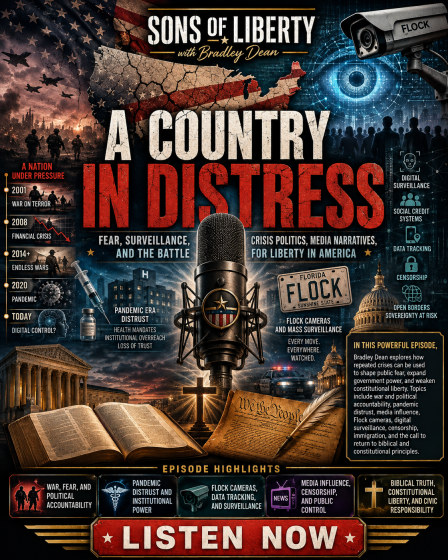
SONS of LIBERTY Radio with Bradlee Dean A Country In Distress When Fear Becomes Policy: Surveillance, Crisis, and the Fight for American Liberty Summary A Nation Framed Through Fear and Crisis The episode presents the host’s argument that the United States is in severe distress because citizens have allowed government, media, and political institutions to accumulate power through repeated appeals to fear. Bradley Dean moves through a long list of wars, public-health scares, economic emergencies, and national-security events to argue that crisis narratives have repeatedly conditioned the public to accept expanded authority. He cites historical quotations, biblical passages, and examples from past administrations to support his position that fear weakens self-government. Throughout the first hour, he emphasizes that Americans themselves bear responsibility when they fail to demand accountability. The program repeatedly contrasts fear of government or social consequences with what the host describes as a biblical fear of God. This framework becomes the organizing idea connecting the episode’s otherwise wide range of subjects. War, Political Power, and Public Accountability The host and caller Sal discuss war, the military-industrial complex, and the idea that political leaders should personally bear responsibility for wars they initiate. Sal references Smedley Butler’s War Is a Racket, while Dean distinguishes what he calls righteous wars from wars driven by politicians, financiers, and institutional interests. Dean says he comes from a military family and stresses that his criticism is directed at political uses of military power rather than at service members. The discussion argues that citizens should require leaders to justify war before sending younger generations to fight. Dean repeatedly returns to the idea that political elites exercise only as much control as the public permits. The exchange reinforces the episode’s larger emphasis on civic responsibility and resistance to unaccountable power. Pandemic Claims, Vaccines, and Institutional Distrust A major portion of the program revisits the COVID-19 era and other disease scares through the host’s highly critical perspective. Dean alleges wrongdoing by government agencies, pharmaceutical companies, Anthony Fauci, Bill Gates, and others, and he presents these assertions as evidence of a broader pattern of manufactured or exploited crises. A prerecorded Gina Carano clip is used to emphasize opposition to vaccine mandates and regret over not speaking more forcefully. Dean also recounts his own refusal to comply with masking rules during air travel and portrays that experience as an example of resisting coercion. Caller Ken raises concerns about illness after tick bites and unusual weather, which Dean connects to broader claims about environmental manipulation and government misconduct. These medical and scientific assertions are presented in the episode as the speakers’ claims and were not independently verified for this transcript cleanup. Flock Cameras, Palantir, and Digital Surveillance The second hour shifts heavily toward surveillance technology, especially Flock cameras, data collection, and the possibility of a broader social-credit-style system. Dean questions where government obtained authority to deploy such systems and argues that public consent has been bypassed. A prerecorded doctor’s clip discusses consent and alleged efforts to avoid public-comment processes, while another clip describes reported cases of law-enforcement personnel using Flock cameras for stalking. Dean then plays an interview with a young person from China who describes facial recognition, WeChat and Alipay, digital tracking, and social-credit mechanisms. The host connects those examples to Palantir, data centers, vaccine passports, and expanded government monitoring in the United States. The segment’s central warning is that surveillance infrastructure, once normalized, may become difficult to reverse. Immigration, Islam, Zionism, and Censorship The latter part of the episode moves into highly controversial political and religious commentary concerning immigration, Muslim political candidates, Zionism, Israel, antisemitism, and censorship. Dean argues that government and media institutions are promoting people or policies he views as hostile to American constitutional government, and he names several public figures while making allegations about their motives and affiliations. He distinguishes anti-Zionism from antisemitism and says individuals should be judged according to conduct rather than ethnicity. Inserted clips discuss Abdul El-Sayed, alleged organizational ties, and efforts to document or penalize people accused of targeting Jewish students. Dean also criticizes political donations, AIPAC influence, restrictions on criticism of Israel, and what he describes as expanding censorship. These are preserved as the host’s and clip speakers’ views rather than presented as established fact. Biblical Government and the Call to Act Across both hours, the program repeatedly returns to a Christian biblical worldview as its proposed answer to political and social disorder. Dean quotes or paraphrases the Declaration of Independence, biblical passages, historical figures, and Christian thinkers to argue that legitimate government depends on law, justice, and a morally responsible citizenry. He says resistance to tyranny is consistent with the founding principles of the United States and repeatedly urges listeners not to remain passive. Promotional segments reinforce the program’s church services, public events, supporter network, media platform, and related news outlets. The episode closes with a warning that censorship and political intimidation are increasing and with another invitation to the Sunday church service. The final message is that, in the host’s view, national restoration depends on citizens confronting wrongdoing rather than merely listening to commentary about it.
Sponsor detection runs nightly. Check back soon.
Based on semantic analysis of episode topics and host coverage, this show is a strong guest fit for executives in:
Industry fit is computed by PitchCentric using vector embeddings of the show's episode catalog.
Is this podcast yours and you'd like to remove or correct details? Request removal or email privacy@pitchcentric.com.
FAQs
If you have a concern about deliverability, AI quality, data privacy, or whether this will actually work for your specific situation, it's probably answered below.
Founder Solo gives you 50 AI pitches per month using the credit model (Standard pitches cost 1 credit, Enriched pitches cost 2). Founder Pro raises that to 200 credits per month and adds full Booking Probability access, unlimited Magic Match, Apollo enrichment credits, and data export capabilities. Both plans use the same credit system, so you can stretch your monthly budget further by using Standard-mode drafting.
Agency tiers have no base fee. You pay per managed client and per talent profile. Agency Standard is $199 per client per month; Agency Pro is $399 per client per month. Both add $39 per talent profile per month. Your own team's user seats are always free.
A talent profile represents one person (founder, executive, or spokesperson) you are booking onto podcasts. It includes their bio, topics, headshots, and outreach history. Team plans include 5 profiles; agency plans are pay-as-you-go.
Yes, at any time. Upgrades take effect immediately; downgrades apply at the end of the current billing period. Contact support if you need help migrating between plan families.
Every paid plan includes a 15-day free trial. Your card is saved at signup but you will not be charged until day 16. Cancel any time from your dashboard.
You keep access until the end of your current billing period. No charges after that. Your data is retained for 30 days in case you reactivate.
Yes. Select Annual on the pricing toggle and the discounted price is applied automatically at checkout. The annual price shown is the full year cost.
That is our Enterprise tier. Contact our sales team and we will build a custom plan with volume pricing, a dedicated account manager, and SLA guarantees.
