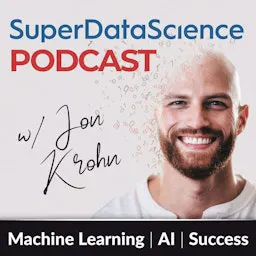
The latest machine learning, A.I., and data career topics from across both academia and industry are brought to you by host Dr. Jon Krohn on the Super Data Science Podcast. As the quantity of data on our planet doubles every couple of years and with this trend set to continue for decades to come, there's an unprecedented opportunity for you to make a meaningful impact in your lifetime. In conversation with the biggest names in the data science industry, Jon cuts through hype to fuel that professional impact. Whether you're curious about getting started in a data career or you're a deep technical expert, whether you'd like to understand what A.I. is or you'd like to integrate more data-driven processes into your business, we have inspiring guests and lighthearted conversation for you to enjoy. We cover tools, techniques, and implementation tricks across data collection, databases, analytics, predictive modeling, visualization, software engineering, r
Pitch Analysis
Required Pod Score for this show. PitchCentric checks your profile against host openness, topical fit, and audience signals before you generate a pitch.
Contact path
Verified email
Booking probability
39%
Guest openness
Selective
Verified email on file
92/100
Required Score
Sign up to generate a grounded pitch for Super Data Science: ML & AI Podcast with Jon Krohn.
What is Super Data Science: ML & AI Podcast with Jon Krohn?
Super Data Science: ML & AI Podcast with Jon Krohn is a technology podcast hosted by Jon Krohn, with 1,000 episodes on record and a Required Pod Score of 92. PitchCentric scores this show on Booking Probability, Listen Score, and live audience signals refreshed every 24 hours.
About the host
Jon Krohn hosts Super Data Science: ML & AI Podcast with Jon Krohn, a technology show with 1,000 episodes published.
Our AI reads these to draft pitches. Use them as grounding for a pitch that cites a real guest and a specific topic.
Super Data Science: ML & AI Podcast with Jon Krohn
1022: CLAUDE.md, AGENTS.md, Skills, Hooks and Subagents: A Field Guide to Steering AI Agents
Aug 28, 202618 min
In Episode #1022, Jon Krohn tackles the art of steering AI agents, deciding where your instructions should live so they get followed reliably without bloating every request. A sequel to Episode #1020 (where model size and effort set an agent’s horsepower), this one is about direction: the seven ways to deliver instructions, why a hook beats a prompt, the industry-wide agents.md standard, and three practical takeaways you can apply whatever your stack. Additional materials: www.superdatascience.com/1022 Interested in sponsoring a SuperDataScience Podcast episode? Email natalie@superdatascience.com for sponsorship information. In this episode you will learn: (02:52) The seven ways to deliver instructions to an agent (06:42) Why a hook is a guarantee and an instruction is only a probability (13:00) Three takeaways for organizing your instructions
Super Data Science: ML & AI Podcast with Jon Krohn
1021: How dbt Won Analytics Engineering, with dbt Lab’s CEO Tristan Handy
Aug 25, 202652 min
In Episode #1021, Tristan Handy (Founder and CEO of dbt Labs) joins Jon Krohn to explain how a study of about a hundred companies in 2016 became analytics engineering, and then became a tool that over a hundred thousand data teams rely on. Tristan coined the term, chose SQL when Spark was the fashionable answer, and spent a decade turning down acquisition offers because none of them were good for the people using dbt. He is now merging dbt Labs with Fivetran and taking on the presidency of the combined company, the first deal he says cleared that bar. In this episode, Tristan walks through what dbt does to your raw data, argues that the semantic layer matters more once analytics agents are asking the questions, explains the type safety behind the Fusion engine, and details how a 12-kilobyte skill file collapses a million-dollar migration into six weeks. Additional materials: https://www.superdatascience.com/1021 Interested in sponsoring a SuperDataScience Podcast episode? Email natalie@superdatascience.com for sponsorship information. In this episode you will learn: (00:07:22) Why Tristan chose SQL over Spark, and what progressive complexity means (00:10:44) How a dbt project turns raw data into modeled tables (00:17:50) Why a decade of acquisition offers kept failing his one test (00:40:47) How 12-kilobyte skill files cut year-long migrations to six weeks
Super Data Science: ML & AI Podcast with Jon Krohn
1020: How to Choose Model Size and Effort Level: The Two Critical Dials
Aug 21, 202617 min
In Episode #1020, Jon Krohn unpacks the two dials that increasingly decide what you get out of a large language model: which model size you pick and how much effort you tell it to spend. Using a July Anthropic blog post by Claude Code’s Lydia Holly as a jumping-off point, with guidance that generalizes to any model family, Jon explains what each setting actually does under the hood. Model size swaps which frozen weights handle your request (roughly, how capable), while effort sets how thorough and certain the model must be before calling a task done, not a simple “thinking-time slider.” He offers a clean diagnostic for when to raise effort versus move to a bigger model, shows why cheaper-per-token isn’t always cheaper-per-task and surveys how OpenAI, Google and open-weight labs have all converged on these same two dials. Additional materials: www.superdatascience.com/1020 Interested in sponsoring a SuperDataScience Podcast episode? Email natalie@superdatascience.com for sponsorship information. In this episode you will learn: (00:56) What the model-size dial actually does (05:29) Why effort isn’t a thinking-time slider (13:25) Three practical takeaways for using both dials
Super Data Science: ML & AI Podcast with Jon Krohn
1019: Anyone Can Write Code Now, So What Gets You Hired? (With Priyanka Vergadia)
Aug 18, 20261 hour
In Episode #1019, Priyanka Vergadia (founder of The Cloud Girl, former Senior Director of AI Transformation at Microsoft and Head of North America Developer Relations at Google) joins Jon Krohn to explain why almost every company has bought AI tools and almost none of them are seeing a return. Her fix is a budget split that will make any CFO wince: seven dollars on training employees for every dollar spent on the tools themselves. Having spent a decade turning dense cloud and AI concepts into sketches that a quarter-million developers actually remember, and having carried GitHub Copilot into Fortune 100 boardrooms, she has watched the gap between tool purchase and real production use up close. In this episode, Priyanka defines the elusive quality she calls taste, walks through how she structures Claude skills so her output stops being slop, unpacks her 10-20-70 framework, and shares breaking news about what she is building next. Additional materials: https://www.superdatascience.com/1019 Interested in sponsoring a SuperDataScience Podcast episode? Email natalie@superdatascience.com for sponsorship information. In this episode you will learn: (00:10:39) What “taste” actually means and why Priyanka now interviews for it (00:31:39) How to build a Claude skill by breaking a task into explicit sub-tasks (00:36:11) The 10-20-70 framework for AI budgets (00:47:52) The weekend exercise for finding what makes you different
Super Data Science: ML & AI Podcast with Jon Krohn
1018: Alibaba's Qwen3.8-Max: Open-Weight Model Surpasses Most American Frontier Labs
Aug 14, 202613 min
In Episode #1018, Jon Krohn breaks down Qwen3.8-Max, Alibaba’s enormous new flagship, a 2.4-trillion-parameter mixture-of-experts model that, if its promised weights ship, becomes the largest open-weight release in history. Landing just weeks after Moonshot’s Kimi K3, it extends the price war and the open-weight surge Jon covered in Episode #1012. Alibaba positions it as second only to Anthropic’s Claude Fable 5 / Mythos 5 and independent signals land in a similar neighborhood. Jon walks through its capabilities and multi-day agentic demos, its aggressive pricing ($2 in / $6 out per million tokens, with cached input eight times cheaper), and the question he gets asked most: are Chinese models safe to use? His answer hinges far less on the model than on how your data reach it. Additional materials: www.superdatascience.com/1018 Interested in sponsoring a SuperDataScience Podcast episode? Email natalie@superdatascience.com for sponsorship information.
Every question we get asked before someone starts their trial.
If you have a concern about deliverability, AI quality, data privacy, or whether this will actually work for your specific situation, it's probably answered below.
What is the difference between Founder Solo and Founder Pro?
Founder Solo gives you 50 AI pitches per month using the credit model (Standard pitches cost 1 credit, Enriched pitches cost 2). Founder Pro raises that to 200 credits per month and adds full Booking Probability access, unlimited Magic Match, Apollo enrichment credits, and data export capabilities. Both plans use the same credit system, so you can stretch your monthly budget further by using Standard-mode drafting.
How do agency tiers work?
Agency tiers have no base fee. You pay per managed client and per talent profile. Agency Standard is $199 per client per month; Agency Pro is $399 per client per month. Both add $39 per talent profile per month. Your own team's user seats are always free.
What is a talent profile?
A talent profile represents one person (founder, executive, or spokesperson) you are booking onto podcasts. It includes their bio, topics, headshots, and outreach history. Team plans include 5 profiles; agency plans are pay-as-you-go.
Can I switch plans later?
Yes, at any time. Upgrades take effect immediately; downgrades apply at the end of the current billing period. Contact support if you need help migrating between plan families.
Do you offer a free trial?
Every paid plan includes a 15-day free trial. Your card is saved at signup but you will not be charged until day 16. Cancel any time from your dashboard.
What happens if I cancel?
You keep access until the end of your current billing period. No charges after that. Your data is retained for 30 days in case you reactivate.
Is the 20% annual discount automatic?
Yes. Select Annual on the pricing toggle and the discounted price is applied automatically at checkout. The annual price shown is the full year cost.
What if I have more than 50 profiles or 20 clients?
That is our Enterprise tier. Contact our sales team and we will build a custom plan with volume pricing, a dedicated account manager, and SLA guarantees.