Episode #90
Ep 90 - Building a Better Productivity App: The Story Behind MagicTask V3
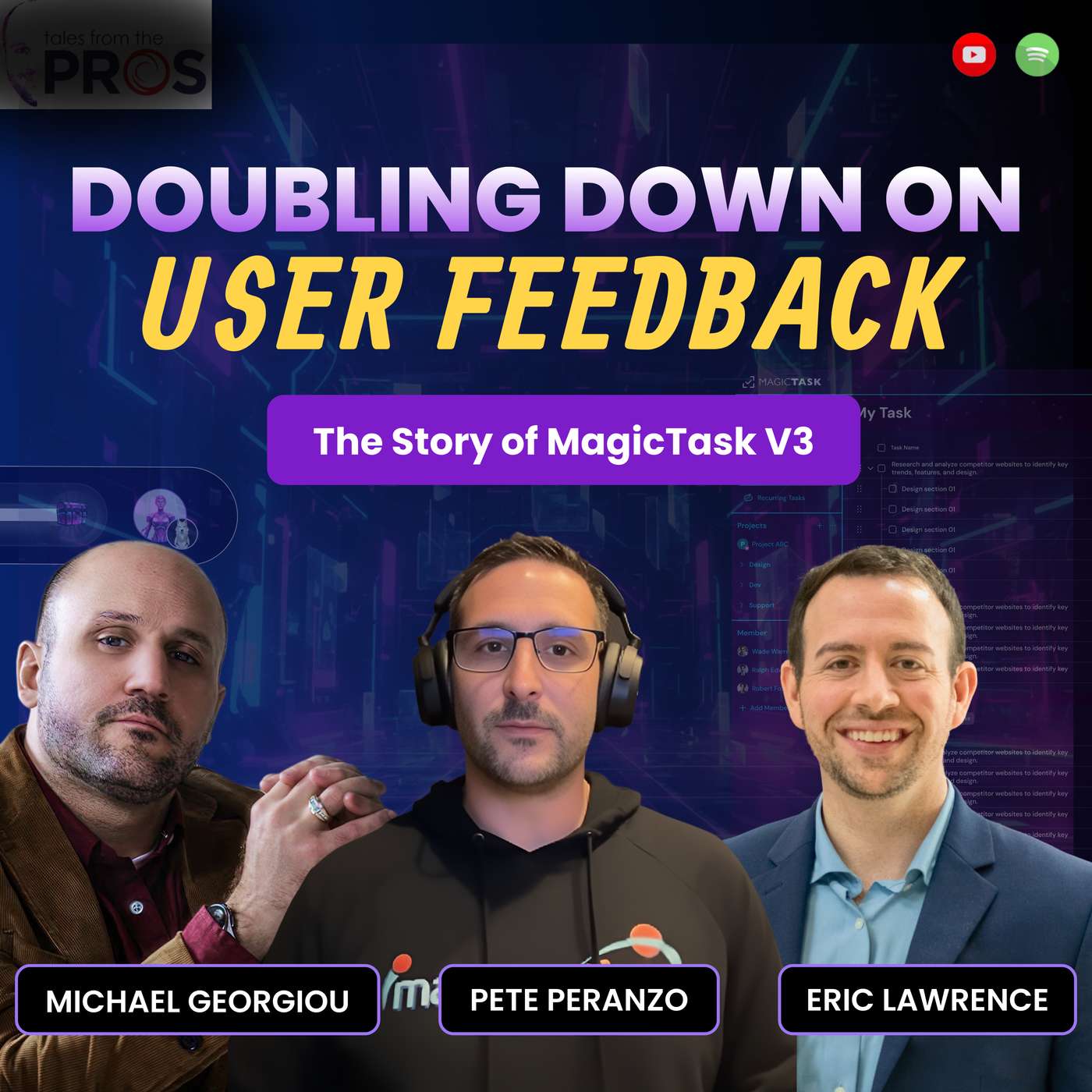
In this episode of Tales from the Pros, hosts Michael Georgiou and Eric Lawrence sit down with Imaginovation co-founder and creator of MagicTask, Pete Peranzo , for a candid, behind-the-scenes look at what it truly takes to build, launch, fail, and completely rebuild a digital product. While MagicTask just shipped its biggest release ever—Version 3—the journey to get there spanned more than six years of technical pivots, monetization mistakes, and fundamental breakthroughs in user psychology. Pete shares the raw origin story of MagicTask, starting back in 2019 when Imaginovation's leadership ran entire agency and development workflows out of Notepad++ text files. After building Version 1 as a web-based checklist and finding it too tedious to sustain long-term use, the team introduced gamification in Version 2. But despite acquiring thousands of users through paid campaigns, V2 fell into a punishing trap: an inverted difficulty curve where working harder resulted in months-long reward droughts, paired with a monetization model that failed to convert users. Rather than continuing to patch an architectural dead-end, the leadership team drew inspiration from Marty Cagan's product benchmark Inspired: How to Create Tech Products Customers Love and made the bold decision to scrap the codebase and rebuild from scratch. Version 3 completely reimagines gamification in SaaS product design with a proprietary Dynamic Difficulty Adjustment (DDA) engine that balances daily rewards to ~1 chest per day, a strict 2-minute daily interaction limit that prevents distraction, and intuitive gaming terminology centered on Realms, Dungeons, and Boss Chests. The conversation also explores how radical simplicity and gamification for ADHD users help maintain daily focus in high-churn environments, how daily task execution functions as an operational leading indicator driving business revenue, and Pete’s ambitious long-term vision of transforming task management into a competitive team arena where companies can battle asynchronously based on their daily work output. If you're a founder, product manager, or software engineer navigating product pivots, technical debt, or exploring enterprise gamification solutions to boost engagement and retention, this episode delivers a transparent, practical breakdown of how to build remarkable digital products that people genuinely love. Highlights You Won’t Want to Miss The origin story: Moving from Notepad++ to building an in-house agency task tool Why Version 2 failed: 6-month reward droughts, monetization missteps, and technical debt The decision to rebuild vs. patch: Applying Marty Cagan's Inspired philosophy to software development Solving the gamification paradox: Why productivity and gaming are like oil and vinegar The 2-minute guardrail: How passive gamification delivers dopamine without disrupting deep work Dynamic Difficulty Adjustment (DDA): Calibrating backend algorithms so every user earns ~1 reward chest per day Replacing abstract "Themes" with intuitive mechanics: Realms, Dungeons, and Boss Chests Why radical minimalism makes MagicTask a game-changer for ADHD and neurodivergent professionals Leading vs. lagging indicators: How daily task execution drives bottom-line revenue The future of work: Pete's vision for company-vs-company arena battles (Imaginovation vs. Google) Listen and Subscribe Spotify: https://open.spotify.com/show/6QkUtrcNllUkqtq1fjlwnZ Apple Podcasts: https://podcasts.apple.com/us/podcast/tales-from-the-pros/id1371067192 YouTube: https://www.youtube.com/@Imaginovation/podcasts SoundCloud: https://soundcloud.com/talesfromthepros Key Takeaways Productivity is defined by consistency, not sporadic bursts of high output Gamification must never compete with work—keep direct game interactions under two minutes daily Inverted progression curves kill user retention; systems must dynamically adapt to individual workloads Internal dogfooding uncovers architectural and UX flaws faster than synthetic testing Don't patch broken fundamentals—when a product isn't remarkable, commit to a ground-up rebuild Cluttered enterprise suites overwhelm users; austere simplicity empowers focus and neurodivergent minds High-performing teams focus on leading indicators (daily completed actions) to ensure lagging results (revenue, growth) Effective gamification uses universally understood mental models (Dungeons, Chests) rather than abstract points Topics We Cover Software product evolution and complete rebuild strategy Gamification psychology vs. workplace productivity Dynamic Difficulty Adjustment (DDA) algorithms MVP validation, user retention, and SaaS monetization lessons Overcoming technical debt and modernizing software architecture Cognitive overload in legacy enterprise project management tools ADHD-friendly product design and focus mechanics Workplace culture, camaraderie, and team-based competition Leading vs. lagging business performance indicators ⏱️ Chapters 00:00 — Introduction: Why productivity should feel rewarding 02:13 — The origin story: Running an agency on Notepad++ 03:40 — Consistency as the true definition of productivity 04:13 — The failure of V2 monetization & early implementation traps 04:45 — The catalyst: Marty Cagan’s Inspired & building something remarkable 06:18 — Escaping the clutter of Jira, Basecamp, and Monday.com 08:50 — The technical realities: Bugs, architecture, and building without AI tools 11:49 — Acquiring 5,000 users vs. validating willingness to pay 12:47 — Dogfooding: How MagicTask powered Imaginovation’s agency operations 13:33 — The gamification flaw: The 6-month to 2-year reward drought 15:21 — The V3 breakthrough: Dynamic Difficulty Adjustment (DDA) explained 18:16 — Shifting from "Themes" to intuitive Realms, Dungeons, and Boss Chests 23:00 — Finding the market gap: Radical simplicity over enterprise bloat 25:12 — The gamification paradox: Balancing gaming dopamine with deep work 26:33 — The 2-minute rule: Making gamification passive and non-intrusive 27:36 — Daily streaks, magic tokens, and building consistent work habits 28:39 — The long-term vision: Evolving from a task manager to an arena platform 32:06 — Gamification for B2B teams, sales motivation, and culture 33:23 — Company-vs-Company battles: Imaginovation vs. Google 36:53 — Leading vs. lagging indicators: How daily habits drive business revenue 38:07 — Why MagicTask holds attention for ADHD & neurodivergent users 39:35 — Key takeaways and final thoughts