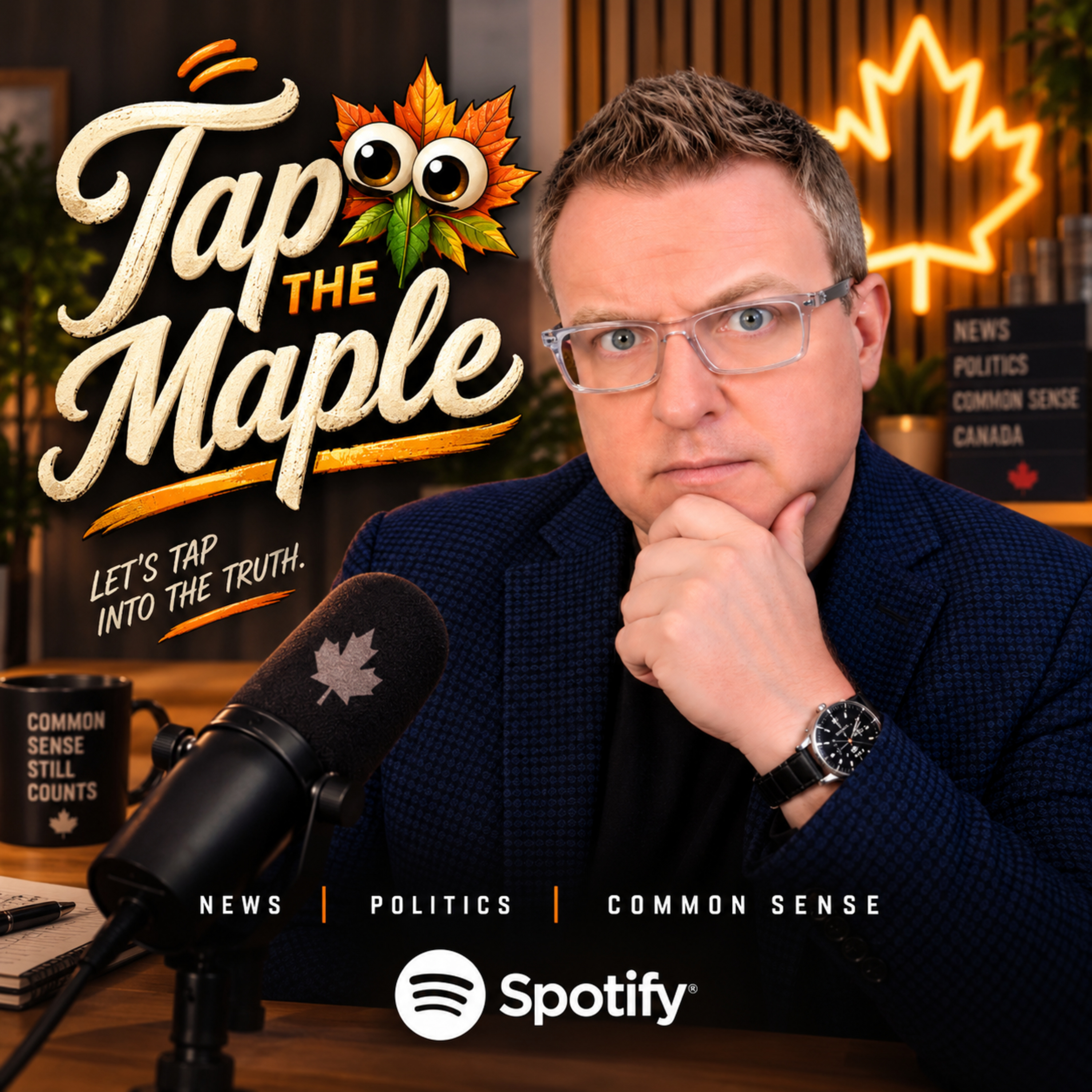
Tap the Maple is an independent Canadian political commentary show covering Canadian politics, the economy, affordability, government spending, taxes, trade, elections, and the decisions shaping our country’s future. Hosted by Chris Baker (Bakes), we go beyond the headlines to examine what government policies mean for your wallet, your freedoms, your family, and the future of Canada. From Parliament and party leaders to housing, inflation, jobs, and the cost of living, Tap the Maple delivers fact-driven analysis and unapologetic debate from a conservative perspective. If you’re looking for independent Canadian news analysis, political commentary, and serious conversations about where Canada is headed, you’re in the right place. Subscribe and join a growing community of Canadians who believe informed citizens build stronger democracies. Let’s tap into the truth. Keywords: Canadian politics, Canada economy, cost of living Canada, inflation Canada, taxes Canada, housing crisis Canada, government spending Canada, Mark Carney, federal budget Canada, trade deals Canada, media bias Canada, economic analysis Canada, Canadian news podcast, political commentary Canada
Pitch Analysis
Required Pod Score for this show. PitchCentric checks your profile against host openness, topical fit, and audience signals before you generate a pitch.
Contact path
Public web form
Booking probability
36%
Guest openness
Selective
80/100
Required Score
Sign up to generate a grounded pitch for Tap The Maple.
Our AI reads these to draft pitches. Use them as grounding for a pitch that cites a real guest and a specific topic.
Tap The Maple
Trump Just BANNED Canadian Products… But Nobody Is Asking The REAL Question
Sep 30, 202624 min
Donald Trump has just taken the Canada-U.S. trade war somewhere extraordinary: the United States is now BANNING certain Canadian products from entering the country. Alcohol. Dairy products. Motorcycles. Nearly US$1 billion in Canadian imports are affected. But instead of asking the same question we've been asking for months, “What is Trump doing to Canada now?”, today we're asking something much more uncomfortable: Why Canada? Because Donald Trump deals with Mexico too. Mexico shares the same American border. Mexico competes for American factories and jobs. Mexico belongs to the same USMCA trade agreement. Yet Canada's relationship with Washington has descended through tariffs, retaliation, collapsed negotiations and now outright import bans. So what are WE doing differently? Canada responded to the latest U.S. tariffs with $27.6 billion in dollar-for-dollar counter-tariffs. Washington responded by escalating again. That raises the question at the heart of today's Tap the Maple: Is Canada's strategy actually working? We follow the timeline, examine Washington's complaints involving alcohol, dairy and automobiles, compare Canada's deteriorating relationship with America's negotiations with Mexico, and uncover one particularly remarkable problem: Canadian alcohol producers losing American customers still face barriers selling their products across their own country. Maybe it's time Canada stopped measuring how tough its retaliation sounds, and started measuring what that retaliation actually accomplishes. Because retaliation and leverage are not necessarily the same thing. And Canadian workers could end up paying the difference. #cdnpoli #canada #canadian #markcarney #donaldtrump #tariffs #americanpolitics #canadianpolitics #politics #news #canadalife #liberal #conservative #usanews #usapolitics #canadanews #canadapolitics #canadavlog #politicalnews #politicalcommentary
Carney’s New Plan Exposes a MASSIVE Problem With His Last One
Sep 29, 202616 min
Bill C-39 promises “one project, one decision, in one year.” But Mark Carney promised to fast-track Canada’s major projects last year. What happened to them? The government says 27 nation-building initiatives have been referred to its Major Projects Office, representing $200 billion in potential investment. In this episode of Tap the Maple, Bakes follows the difference between a project being announced, referred, approved, funded and built. We examine when Bill C-39’s one-year clock actually starts, how timelines can change, and why pipelines and nuclear projects follow different processes from the headline “one project, one decision” pitch. Then we ask the question Ottawa should answer before celebrating another fast-track bill: Which projects from last year are under construction, and what did the first fast-track law do to get them there? What project should we track next? Tell me in the comments. Sources: Government of Canada’s Bill C-39 backgrounder · Major Projects Office’s original project announcement #cdnpoli #canada #canadian #canadalife #markcarney #billc5 #billc39 #canadiannews #canadianpolitics #canadanews #canadavlog #canadapolitics #canadavlogs #politicalcommentary
The TRUTH About America Searching Your Phone at the Border... PROPAGANDA FREE
Sep 28, 202618 min
CTV warned Canadians that U.S. border officials can search their cellphones without reasonable suspicion. That's true, but once you look at the actual U.S. policy, the court case behind the story and CBP's own statistics, the picture becomes very different. More than 420 million travellers were processed by U.S. Customs and Border Protection in FY2024. Electronic devices searched: 47,047, less than 0.01%. And that's only the beginning. In this episode of Tap The Maple, Bakes digs into the actual U.S. cellphone search policy, the difference between basic and advanced searches, what border officers can access, restrictions involving cloud data, what really changed in 2026, and the surprising facts behind the court case that reignited the story. The power to search electronic devices at the U.S. border is real. The privacy debate is real. But when Canadians are warned about a frightening possibility, shouldn't they also be told how often it actually happens? Sometimes the most important part of a scary statistic is the denominator. Watch to the end and decide for yourself whether Canadians were given enough context to understand the actual risk. #cdnpoli #canada #cbp #borderpatrol #usa #america #travel #borderprotection #american #americanpolitics #canadianpolitics #canadiannews #canadanews #markcarney #donaldtrump
Upsetting Daddy: Carney’s New PBO Just Gave Him a BIG Problem
Sep 27, 202620 min
Mark Carney says Ottawa is on track to balance its operating budget ahead of schedule. But Canada's Parliamentary Budget Office has just released an analysis that raises some fascinating questions about what “balanced” actually means. The federal government now separates spending into operating and capital categories, and the PBO says some of those classifications “appear contradictory.” Even more importantly, the PBO explains that changing how expenditures are classified can affect the operating balance without changing the underlying fiscal policy. So can Ottawa claim an operating balance while the federal government continues borrowing billions of dollars? Yes. And that's where this gets interesting. We break down the difference between Canada's overall deficit and its new operating-budget fiscal anchor, why the distinction matters, and the PBO's finding that $173.3 billion in new measures since Budget 2025 vastly exceeded the $18.5 billion in cumulative fiscal room created by economic and fiscal developments. Then there's another twist. Former interim Parliamentary Budget Officer Jason Jacques repeatedly produced uncomfortable fiscal assessments for Ottawa. A parliamentary committee recommended Jacques for the permanent seven-year position, but Annette Ryan ultimately became Canada's new Parliamentary Budget Officer. Now Ryan's PBO is raising significant questions of its own about the government's fiscal framework. Changing the referee didn't change the scoreboard. In this episode of Tap the Maple, Bakes breaks down the accounting in plain English, because “balancing the operating budget” and “balancing Canada's budget” are two very different things. #cdnpoli #canada #canadian #canadalife #canadianpolitics #canadiannews #canadapolitics #canadanews #markcarney #liberal #conservative #canadaeconomy #canadianeconomy #pbo #budget #budgetofficer
Mark Carney told The New York Times that Canada prepared for the “extreme tail risk” of American military action under Donald Trump. There is one enormous problem: Trump had already been asked directly whether he would use military force against Canada, and he said no. So why did Canada’s prime minister resurrect the image of an American invasion during a major interview with an American newspaper while attending the United Nations in New York? Why did Canadians hear this supposed revelation through foreign media? What evidence existed that the United States posed a genuine military threat? What exactly did Carney authorize Canada to prepare for? And was this really national-security planning, or political theatre designed to make Carney appear strong on the international stage? In this episode of Tap the Maple, Bakes examines the enormous gap between an economic dispute and a military invasion, the power of fear in political messaging, and the strategic value Carney gains from casting himself as Canada’s defender against a threat that was never shown to exist. A government quietly examining hypothetical risks is one thing. A prime minister publicly placing the words “American invasion” into the international conversation is something very different. If Mark Carney wants credit for protecting Canada, Canadians have every right to ask: protecting us from what? #cdnpoli #canada #liberal #conservative #canadian #canadalife #canadavlog #canadavlogs #donaldtrump #america #usa #us #amercanpolitics #americannews #newyorktimes #markcarney #canadianpolitics #canadapolitics #canadanews #canadiannews
Every question we get asked before someone starts their trial.
If you have a concern about deliverability, AI quality, data privacy, or whether this will actually work for your specific situation, it's probably answered below.
What is the difference between Founder Solo and Founder Pro?
Founder Solo gives you 50 AI pitches per month using the credit model (Standard pitches cost 1 credit, Enriched pitches cost 2). Founder Pro raises that to 200 credits per month and adds full Booking Probability access, unlimited Magic Match, Apollo enrichment credits, and data export capabilities. Both plans use the same credit system, so you can stretch your monthly budget further by using Standard-mode drafting.
How do agency tiers work?
Agency tiers have no base fee. You pay per managed client and per talent profile. Agency Standard is $199 per client per month; Agency Pro is $399 per client per month. Both add $39 per talent profile per month. Your own team's user seats are always free.
What is a talent profile?
A talent profile represents one person (founder, executive, or spokesperson) you are booking onto podcasts. It includes their bio, topics, headshots, and outreach history. Team plans include 5 profiles; agency plans are pay-as-you-go.
Can I switch plans later?
Yes, at any time. Upgrades take effect immediately; downgrades apply at the end of the current billing period. Contact support if you need help migrating between plan families.
Do you offer a free trial?
Every paid plan includes a 15-day free trial. Your card is saved at signup but you will not be charged until day 16. Cancel any time from your dashboard.
What happens if I cancel?
You keep access until the end of your current billing period. No charges after that. Your data is retained for 30 days in case you reactivate.
Is the 20% annual discount automatic?
Yes. Select Annual on the pricing toggle and the discounted price is applied automatically at checkout. The annual price shown is the full year cost.
What if I have more than 50 profiles or 20 clients?
That is our Enterprise tier. Contact our sales team and we will build a custom plan with volume pricing, a dedicated account manager, and SLA guarantees.