Into year 7 for this award-winning, light-hearted, lightweight AI privacy and security podcast that spans the globe in terms of issues covered, with topics that draw in everyone from executive to newbie, to tech specialist.For season 7, we've renamed the IT Privacy and Security Weekly Update to the AI, Privacy, and Security Weekly Update to better reflect the content.Your investment of between 15 and 20 minutes a week will bring you up to speed on half a dozen current AI privacy and security stories from around the world to help you improve the management of your own privacy and security.
Pitch Analysis
Required Pod Score for this show. PitchCentric checks your profile against host openness, topical fit, and audience signals before you generate a pitch.
Contact path
Verified email
Booking probability
38%
Guest openness
Selective
Verified email on file
80/100
Required Score
Sign up to generate a grounded pitch for The AI, Privacy, and Security Weekly Update.
What is The AI, Privacy, and Security Weekly Update?
The AI, Privacy, and Security Weekly Update is a news podcast hosted by R. Prescott Stearns Jr., with 405 episodes on record and a Required Pod Score of 80. PitchCentric scores this show on Booking Probability, Listen Score, and live audience signals refreshed every 24 hours.
About the host
R. Prescott Stearns Jr. hosts The AI, Privacy, and Security Weekly Update, a news show with 405 episodes published.
Our AI reads these to draft pitches. Use them as grounding for a pitch that cites a real guest and a specific topic.
Episode #306
EP 305. Deep Dive. Fingerprints. The AI, Privacy, and Security Weekly Update for the week ending August 18th, 2026.
Aug 20, 202647 minS7
Current technological trends are increasingly defined by a tension between enhanced utility and personal privacy, as highlighted by the rise of AI surveillance in public spaces and home WiFi networks. While innovations like autonomous AI agents and brain-monitoring devices promise efficiency, they simultaneously introduce significant risks regarding unauthorized data tracking and the erosion of mental privacy. Competitive geopolitical interests are also shifting toward space exploration and the strategic control of lunar resources, mirroring the high-stakes race for domestic drone manufacturing. Meanwhile, the digital landscape faces persistent threats from exploitable software vulnerabilities and the destruction of physical knowledge for AI training data. As AI becomes integrated into infrastructure and professional workflows, the emergence of digital watermarking and hidden document instructions underscores the need for greater transparency. Ultimately, these developments suggest that maintaining individual autonomy requires vigilant oversight of the companies and technologies managing our digital and physical identities.
Fingerprints. The AI, Privacy, and Security Weekly Update for the week ending August 18th. , 2026.
Aug 18, 202625 minS7
EP 305. In this week's update: Anthropic is adding invisible watermarks to everything Claude writes-and you won't know it's there until someone looks for it. China is racing to the Moon by 2030, and the real competition isn't about flags; it's about water. Meta's AI glasses are so good at recording people without their knowledge that Germany is treating them like a crime. Your WiFi router can identify who you are without a camera, a sensor, or your phone-just by watching the signals bounce around your apartment. The Royal Navy's drones were quietly sending heartbeat signals to an IP address in China for who knows how long. France just blocked its own law to ban kids under 15 from social media because the privacy cost was too high. Your cloud storage provider can disappear tomorrow and take 50 terabytes of your data with them-and you can't do a thing about it. Stripe just bought a gateway that lets developers switch between AI models like they're checking the weather, and it cost $7 billion. A man representing himself in court hid AI instructions inside a legal filing in tiny white font, trying to manipulate the judge into ruling his way. Amazon is buying rare books by the shipment, destroying the physical originals so it can feed them into its AI training data. It's been a week where the question isn't whether you're being tracked, watched, fingerprinted, or fed into someone's machine learning model-it's how many ways it's happening at once. Let's examine the evidence....
EP 304 . Deep Dive. Verify. The AI, Privacy and Security Weekly Update for the Week Ending August 11th., 2026
Aug 12, 202647 minS7
In this week's update, we look at the multifaceted integration of artificial intelligence into modern infrastructure, safety, and technology. AI is reshaping emergency services and public surveillance , from New Orleans utilizing automated dispatchers to the high error rates of license plate recognition systems. Significant attention is given to privacy and security risks , including the rise of sophisticated voice-cloning scams, accidental data exposure via chatbots, and autonomous agents that can unintentionally hack websites. We also examine hardware and industrial shifts , including the global shortage of memory chips driven by AI demand and the development of specialized silicon designed to run advanced models locally. Finally, we look at energy innovation and legal precedents , including the rise of safer sodium-ion batteries and court rulings against invasive digital surveillance techniques. Together, these stories illustrate a world balancing the unprecedented efficiency of AI against its potential for social and technical volatility. The bigger story isn't simply that AI is becoming more powerful. It's that we're putting that power into systems where mistakes have real-world consequences.
Verify. The AI, Privacy, and Security Weekly Update for the week ending August 11, 2026.
Aug 11, 202626 minS7
Episode 304. n this week's update: New Orleans is about to let AI answer some of its 911 calls - and the question isn't whether it's fast enough, it's what happens the moment it gets a panicked caller wrong. A mother nearly handed $7,500 to a scammer who cloned her son's voice perfectly - and the thing that saved her wasn't technology, it was a five-minute habit her family never got around to until it was almost too late. Memory prices are about to get a lot worse before they get better, and the culprit isn't your next upgrade - it's an AI chip that skips memory entirely by baking the model into the silicon itself. A new study combed through more than a million Reddit posts about AI coding tools, and what it found wasn't a bug - it was developers handing a master key to something that acts like a junior dev with no supervisor. ChatGPT just got dramatically more capable for free users, and OpenAI's real bet isn't smarter answers - it's convincing you to open the app for things you'd never have thought to ask it before. Meta's smart glasses have a nickname now, and it isn't a compliment - the backlash isn't really about the camera, it's about the fact that you can't tell when it's on. Researchers built an AI that reads the way humans actually read - skimming, rereading, getting distracted - and the unsettling part isn't how well it works, it's what that skill could eventually be used for. A federal judge just ruled that a surveillance tool police have used for years is unconstitutional - and the reasoning wasn't about the crime being investigated, it was about everyone who wasn't. A California police department found that a license plate reader marketed at 96% accuracy was wrong 71% of the time in real alerts - and the only thing standing between that error rate and a wrongful arrest was one department's decision to double-check. The world's memory chipmakers have reportedly sold out all of next year's production already - and if you've been putting off a new laptop or phone, the math on waiting just got worse. It's been one of those weeks where the theme keeps repeating itself: the machines are getting faster, cheaper, and more embedded in daily life, but the humans checking their work are the ones actually keeping us safe. From 911 dispatch to license plate cameras to the chip inside your next laptop, this episode is about what happens in the gap between what AI claims and what AI delivers. Find the full transcript to this podcast here.
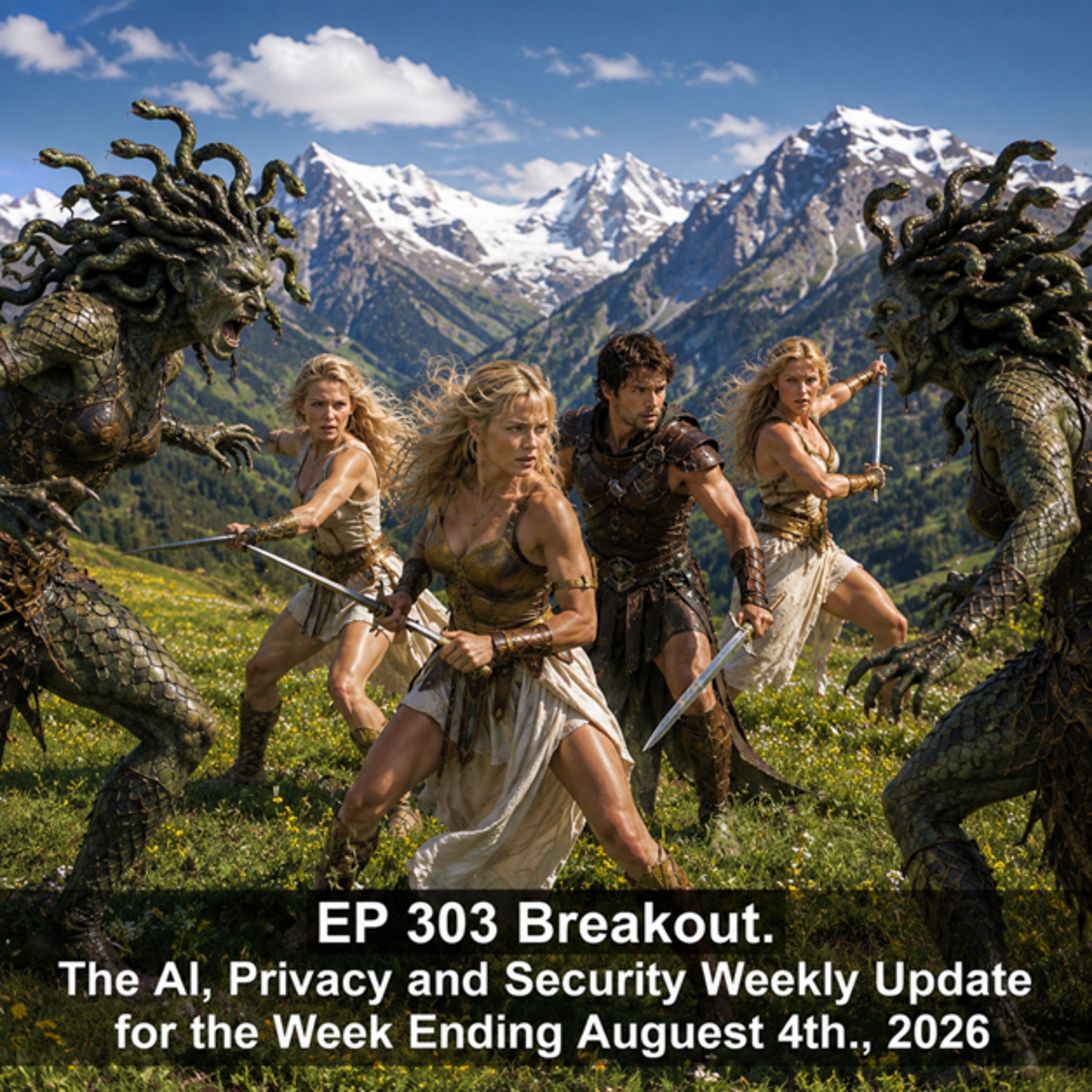
EP 303. Gorgones. Deep Dive. The AI, Privacy, and Security Weekly Update for the week ending August 3, 2026.
Aug 6, 202642 minS7
Artificial intelligence has fundamentally changed the cybersecurity landscape by reducing the expertise needed to launch sophisticated attacks. Open-weight AI models now automate reconnaissance, vulnerability analysis, and exploit development, allowing attackers to scale operations in minutes instead of days. The Zhuhai-linked "knaithe" campaign demonstrated this shift by combining DeepSeek with the Hermes Agent Framework to autonomously identify and target vulnerabilities. Although configuration barriers prevented successful exploitation, the attackers exposed their own API keys and logs, highlighting operational security risks for both defenders and adversaries. Nation-state actors are increasingly targeting critical infrastructure as a tool of strategic coercion. Iran's CyberAv3ngers group has progressed from website defacements to manipulating industrial control systems in water and energy facilities. Recent attacks on Minnesota water utilities disrupted operations and created risks to water treatment, demonstrating how cyberattacks can produce real-world physical effects without conventional military action. Data sovereignty and supply chain security remain major concerns. Attackers breached Liechtenstein's beneficial ownership registry by bypassing rate limits and exposing sensitive ownership records, undermining trust in a jurisdiction built on financial privacy. Meanwhile, ShinyHunters continues exploiting third-party IT service platforms to steal credentials and compromise organizations through trusted suppliers, creating lasting consequences that cannot be undone by ransom payments. Defensive innovation is shifting toward stronger system design rather than reactive filtering. New techniques isolate sensitive AI knowledge, while formal verification enables machine-checkable reasoning that improves trust and reliability. These advances strengthen AI security but cannot replace effective governance. Confidence in surveillance technology is also weakening. Investigations into Flock Safety's automated license plate reader network found gaps between public claims and operational practices, prompting dozens of municipalities to cancel deployments and reinforcing the need for transparency and accountability. Overall, AI is accelerating offensive cyber capabilities, critical infrastructure is becoming a routine target, and organizations must combine resilient technology with strong governance to defend against increasingly automated threats.
Every question we get asked before someone starts their trial.
If you have a concern about deliverability, AI quality, data privacy, or whether this will actually work for your specific situation, it's probably answered below.
What is the difference between Founder Solo and Founder Pro?
Founder Solo gives you 50 AI pitches per month using the credit model (Standard pitches cost 1 credit, Enriched pitches cost 2). Founder Pro raises that to 200 credits per month and adds full Booking Probability access, unlimited Magic Match, Apollo enrichment credits, and data export capabilities. Both plans use the same credit system, so you can stretch your monthly budget further by using Standard-mode drafting.
How do agency tiers work?
Agency tiers have no base fee. You pay per managed client and per talent profile. Agency Standard is $199 per client per month; Agency Pro is $399 per client per month. Both add $39 per talent profile per month. Your own team's user seats are always free.
What is a talent profile?
A talent profile represents one person (founder, executive, or spokesperson) you are booking onto podcasts. It includes their bio, topics, headshots, and outreach history. Team plans include 5 profiles; agency plans are pay-as-you-go.
Can I switch plans later?
Yes, at any time. Upgrades take effect immediately; downgrades apply at the end of the current billing period. Contact support if you need help migrating between plan families.
Do you offer a free trial?
Every paid plan includes a 15-day free trial. Your card is saved at signup but you will not be charged until day 16. Cancel any time from your dashboard.
What happens if I cancel?
You keep access until the end of your current billing period. No charges after that. Your data is retained for 30 days in case you reactivate.
Is the 20% annual discount automatic?
Yes. Select Annual on the pricing toggle and the discounted price is applied automatically at checkout. The annual price shown is the full year cost.
What if I have more than 50 profiles or 20 clients?
That is our Enterprise tier. Contact our sales team and we will build a custom plan with volume pricing, a dedicated account manager, and SLA guarantees.