The Court Reporter Podcast is a space for court reporters who want to leverage technology and streamline their workflows, to move from feeling overwhelmed and scattered to clear, confident, and assertive in their work and their lives. Hosted by Brynn Reynolds Seymour, this podcast offers grounded conversations, practical insight, and perspective drawn from real experience inside the courtroom. Each episode explores the mental, professional, and relational challenges court reporters face but rarely talk about openly, from managing stress and self-doubt to communicating effectively with attorneys, advocating for yourself, and creating systems that support clarity and balance. Rather than quick fixes or industry noise, this podcast focuses on thoughtful guidance, mindset shifts, and simple strategies that help you show up with confidence on the record and off. You will hear honest reflections, professional coaching insights, and real-world lessons on time management, boundaries, communication, and leadership within the justice system. If you are a court reporter who wants to trust yourself more, think more clearly, and build a sustainable business without burnout, The Court Reporter Podcast is for you.
Pitch Analysis
Required Pod Score for this show. PitchCentric checks your profile against host openness, topical fit, and audience signals before you generate a pitch.
Contact path
Public web form
Booking probability
32%
Guest openness
Selective
80/100
Required Score
Sign up to generate a grounded pitch for The Court Reporter Podcast.
Our AI reads these to draft pitches. Use them as grounding for a pitch that cites a real guest and a specific topic.
Episode #101
101 | How a Mother-Daughter Team Built a Successful Court Reporting Business
Sep 23, 202634 min
What happens when you stop trying to do everything yourself and start building a business around what you do best? In this episode, I sit down with Donna , a stenographic court reporter who has been certified since 1969 and has more than 50 years of experience in the profession, and her daughter Dana , who went from delivering transcripts to overseeing operations and eventually becoming an equity partner in the family business. Donna takes us back to the early days of her career, from taking on demanding assignments to navigating decades of technological change in court reporting. Along the way, she built an agency and a reputation around what she does exceptionally well: being a court reporter . But as the business grew, so did everything that came with running it. That's where Dana's strengths came in. With a natural ability for organization, operations, and building relationships, Dana gradually took on more of the administrative side of the business—allowing Donna to spend more of her time doing what she does best. Their story is a great example of something I talk about often on this podcast: you don't have to be great at everything to build a successful court reporting business. You need to know your strengths, recognize where you need help, and find the right people to fill those gaps. We also talk about the importance of relationships, earning clients' trust, securing municipal contracts, adapting to changes in the industry, and what it takes to successfully build and sustain a business across generations. At its heart, this is a story about a mother and daughter whose very different strengths became their greatest advantage. In this episode: Donna's journey through more than 50 years of court reporting What court reporting looked like when Donna began in 1969 Building a court reporting agency from the ground up Navigating decades of technological change How Dana went from delivering transcripts to running operations Transitioning administrative responsibilities from Donna to Dana Why Donna and Dana's different strengths work so well together Knowing what you're good at—and when to ask for help Building and maintaining strong client relationships Earning trust and securing municipal contracts Strategic delegation in a court reporting business Building a successful mother-daughter partnership Creating a business that can adapt and endure
From Backlogged to Building Bigger: Celebrating 100 Episodes
Sep 14, 202628 min
We made it to 100! When I launched The Court Reporter Podcast in January 2023, I simply described myself as “a court reporter with something to say.” Three years and 100 episodes later, the podcast has become something much bigger. For this special 100th episode, I sit down with my friend and Virtual Transcript Manager, Karina, to talk about the journey that brought us here — including how our friendship grew into a working partnership that has helped transform the way I run my court reporting business. We talk about what it was like just a few months ago, when the business was overwhelmed with a backlog of transcripts, and how building a team, bringing in trusted support, and creating better systems helped get everything back on track. We also reveal a major new development: the Court Reporter Podcast now has its own studio. What started as a search for a place to work eventually turned into something neither of us expected — a studio and potential community space designed for court reporters and other legal professionals in mind. And looking ahead, I share the bigger vision behind all of it: helping court reporters spend more time on the record and less time on administrative work , while building businesses and lives that don't require them to carry every piece themselves. This is a conversation about friendship, entrepreneurship, overwhelm, delegation, finding the right people, and figuring out what comes next. And, of course, it's a celebration of reaching 100 episodes . In this episode: Celebrating 100 episodes of The Court Reporter Podcast How Brynn and Karina became friends — and eventually business partners Going from 18 transcripts “in the red” to getting the backlog under control Building a team and creating scalable systems Why finding the right people can completely change your business The unexpected story behind the new Court Reporter Podcast studio My journey from traditional court reporting to building a more flexible business More time on the record, less time on the admin The vision for supporting other court reporters What's next for the podcast, the studio, and the community Thank you for being part of the first 100 episodes. Here's to the next 100.
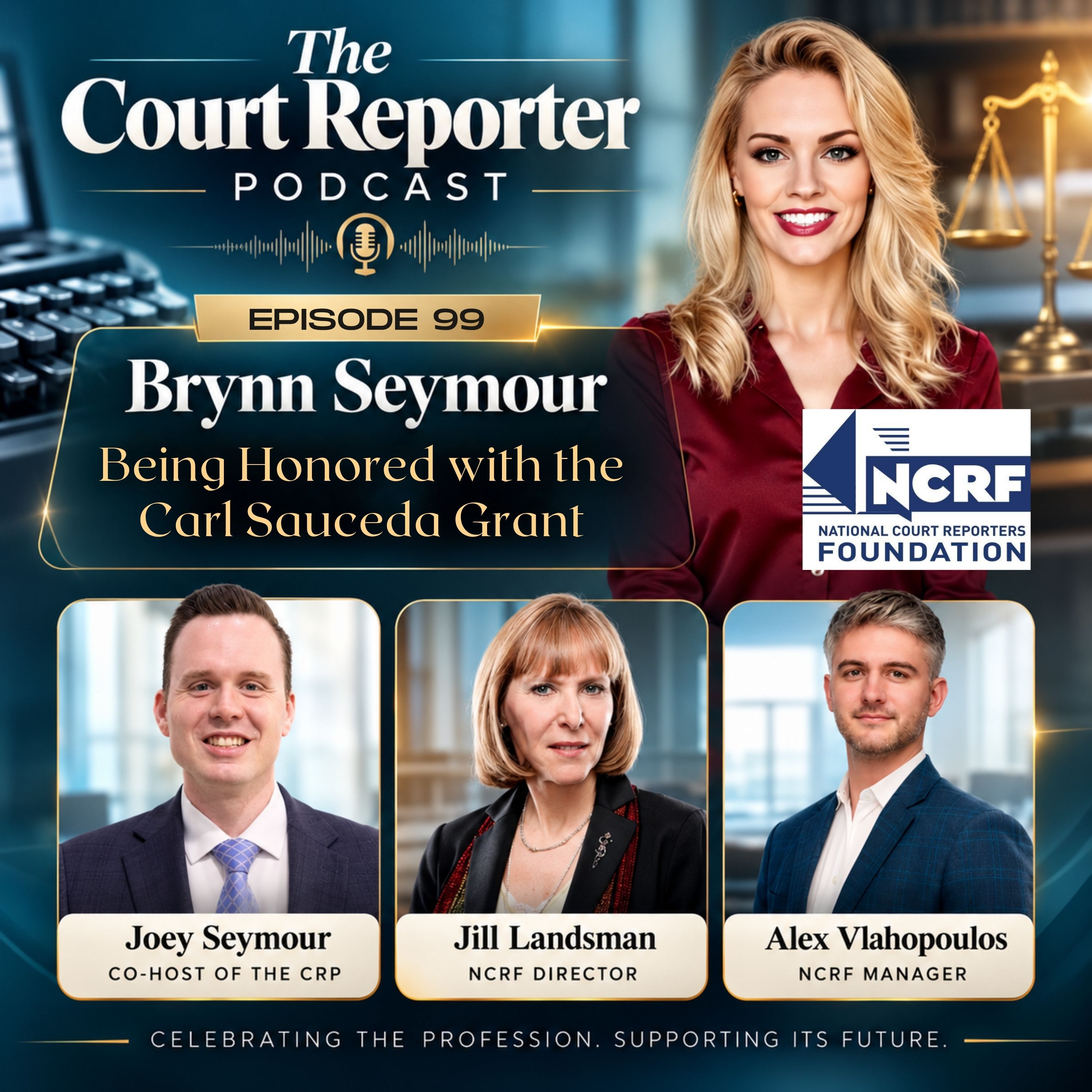
99 | Keep Showing UP: NCRF Awards the Court Reporter Podcast with the Carl Sauceda Grant ft. Alex Vlahopoulos & Jill Landsman
Aug 31, 202626 min
In this special episode of The Court Reporter Podcast , Joey Seymour steps behind the microphone as guest host for a conversation with Jill Parker Landsman and Alex Vlahopoulos of the National Court Reporters Foundation (NCRF). The conversation gets personal as Jill and Alex share why I, as the host of the Court Reporter Podcast, was unanimously selected as the 2026 recipient! I am truly honored and encouraged by this, so I wrote a song about it... I hope you love it! I'm so excited to continue giving back to the profession. They dive deep into the impact The Court Reporter Podcast has had inside and even beyond the U.S., and why this grant is about much more than receiving an award. I am so grateful to receive this nomination, and I have so many people to thank for supporting along the journey. Keep showing up! In this episode: The story and legacy of Carl Sauceda Why the grant was created in his honor What makes someone an ambassador for court reporting Why the grant continues to create a ripple effect years after someone receives it Why Brynn was unanimously selected as the 2026 recipient The role social media, mentorship, education, and outreach can play in advancing the profession, and why that matters (discussing the nationwide shortage) How to nominate a deserving reporter or captioner for a future Carl Sauceda Grant Jill's advice for students and working reporters: never stop practicing Why technical skill alone isn't enough — and why freelance reporters also need strong business skills Most importantly, this conversation is an invitation to consider the impact each of us can have on the profession. You don't need a title, a huge platform, or decades in the field to give back. Mentor someone. Encourage a student. Introduce someone to stenography. Share what you've learned. Create something that helps the reporter coming behind you. Keep showing up — because you may never know how far that impact will travel.
98 | Navigating the Highs and Lows of Court Reporting Careers
Aug 24, 202616 minS3
From Australia to London: The Global World of Realtime Reporting What happens when a childhood fascination with a court reporter on television turns into a 30+ year international career? In this episode, I sit down with Leah Willisdorf , an accomplished international realtime reporter who takes us from her beginnings in Australia to her current home in London. Leah shares how a fictional court reporter on a television show sparked her interest in the profession and ultimately led her to a career spanning more than three decades. She explains why realtime reporting has become such an important skill in today's legal industry and why reporters who master it are increasingly valuable. We also dive into Leah's experience working on international arbitrations and corporate depositions , where the expectations for speed, accuracy, and professionalism are exceptionally high. Leah opens up about the pressures of working in these environments and the reality of burnout in a demanding profession. One of the most valuable parts of our conversation is Leah's advice for creating a sustainable career. She discusses the importance of building a strong support network—including scopists and proofreaders—and finding ways to maintain a healthy work-life balance while working at a high level. Leah's enthusiasm for court reporting is contagious. From international travel and unique assignments to developing highly sought-after skills, she makes a compelling case for why court reporting can be an incredibly rewarding career. This is another episode that was recorded live at the NCRA convention expo hall. In this episode: How a television show inspired Leah to become a court reporter Leah's journey from Australia to London Building a 30+ year career in court reporting Why realtime reporting is becoming increasingly important Working on international arbitrations The demands of corporate depositions Handling high-pressure assignments Burnout and the challenges of the profession Why scopists and proofreaders are so important Building a sustainable work-life balance The opportunities for travel and international work Why aspiring reporters should develop their realtime skills Takeaways Inspiration can come from the most unexpected places—even television. Realtime reporting is one of the most valuable skills a modern court reporter can develop. International arbitrations and corporate depositions demand exceptional speed, accuracy, and preparation. A strong support network can make a demanding career much more sustainable. Burnout is a real challenge, and maintaining balance is essential for a long career. Developing realtime skills can open the door to unique assignments and international opportunities. Court reporting can provide a career filled with travel, variety, and continuous professional growth.
97 | Stop Doing Everything Yourself: How Top Court Reporters Build Teams, Earn More & Avoid Burnout with Cindy Sebo
Aug 18, 202624 minS3
From a Chance Encounter to 30+ Years in Court Reporting In this episode, I sit down with Cindy Sebo , a court reporter certified across 16 states with more than 30 years of reporting experience. If you weren't already convinced from my 96 other episodes that you need a VTM (Virtual Transcript Manager, basically like a super-scopist & project manager of the entire production pipeline), I think you will finally be convinced after listening to this. Cindy shares the unexpected story of how she discovered court reporting (and how similar it is to mine!!!) and how to earn more as a court reporter... spoiler alert: it's by having your own dedicated VTM! This episode was recorded live at the NCRA convention expo hall, specifically at a booth that Steno had set up which worked out very well for podcast recordings. Listen to learn business and leadership tips that will empower you to go from "transcript-to-transcript" to CEO, running the show :)
Every question we get asked before someone starts their trial.
If you have a concern about deliverability, AI quality, data privacy, or whether this will actually work for your specific situation, it's probably answered below.
What is the difference between Founder Solo and Founder Pro?
Founder Solo gives you 50 AI pitches per month using the credit model (Standard pitches cost 1 credit, Enriched pitches cost 2). Founder Pro raises that to 200 credits per month and adds full Booking Probability access, unlimited Magic Match, Apollo enrichment credits, and data export capabilities. Both plans use the same credit system, so you can stretch your monthly budget further by using Standard-mode drafting.
How do agency tiers work?
Agency tiers have no base fee. You pay per managed client and per talent profile. Agency Standard is $199 per client per month; Agency Pro is $399 per client per month. Both add $39 per talent profile per month. Your own team's user seats are always free.
What is a talent profile?
A talent profile represents one person (founder, executive, or spokesperson) you are booking onto podcasts. It includes their bio, topics, headshots, and outreach history. Team plans include 5 profiles; agency plans are pay-as-you-go.
Can I switch plans later?
Yes, at any time. Upgrades take effect immediately; downgrades apply at the end of the current billing period. Contact support if you need help migrating between plan families.
Do you offer a free trial?
Every paid plan includes a 15-day free trial. Your card is saved at signup but you will not be charged until day 16. Cancel any time from your dashboard.
What happens if I cancel?
You keep access until the end of your current billing period. No charges after that. Your data is retained for 30 days in case you reactivate.
Is the 20% annual discount automatic?
Yes. Select Annual on the pricing toggle and the discounted price is applied automatically at checkout. The annual price shown is the full year cost.
What if I have more than 50 profiles or 20 clients?
That is our Enterprise tier. Contact our sales team and we will build a custom plan with volume pricing, a dedicated account manager, and SLA guarantees.