The Excellence Imperative is a leadership podcast for senior leaders who believe results matter—but how those results are achieved matters even more.Hosted by James Whitmore, the show explores what it truly takes to build organizations that perform consistently, adapt confidently, and endure over time. Grounded in servant leadership and the Shingo Principles, each episode examines the leadership behaviors, cultural habits, and management systems that separate short-term success from sustainable excellence.Rather than chasing tools, trends, or quick fixes, The Excellence Imperative focuses on principles that shape decision-making, strengthen trust, and create clarity at every level of the organization. Through thoughtful solo reflections and conversations with experienced leaders, the podcast challenges conventional thinking about leadership, accountability, and operational excellence.This is a space for leaders who want to:Lead with humility, purpose, and discipline.Build cultures
Pitch Analysis
Required Pod Score for this show. PitchCentric checks your profile against host openness, topical fit, and audience signals before you generate a pitch.
Contact path
Verified email
Booking probability
30%
Guest openness
Selective
Verified email on file
80/100
Required Score
Sign up to generate a grounded pitch for The Excellence Imperative.
The Excellence Imperative is a business podcast hosted by James Whitmore, with 18 episodes on record and a Required Pod Score of 80. PitchCentric scores this show on Booking Probability, Listen Score, and live audience signals refreshed every 24 hours.
About the host
James Whitmore hosts The Excellence Imperative, a business show with 18 episodes published.
Our AI reads these to draft pitches. Use them as grounding for a pitch that cites a real guest and a specific topic.
Episode #18
Accountability with Dignity: Leading Conversations that Repair and Advance
Aug 2, 20269 min
Senior leaders face a persistent tension: demand results while preserving people’s dignity and frontline judgment. In this 30-minute panel James Whitmore and Mark Ellison guide a focused conversation with two experienced leaders about one of the most consequential leadership skills rarely taught—the accountability conversation. This episode moves beyond abstract prescriptions and peer panels to show how leaders can hold direct, restorative, and forward-looking dialogues that repair relationships, surface systemic causes, and produce clear, owned commitments. Listeners will leave with a short conversation script, three diagnostic questions to separate person-level from system-level causes, and a simple way to make accountability visible in their management system. Practical, principle-driven, and tightly actionable, this episode helps senior leaders convert pressure into learning and ownership rather than fear and finger-pointing.
The Leadership Audit: Measuring an Organization's Capacity to Improve
Jul 26, 20269 min
Senior leaders often judge transformation by initiatives launched or targets set, not by whether the organization can reliably improve. In this panel James Whitmore leads a disciplined conversation with Mark Ellison and two experienced senior leaders to share a compact, principle-driven audit for assessing an organization’s capability to improve. Over 30 minutes we move beyond checklists to practical signs—how problems are surfaced, how experiments are learned from, how leadership signals reinforce improvement, and how governance either enables or cripples capability. Listeners leave with a repeatable audit framework they can run with their senior team in a single offsite or leadership rhythm, a prioritized behavior to address first, and concrete questions to expose hidden constraints. This episode balances the humility of servant leadership with operational rigor so leaders can diagnose capability without blame and act with clarity.
The Trade-Off Ledger: Making Hidden Leadership Costs Visible
Jul 19, 20267 min
Every day leaders accept small conveniences—skipping a retrofit, delaying a problem escalation, tolerating a workaround—that accumulate into invisible costs. This episode introduces the Trade-Off Ledger: a principle-centered practice that makes those hidden costs visible, deliberate, and governable. Through a structured panel conversation James Whitmore and Mark Ellison probe where trade-offs live (technology, talent, schedule, standards), how tacit compromises become systemic failure modes, and what senior leaders must change in their language, rhythms, and governance to reverse the slide. The discussion balances principle with execution: how to name trade-offs without blaming, how to quantify long-term impact without perfect data, and how to design a simple ledger and cadence that brings trade-offs into leadership rounds. Listeners will leave with one concrete management habit to start tracking this week and a short checklist for converting ad-hoc compromises into principled, collective decisions.
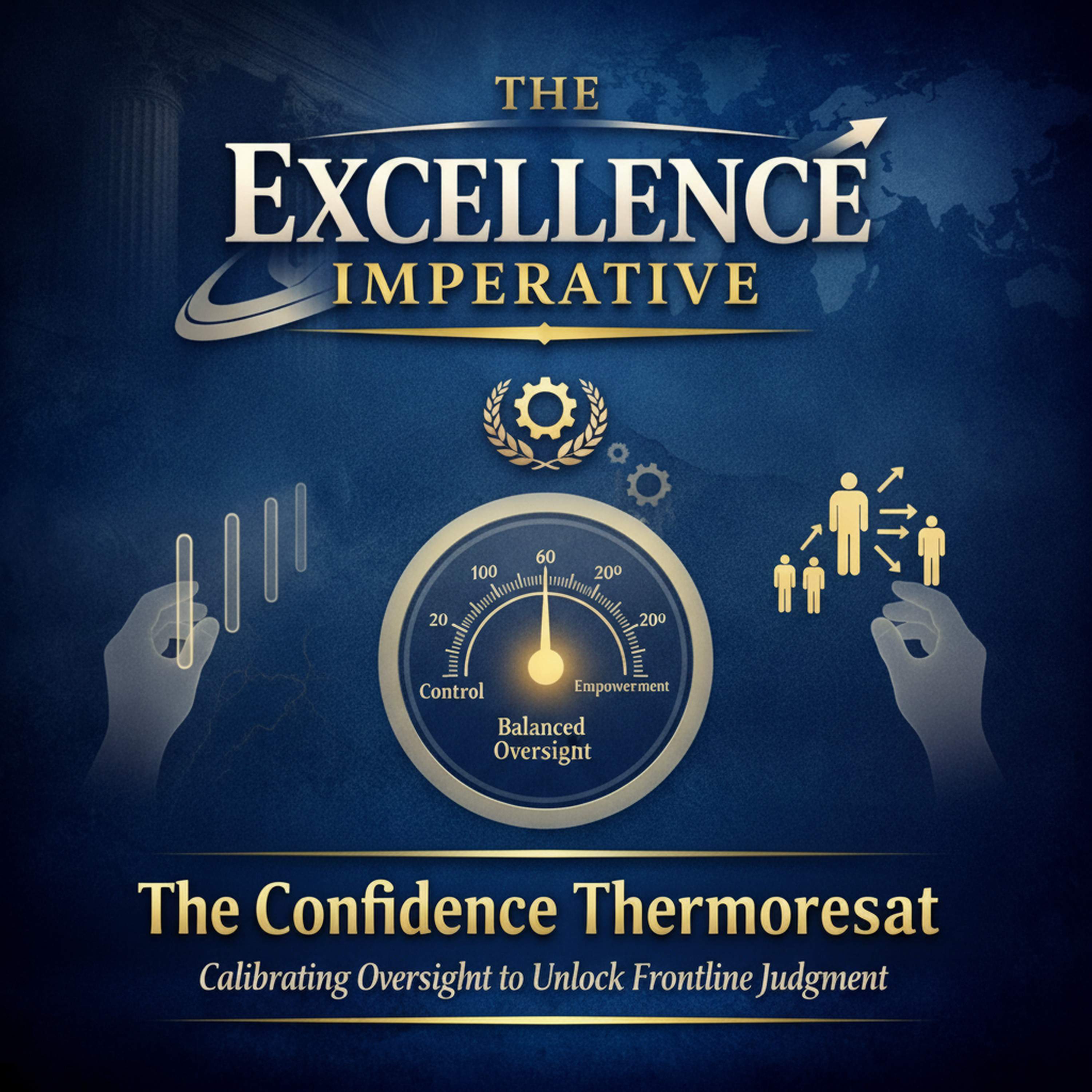
The Confidence Thermostat: Calibrating Oversight to Unlock Frontline Judgment
Jul 12, 20268 min
Senior leaders constantly face the same invisible dial: how much oversight to apply before oversight itself becomes the problem. In this panel James Whitmore and Mark Ellison convene experienced leaders to explore how to calibrate that 'confidence thermostat'—creating guardrails, information flows, and leader behaviors that protect value without smothering initiative. We move beyond binary debates of control vs. empowerment and into practical design: which decisions require hard boundaries, which need faster feedback loops, and which should live with the team closest to the work. Listeners will leave with a simple diagnostic to map three decision zones in their organization, a short leader habit to test this week, and examples of how small governance changes preserve trust, speed, and sustainable performance. This episode is for senior leaders who want to make their oversight actually enable excellence rather than unintentionally erode it.
Leadership Inheritance: Designing Transitions That Preserve Principles and Performance
Jul 5, 20268 min
Leadership transitions are inevitable; the hard question is what stays when leaders change. This panel episode examines succession not as an HR event but as a design challenge for lasting excellence. James Whitmore and Mark Ellison lead a conversation with experienced leaders on how to codify leadership habits, embed leader standard work, and structure handoffs so cultural habits and operational disciplines persist. Listeners will hear concrete examples of transition failures and recoveries, practical templates for transfer-of-accountability conversations, and governance patterns that prevent “legacy drift.” The episode balances principle and execution: it surfaces the leadership behaviors that create durable norms, the system levers that make those behaviors visible, and a single, high-impact practice leaders can test in the next 30 days. Intended for senior leaders responsible for stewardship, this conversation gives a playbook for leaving a legacy that outlasts any one tenure.
Every question we get asked before someone starts their trial.
If you have a concern about deliverability, AI quality, data privacy, or whether this will actually work for your specific situation, it's probably answered below.
What is the difference between Founder Solo and Founder Pro?
Founder Solo gives you 50 AI pitches per month using the credit model (Standard pitches cost 1 credit, Enriched pitches cost 2). Founder Pro raises that to 200 credits per month and adds full Booking Probability access, unlimited Magic Match, Apollo enrichment credits, and data export capabilities. Both plans use the same credit system, so you can stretch your monthly budget further by using Standard-mode drafting.
How do agency tiers work?
Agency tiers have no base fee. You pay per managed client and per talent profile. Agency Standard is $199 per client per month; Agency Pro is $399 per client per month. Both add $39 per talent profile per month. Your own team's user seats are always free.
What is a talent profile?
A talent profile represents one person (founder, executive, or spokesperson) you are booking onto podcasts. It includes their bio, topics, headshots, and outreach history. Team plans include 5 profiles; agency plans are pay-as-you-go.
Can I switch plans later?
Yes, at any time. Upgrades take effect immediately; downgrades apply at the end of the current billing period. Contact support if you need help migrating between plan families.
Do you offer a free trial?
Every paid plan includes a 15-day free trial. Your card is saved at signup but you will not be charged until day 16. Cancel any time from your dashboard.
What happens if I cancel?
You keep access until the end of your current billing period. No charges after that. Your data is retained for 30 days in case you reactivate.
Is the 20% annual discount automatic?
Yes. Select Annual on the pricing toggle and the discounted price is applied automatically at checkout. The annual price shown is the full year cost.
What if I have more than 50 profiles or 20 clients?
That is our Enterprise tier. Contact our sales team and we will build a custom plan with volume pricing, a dedicated account manager, and SLA guarantees.