The Information Bottleneck
Yuandong Tian on Recursive Self-Improvement
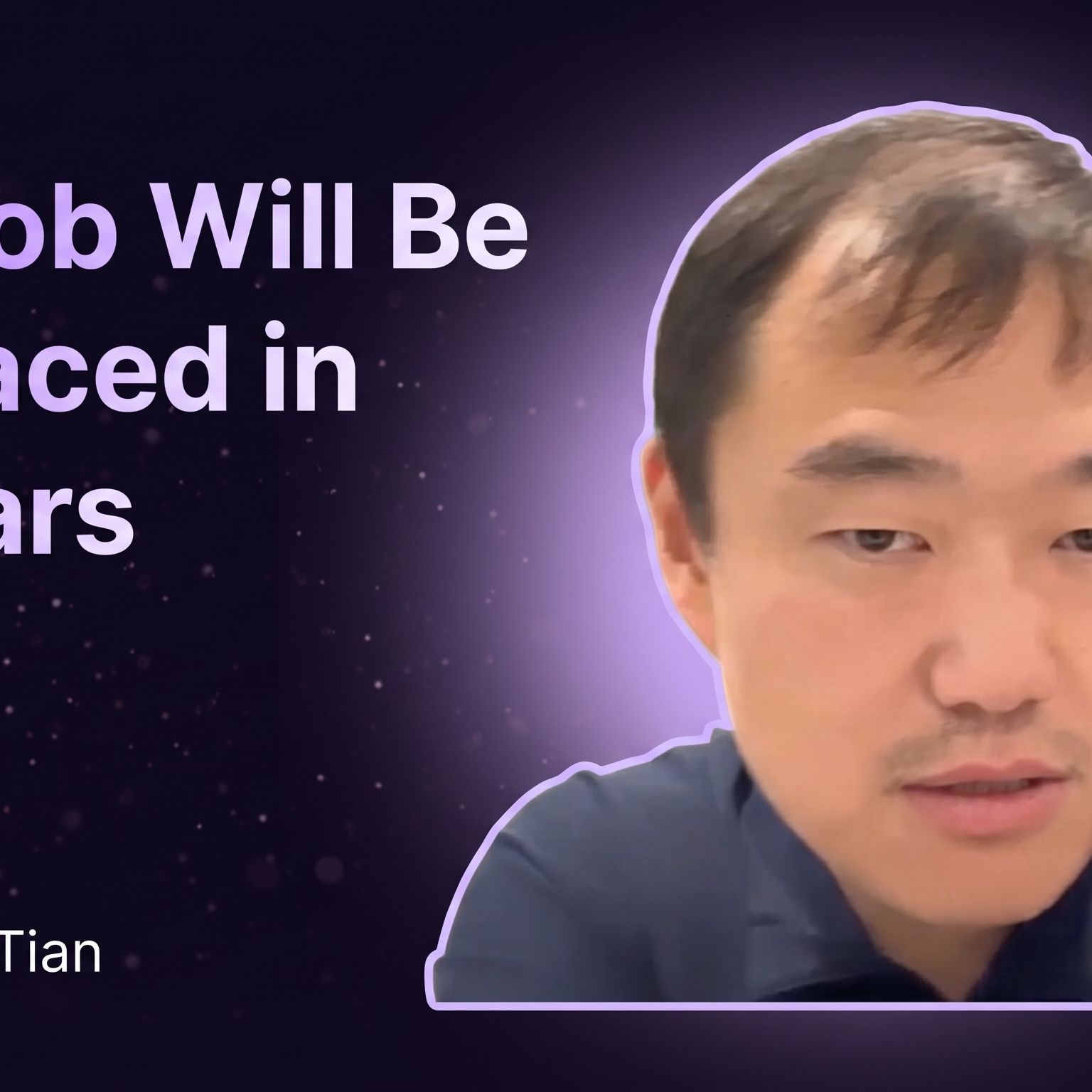
Yuandong Tian spent many years at Meta FAIR and recently left to co-found Recursive Superintelligence, a company building AI that improves itself. In this episode, he tells us why. We start with his work on computer Go, where he built DarkForest before AlphaGo came out. A few years later came OpenGo, which played Korean professionals on a single GPU and didn't lose a game. He then tried to bring RL to real-world problems and found that the design of the action space mattered more than the algorithm. We also talk about Coconut, his paper on reasoning in latent space instead of tokens, and why frontier models still aren't trained that way. The second half is about recursive self-improvement. Yuandong wrote his last paper at Meta together with GPT-5 and says it made him 6 to 10 times faster. That convinced him his own job could be replaced within five years. We ask him where agents still fall short and whether a new architecture can really beat transformers at scale. He also gives his view on the calls to restrict self-improving AI and makes the case for open source. Recursive is hiring in San Francisco and London: talent@recursive.com Topics * Computer Go: DarkForest, AlphaGo and OpenGo * Gradient-free optimization * Action space design and neural architecture search * Coconut and reasoning in latent space * Understanding how neural networks learn representations * Grokking, and writing a paper with GPT-5 * Recursive self-improvement and coding agents * New architectures vs. transformers * The NanoGPT speedrun * Data efficiency and robotics * Restricting self-improving AI * Open source models Timeline 0:00 Intro 0:45 From CMU to deep learning, and the AlexNet debates 5:35 AlphaGo and beating Go pros on a single GPU 10:27 Gradient-free optimization 13:16 Diffusion models and diversity 16:23 RL on real problems: why the action space matters 20:34 AutoML and architecture search 22:05 Coconut and reasoning in latent space 26:07 Why latent reasoning hasn't caught on 30:36 Adapting research to the LLM era 34:04 Why he left Meta to work on recursive self-improvement 37:10 Do we still need humans? 39:37 Where agents fall short 43:08 Can new architectures beat transformers at scale? 47:29 The hardest part of research to automate 50:16 What comes next for AI 52:52 Should self-improving AI be restricted? 54:11 Open source models 56:43 Hiring at Recursive Music - "Kid Kodi" - Blue Dot Sessions - via Free Music Archive - CC BY-NC 4.0