
The King Is Coming with Jeff Kinley
The King Is Coming, September 27, 2026
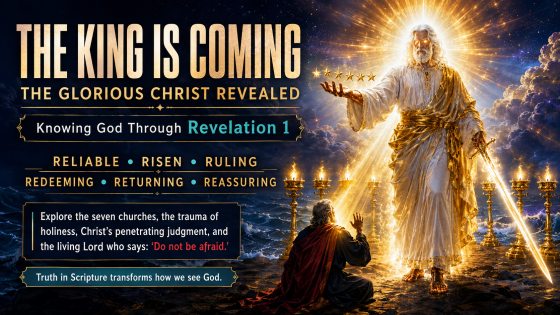
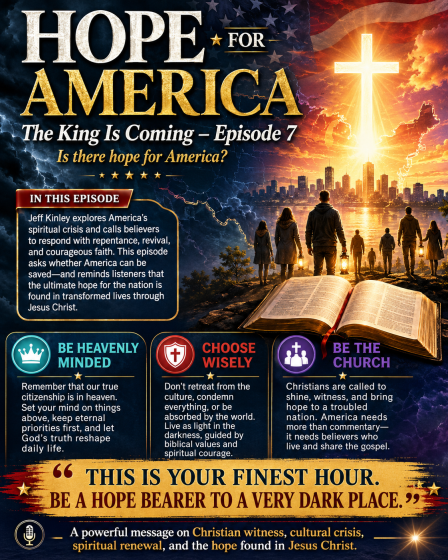
The King Is Coming with Jeff Kinley Revelations Guide to Knowing God, Episode 4: The Grace of God and the Tribulation Revival Jeff Kinley continues his series Revelation's Guide to Knowing God by turning to the grace of God, tracing how a vast multitude of tribulation believers, the 144,000 Jewish evangelists, two witnesses, and three flying angels help bring about a last-days revival after the rapture. A New Book and the Fourth Attribute of God Jeff Kinley opens The King Is Coming by teasing the question at the center of this episode, whether Scripture promises a last-days revival before the end, and promises an answer drawn from the Bible itself. He then turns to his newest book, God's Grand Finale: Wrath, Grace, and Glory in Earth's Final Days, explaining that it walks through the entire Book of Revelation not simply to forecast future events but to draw out thirteen attributes of God that help believers know Him more intimately. Returning from the break, Kinley places the day's teaching inside his larger series, Revelation's Guide to Knowing God, reminding listeners that earlier broadcasts have already covered the glory, the sovereignty, and the wrath of God as they appear in Revelation. Today, he says, the subject shifts to something warmer, the grace and graciousness of Jesus Christ, and he previews the question many listeners keep asking him about whether a final, great revival is coming. No Revival Promised Before the Rapture Kinley turns to Second Thessalonians chapter 2 verse 3, where Paul writes that before the day of the Lord a great falling away, or apostasy, must come first. He tells listeners that Scripture prophesies this departure from the faith but nowhere promises a final revival during the church age, before the Tribulation begins. That does not mean, he adds, that God cannot send pockets of revival breaking out around the world even now, only that no chapter and verse can be pointed to as proof of one. Kinley says he is nevertheless watching many believers awaken to Bible prophecy, calling it the front porch that leads people back into serious study of their Bibles, and he reads from listener emails describing how prophecy pulled them out of a lethargic, mediocre faith. He then asks the harder question: if no revival is promised this side of the rapture, does Revelation describe one happening on the other side, during the Tribulation itself. A Great Multitude Before the Throne Turning to Revelation chapter 7, Kinley reads the passage that follows the sealing of the 144,000, where John describes a great multitude that no one can count, drawn from every tribe, nation, people, and tongue, standing before the throne in white robes with palm branches, crying out that salvation belongs to God and the Lamb. He explains that an elder identifies this multitude as those who have come out of the great Tribulation and washed their robes in the blood of the Lamb, a detail Kinley stresses means these are new believers converted during the Tribulation itself, not leftover Christians from the church age. He estimates the majority come to faith in the first three and a half years, before the Antichrist's midpoint mark of the beast forces every remaining person into an irreversible choice for or against Christ. Kinley notes John's own word for the number, a Greek term tied to arithmetic, meaning that John himself cannot calculate how enormous this multitude truly is. How the Holy Spirit Still Draws the Lost Kinley turns from who these believers are to how they are saved, breaking the question into the manner, the method, and the means. On the manner, he asks whether the Holy Spirit is absent from earth once the church is raptured, and answers no, because the Spirit is omnipresent and cannot be confined to any one place. Citing John chapter 16, he explains that the Holy Spirit continues His convicting ministry during the Tribulation exactly as He does now, persuading people of their sin and their need for a Savior. He adds, citing John chapter 6, that God the Father is the one who draws people to Himself, while Jesus Christ alone saves through His shed blood, describing salvation as a work shared between all three persons of the Trinity. Kinley calls this an amazing thought, that the very process that brought him and his listeners to faith continues operating for those left behind after the rapture, even without the church physically present on earth. Witnesses, Evangelists, and Left-Behind Bibles Moving to method, Kinley lists several ways he believes people will come to Christ after the rapture, some drawn directly from Scripture and others he offers as reasoned speculation. Many, he suggests, will remember previous exposure to the gospel and immediately fall to their knees once they realize what has happened. Left-behind Bibles, Christian books, and recorded programs will give others tools to understand the disappearance, and newly saved believers will rush to tell friends and family before the Antichrist and his judgments arrive. Kinley then turns to what the Bible explicitly names, starting with the 144,000 sealed Jewish evangelists of Revelation chapters 7 and 14, twelve thousand from each tribe, described as chaste, blameless, and fiercely loyal to the Lamb. He also introduces the two witnesses of Revelation chapter 11, who prophesy for 1,260 days in sackcloth, calling fire from their mouths and shutting up the sky, and whom Kinley believes, based on their miracles, are most likely Moses and Elijah. Three Angels and a Limited-Time Grace Kinley closes his list of methods with three angels from Revelation chapter 14, naming them himself: a gospel angel flying in mid-heaven and preaching an eternal gospel to every nation, a Babylon angel announcing that the Antichrist's capital city has fallen, and a final angel warning that anyone who takes the mark of the beast will share the beast's fate in the lake of fire. He compares the Babylon angel's message to hearing that Washington has been destroyed, proof that the Antichrist's kingdom is collapsing while God's kingdom endures. Turning finally to the means of salvation, Kinley insists it never changes, citing Romans 5:8 and John 14:6 to affirm that the shed blood of Jesus Christ remains the only way to God in the Tribulation exactly as it is now. He marvels at God's patience toward sinners, warns from Second Corinthians 6 that salvation is a limited-time offer, and urges anyone listening to believe on Jesus Christ immediately before the broadcast closes with its usual appeal for donations to World Prophetic Ministries.