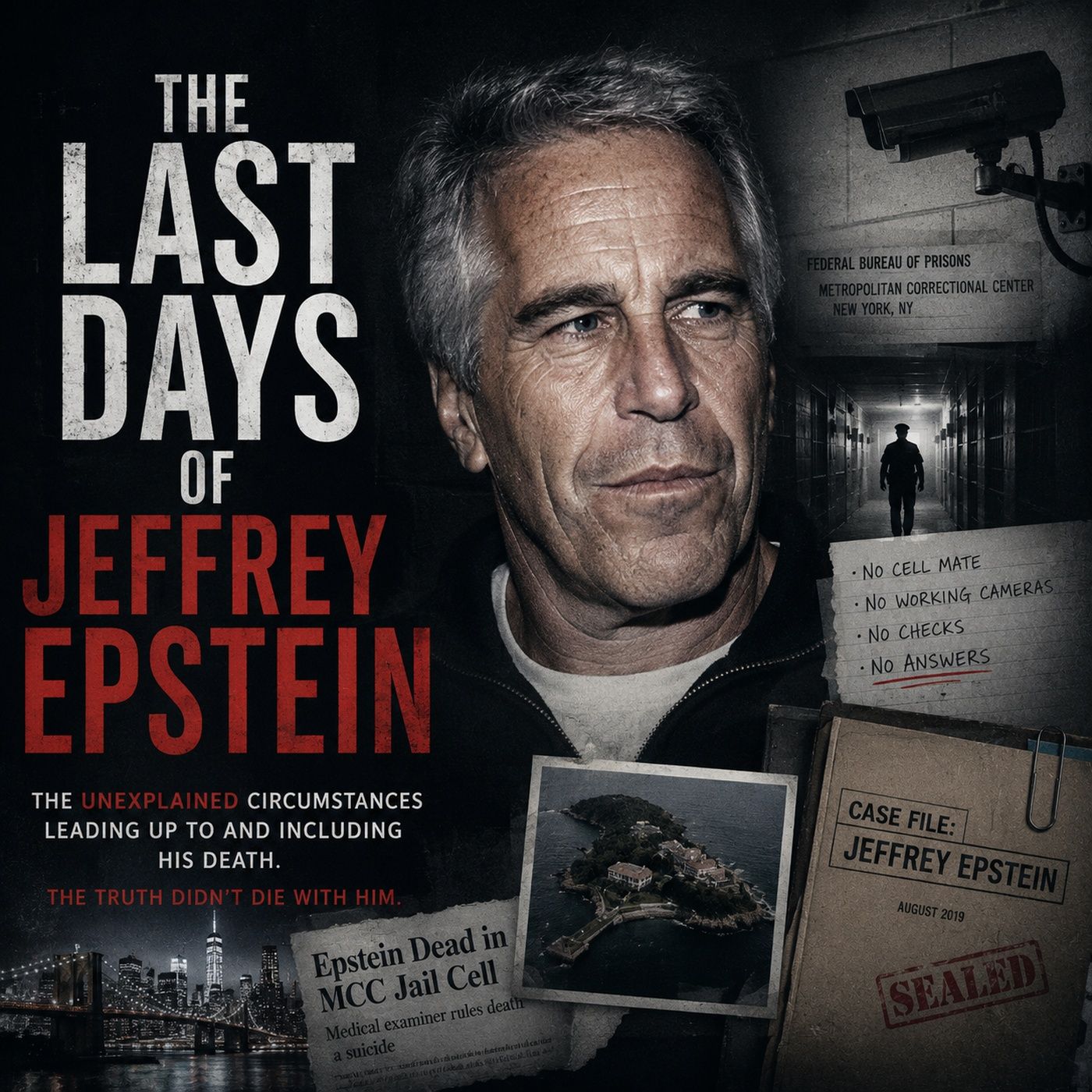
The Last Days of Jeffrey Epstein is a long-form investigative podcast that serves as both an archive and a real-time chronicle of the events surrounding the life, imprisonment, and death of Jeffrey Epstein. From the moment of his arrest in 2019 through the unanswered questions that continue to emerge years later, the podcast follows the timeline piece by piece — examining court filings, jail records, witness statements, surveillance failures, media reports, government investigations, and newly released documents as they become public. Rather than treating the story as a closed chapter, the series approaches it as an evolving historical event whose consequences continue to ripple through politics, finance, intelligence circles, law enforcement, and the media. Every episode is designed to preserve the record while also analyzing how the narrative around Epstein has shifted over time, what information has surfaced, what remains hidden, and why the case continues to generate worldwide scrutiny. The podcast blends archival storytelling with ongoing investigative coverage, creating a living timeline of one of the most controversial deaths in modern American history. Using court documents, deposition transcripts, inspector general reports, leaked communications, news coverage, and firsthand accounts, The Last Days of Jeffrey Epstein reconstructs the chain of events that led to Epstein’s death inside the Metropolitan Correctional Center in New York while continuing to track the fallout that still unfolds in real time. The series does not simply revisit headlines; it documents how the story evolved, how institutions responded, how narratives changed, and how new revelations continue to reshape public understanding years later. Whether examining the failures inside MCC, the powerful figures connected to Epstein, or the unanswered questions surrounding the final days of his life, the podcast functions as both a historical archive and an ongoing examination of a case that refuses to disappear.
Pitch Analysis
Required Pod Score for this show. PitchCentric checks your profile against host openness, topical fit, and audience signals before you generate a pitch.
Contact path
Verified email
Booking probability
40%
Guest openness
Selective
Verified email on file
80/100
Required Score
Sign up to generate a grounded pitch for The Last Days Of Jeffrey Epstein.
Our AI reads these to draft pitches. Use them as grounding for a pitch that cites a real guest and a specific topic.
The Last Days Of Jeffrey Epstein
Jeffrey Epstein And The Charity Hustle
Sep 29, 202626 min
One of the most important aspects when talking about Jeffrey Epstein and the crimes committed by his criminal enterprise is the financial angle. For all of the platitudes we have heard from the investigators, we have still yet to see a real, robust investigation into the financial aspect of the case. Nothing personifies that like his corrupt charities. On this episode, we explore some of those charities and how they were manipulated and used to help shield Epstein and his activities. To contact me: bobbycapucci@protonmail.com source: https://www.nytimes.com/2019/11/26/business/jeffrey-epstein-charity.html
Pam Bondi Says A Truckload Of Epstein Related Documents Are Now In The DOJ's Possession
Sep 29, 202615 min
Attorney General Pam Bondi's recent announcement regarding the FBI's delivery of a "truckload" of Jeffrey Epstein-related documents raises several concerns. The timing of this disclosure, following public disappointment over the initial release of largely redundant information, suggests a reactive rather than proactive approach to transparency. Bondi's claim that these documents were previously withheld by the FBI's New York office without clear justification further undermines confidence in the thoroughness and integrity of the investigation The lack of new revelations in the earlier releases, coupled with the sudden appearance of these additional files, raises questions about the efficacy of the Justice Department's efforts to uncover the full extent of Epstein's network and activities. This situation highlights potential systemic issues within federal agencies regarding the handling and disclosure of critical evidence in high-profile cases. to contact me: bobbycapucci@protonmail.com source: Pam Bondi says 'truckload' of Epstein files have arrived from FBI, she plans to release 'as fast as we can' | Daily Mail Online
The Serpico of Mar-a-Lago: Mike Johnson Claims Donald Trump Was An FBI Informant
Sep 29, 202618 min
Mike Johnson’s claim that Donald Trump was an undercover FBI informant working to bring down Jeffrey Epstein is nothing more than political fan fiction. It comes after every other narrative—calling Epstein a hoax, smearing survivors, and demanding the public “move on”—has completely collapsed. The idea that Trump, who partied with Epstein, publicly called the scandal a Democrat hoax, and routinely defamed survivors, was secretly the Serpico of Mar-a-Lago is absurd on its face. If it were true, the files would already be released and Trump himself would be shouting about it from every podium. Instead, there’s silence, spin, and desperate storytelling designed to distract from the reality: survivors were ignored, Epstein was protected, and the files remain locked away. At its core, this narrative is just another attempt to shield powerful people from accountability by rewriting history with Trump as the unlikely hero. But it collapses under even the slightest scrutiny—because the contradictions are glaring, the evidence is nonexistent, and the cruelty toward survivors is undeniable. Rather than offer transparency, Johnson offers a bedtime story, hoping the public will swallow it whole. Yet the truth is clear: if Trump really was an informant, then we should all be demanding the release of the files to see his supposed heroics. And since they refuse, we know exactly what this is—another cheap distraction to keep the truth buried, while the survivors still wait for the justice they deserve. to contact me: bobbycapucci@protonmail.com
Prince Andrew And The Charity Work He Agreed To But Never Did
Sep 29, 202613 min
Prince Andrew said in the aftermath of his settlement with Virginia Giuffre that he intended to demonstrate his regret over his association with Jeffrey Epstein by supporting the fight against sex trafficking and helping survivors. The language formed part of the public effort to draw a line under the scandal, with Andrew acknowledging Giuffre as an established victim of abuse and promising to support organizations working on behalf of trafficking survivors. At the time, the pledge was presented as a concrete step toward repairing some of the damage caused by his relationship with Epstein and the allegations that had engulfed him. That promised charitable work never developed into any meaningful public campaign. There was no sustained initiative, foundation, major partnership or visible long-term effort by Andrew focused on trafficking survivors, and over time the pledge largely disappeared from public view. Instead of becoming a central part of his post-scandal life, the commitment remained mostly a statement attached to the settlement. The absence of follow-through became another point of criticism surrounding Andrew, particularly because the promise had been framed as evidence that he understood the seriousness of Epstein’s crimes and wanted to contribute to helping the people harmed by trafficking. to contact me: bobbycapucci@protonmail.com
Adriana Ross FBI 302 Raises Questions on Epstein’s Role in Trump–Melania Introduction (Part 3)
Sep 29, 202612 min
Newly surfaced FBI material indicates that Jeffrey Epstein may have played a role in introducing Melania Trump to Donald Trump, directly contradicting prior public denials that any such connection existed. The information suggests that Epstein’s social network extended into the circumstances surrounding how the two met, raising questions about earlier efforts to distance that relationship from him. This contradiction has intensified scrutiny, particularly as officials and public figures continue to push narratives that minimize or deny Epstein’s proximity to influential circles. The information traces back to an FBI FD-302 interview with Adriana Ross, one of Jeffrey Epstein’s longtime associates, in which she described elements of Epstein’s social orbit and interactions with high-profile figures. In that interview summary, Ross allegedly indicated that Epstein had a role in facilitating the introduction between Melania and Donald Trump, placing him closer to that moment than publicly acknowledged. Because FD-302s are internal FBI records that capture agents’ recollections of witness statements rather than verbatim transcripts, the account reflects what Ross told investigators at the time, adding a layer of evidentiary significance while still leaving room for interpretation and dispute. to contact me: bobbycapucci@protonmail.com source: EFTA00090773.pdf
Every question we get asked before someone starts their trial.
If you have a concern about deliverability, AI quality, data privacy, or whether this will actually work for your specific situation, it's probably answered below.
What is the difference between Founder Solo and Founder Pro?
Founder Solo gives you 50 AI pitches per month using the credit model (Standard pitches cost 1 credit, Enriched pitches cost 2). Founder Pro raises that to 200 credits per month and adds full Booking Probability access, unlimited Magic Match, Apollo enrichment credits, and data export capabilities. Both plans use the same credit system, so you can stretch your monthly budget further by using Standard-mode drafting.
How do agency tiers work?
Agency tiers have no base fee. You pay per managed client and per talent profile. Agency Standard is $199 per client per month; Agency Pro is $399 per client per month. Both add $39 per talent profile per month. Your own team's user seats are always free.
What is a talent profile?
A talent profile represents one person (founder, executive, or spokesperson) you are booking onto podcasts. It includes their bio, topics, headshots, and outreach history. Team plans include 5 profiles; agency plans are pay-as-you-go.
Can I switch plans later?
Yes, at any time. Upgrades take effect immediately; downgrades apply at the end of the current billing period. Contact support if you need help migrating between plan families.
Do you offer a free trial?
Every paid plan includes a 15-day free trial. Your card is saved at signup but you will not be charged until day 16. Cancel any time from your dashboard.
What happens if I cancel?
You keep access until the end of your current billing period. No charges after that. Your data is retained for 30 days in case you reactivate.
Is the 20% annual discount automatic?
Yes. Select Annual on the pricing toggle and the discounted price is applied automatically at checkout. The annual price shown is the full year cost.
What if I have more than 50 profiles or 20 clients?
That is our Enterprise tier. Contact our sales team and we will build a custom plan with volume pricing, a dedicated account manager, and SLA guarantees.