Episode #4
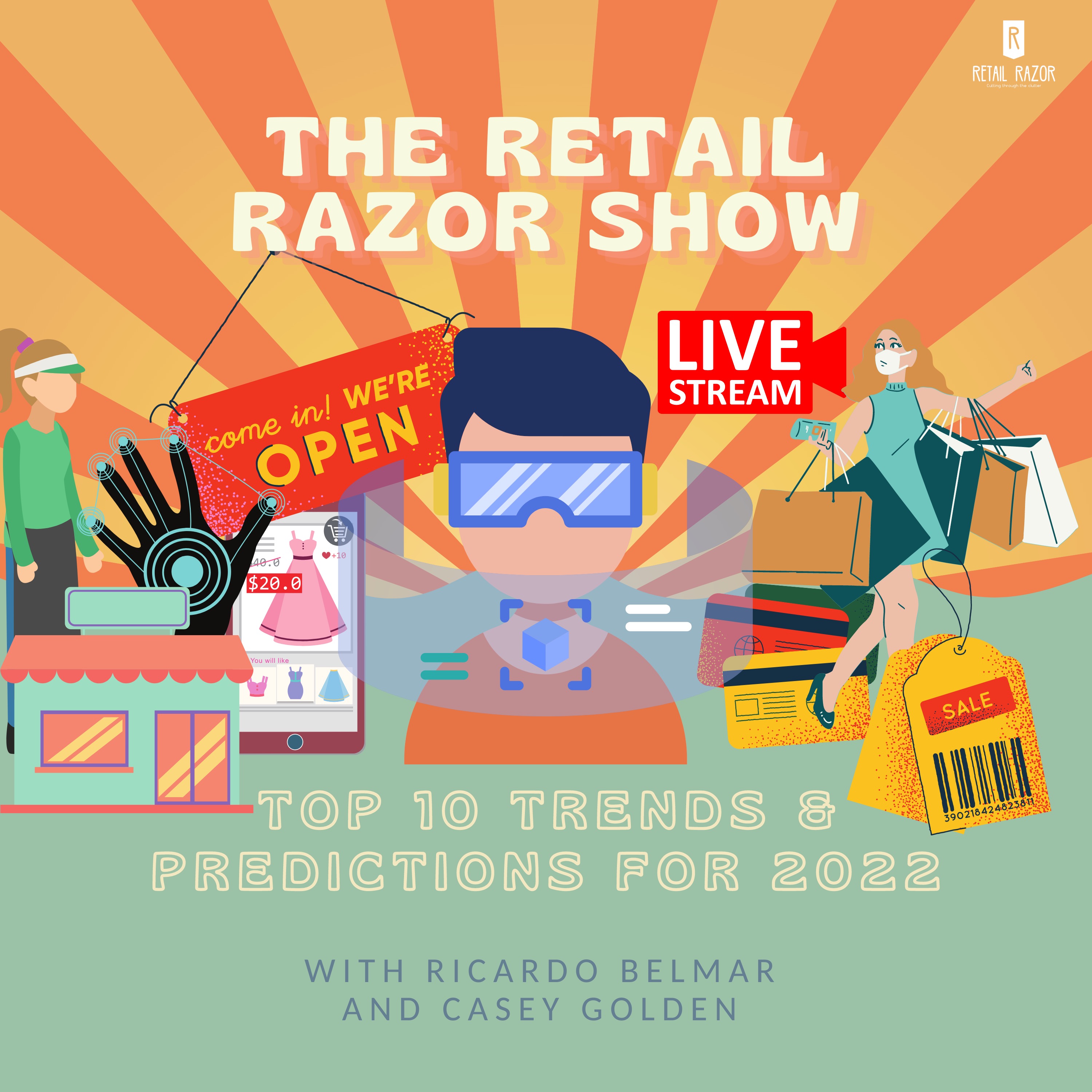
S1E4 - Top Trends & Predictions for 2022
S1E4 – Top 10 Trends & Predictions for 2022 Welcome to Season 1, Episode 4 , the fourth ever episode of The Retail Razor Show ! I’m your host, Ricardo Belmar , a RETHINK Retail Top Retail Influencer for 2022 & 2021, RIS News Top Movers and Shakers in Retail for 2021, advisory council member at George Mason University’s Center for Retail Transformation , and lead partner marketing advisor for retail & consumer goods at Microsoft. And I’m your co-host, Casey Golden , CEO of Luxlock and slayer of retail frankenstacks! Together, we’re your guides on the retail transformation journey. Whether you're thinking digital and online, mobile, or brick & mortar stores, we’ll help you cut through the clutter! For episode 4 we’ve changed it up a bit and jumped over to the Callin platform to record this special episode where we give you our Top 10 Trends and Predictions for 2022! Hear what we’re thinking matters most for 2022 and what we expect it means for retail and retail tech. If you have any comments on what we’ve said, be sure and hit us up on Twitter or LinkedIn! And be sure and follow us on Callin so you don’t miss future episodes where we’ll be interviewing the people who are transforming retail and retailtech! The Retail Razor Show Follow us on Twitter : https://bit.ly/TwRRazor Connect with us on LinkedIn : https://bit.ly/LI-RRazor Join our club on Clubhouse : http://bit.ly/RRazorClub Listen to us on Callin : https://bit.ly/RRCallin Subscribe on YouTube: https://bit.ly/RRShowYouTube Subscribe on Apple Podcasts : https://bit.ly/RetailRazorShow Retail Razor Show Episode Page : https://bit.ly/RRShowPod Host → Ricardo Belmar, Follow on Twitter - **** https://bit.ly/twRBelmar Connect on LinkedIn - **** https://bit.ly/LIRBelmar Read my comments on RetailWire - **** https://bit.ly/RWRBelmar Co-host → Casey Golden, Follow on Twitter - **** https://bit.ly/twCasey Connect on LinkedIn - **** https://bit.ly/LICasey Read my comments on RetailWire - https://bit.ly/RWCasey TRANSCRIPT S1E4 Top 10 Trends & Predictions for 2022 [00:00:20] Introduction [00:00:20] Ricardo Belmar: Hello everyone. And welcome to retail razor show our first recording here on the Callin platform. So this is exciting, isn't it? Casey. [00:00:27] Casey Golden: It is. [00:00:28] Ricardo Belmar: I'm looking forward to our future episodes here. We're going to do some really cool interviews with people who are really doing things to transform retail and commerce. [00:00:37] Casey Golden: Anything that makes it easier to have these conversations, I'm in. [00:00:41] Ricardo Belmar: Exactly. Exactly. So today we've got some fun stuff we're doing. We're going to talk about our top 10 trends and predictions for 2022. Because it's the beginning of the year. So of course we have to do that. Right. [00:00:52] Casey Golden: We do. And we have what, nine months to implement ? [00:00:55] Ricardo Belmar: That's right. [00:00:56] So we're hopefully improving our odds of success so that when we can do this next time, everyone can come back and say, Hey, they got that one right. [00:01:03] Casey Golden: Exactly. I will be keeping score!. [00:01:07] Ricardo Belmar: Well, we'll see how we each do here. I think we've each got five to share. So we'll see how we do this time next year. [00:01:13] #1 - Retail Media Networks & Customer Data [00:01:13] Ricardo Belmar: All right. So let's jump into top 10 trends and predictions. I'll kick off. And my first one has [00:01:20] to do with retail media networks which I know people who might be listening to, they're going to say, oh, that's not much of a prediction, but the slight twist I'm putting on this is a, they're kind of two schools of thought on this. [00:01:32] A number of people in the industry are saying that they're starting to see too many of these retail media networks and that they're all competing for the same ad capacity with brands. And how is any individual retailer really going to make a dent when Amazon's commanding over a third of all of this retail media network ad spend. [00:01:51] And my take on that is it, I feel like that's the wrong perspective to take because these networks aren't necessarily competing with each other. What they're really competing against are other forms of media, whether it's print, TV, streaming, video networks, all those kinds of things, or just plain old display ads on Google. [00:02:11] You know, these retail media networks are designed so that knowing that I'm already on the retailers platform and that's, we're assuming that retailer has a [00:02:20] marketplace on their e-commerce. So really what are they trying to do? I think they're trying to do two things here. Yes. There is an added revenue stream they're trying to generate by getting brands to spend money with them and to, buy product placements. And obviously Amazon is the most successful, but there are plenty of others, Kroger's doing well with this, Home Depot is doing well with this. And I think there's lots of room for other retailers to do the same even Target does well although their marketplace is kind of by invitation so it's a closed one. It's not quite the same, but I think there's plenty of room for, for retailers to succeed here. Because again, it's not, you're not really measuring yourself against how much ad market share am I taking from Amazon? It's just how much ad space am I selling on my marketplace site? [00:02:59] That's really the metric that matters. So I think any retailer with a marketplace can make this work and that's why we're going to see so many, even Best Buy announced. I think within the last week that they're doing this, and there's also room to expand just beyond your own marketplace, I think Best Buy's announcement also said that not only can you buy ad placement on the marketplace site [00:03:20] bundled into this would also be promotional ads in the store. So if you're a brick and mortar and online marketplace retailer, you've got both of those available and best buy is also saying we'll do third-party placement on third party networks, as well as part of the bundle. [00:03:33] So they'll get some revenue out of that, even if the brand is saying, yeah, give me some ads on the Best Buy site, but then I also want it on, Google search. And it seems like Best Buy is saying, we'll manage that for you as part of the program. So I think lots of room there, the second really important thing for this, which is the one I, I believe everybody overlooks. [00:03:51] This is another great way for a retailer to generate customer data because as customers interact with the digital ads for this, That's new customer data that's feeding into, hopefully the retailer has a customer data platform. They add this in with all the other first party data they have. And guess what? [00:04:07] They're going to learn a lot more about how their customers are shopping. And I would argue that's even more important than the incremental revenue they're going to get from the retail media networks. So that's my prediction that we're just going to see every retailer that [00:04:20] does a marketplace on their site. [00:04:21] They're going to introduce a retail media network this year. [00:04:23] Casey Golden: I think we've, we've definitely learned over the last two years with the increase of the cost of advertising that a lot of brands and companies need to diversify those channels and, and spread that out because it's been quite concentrated and the prices were driven up extensively while everybody moved their media buys into digital. [00:04:44] Ricardo Belmar: That's true. That's true. [00:04:45] #2 - Brick & Mortar Expansion [00:04:45] Casey Golden: I'm coming in at number two with brick and mortar expansion. Physical retail is not dead. I it's going to change. Amazon's new department store is re-imagining the shopping and buying experience. Really reaching customers in a, in a non-traditional way for them. And we're going to see a lot more pop-ups versus anchor stores changing these physical spaces from stacks of shirts to entertainment and showrooms. [00:05:08] I think we can all agree that Glossier has been the big winner here and pop-ups, and with that model, I think we're going to be seeing a lot more short-term and flexible leases so that more brands can go [00:05:20] into a space, spend three months and have the opportunity to create an extension. Really starting to understand who your customers are, where they live, where your biggest market opportunity is and create moments where brands and consumers can go through that product discovery and experience the brand, circulates a lot more neighborhood freshness. And when brands are trying to increase that LTV you know, we're fighting very low conversion rates online. Having a pop-up store can really increase that LTV over the long run, because it can create that brand affinity that e-commerce just, hasn't been able to capture the same way that brick and mortar has with getting into routine and, and making that meaningful connection to a consumer [00:06:06] Ricardo Belmar: Yeah, I like this prediction a lot. I really agree with you on all those points. The big thing that a lot of people miss here with this, even when we're talking about natively digital brands that are just starting to open stores too, I think that's included [00:06:20] in what you're saying here at the end of the day, in some ways, right? [00:06:23] This is just one big experiment for the brand. And, and I think that's a good thing because we don't historically think of opening stores as an experiment. I think maybe Amazon changed everyone's viewpoint on that for the better. And I think that is how everyone should look at it because you can learn a lot from that pop-up experience, just like you described, and then feed that back into even other sales channels. [00:06:42] You have to make you adapt to your customers. And that's really the whole point, isn't it? [00:06:46] Casey Golden: It is. You know, we've got to get in front of customers in general, and sometimes that's just showing up in their neighborhood and saying, we're here to serve you. Come experience our brand. [00:06:57] Ricardo Belmar: Yeah. And I'd say, if we really want to go out on a limb, we can kind of call this one, the the end of the retail apocalypse storyline. [00:07:03] Right. Because we're going to see more store openings as a result. [00:07:06] Casey Golden: I have seen a lot of announcements for new stores. [00:07:09] Ricardo Belmar: Exactly. [00:07:10] #3 - Social Commerce & Livestreaming [00:07:10] Ricardo Belmar: All right, let's go to number three. So number three, this may not come as a surprise to a lot of people because I know I, I think we've all talked about this frequently. [00:07:18] We've got some [00:07:20] other podcast episodes coming on it and that's social commerce and live streaming going big. This year across the U S and in north America, it may not get as big as we see it in China and Asia, but that's okay. It's got room to grow. I think this is going to be something we see from both small and large retail. [00:07:35] I think the big twist I'm going to put on this is when we think about particularly the livestreaming piece. And in fact, I'm going to say the live streaming component to this is more important than social commerce as a whole, even though we tend to lump those things together, a lot of people assume that when we say social commerce, we're talking about selling through Instagram and Facebook and all the different social media platforms. [00:07:57] And I think small retailers will keep doing that. I think that's where the growth for them is. But the challenge with that, and we've said this before in our, at our clubhouse sessions is you don't own the platform then, right? You're borrowing the social media platforms access to customers. So you're not owning the relationship there in your sales process. [00:08:15] I think live streaming is going to help retailers change that perspective a couple of different [00:08:20] ways. One is using their frontline store associates as the live streamers versus paid influencers. So rather than going out and spending a lot of money, hiring an Instagram influencers, we're going to see retailers start leveraging frontline staff, who, by the way, if you look at the demographics of who you have, a lot of your I'll assume younger, but not necessarily right. [00:08:39] A lot of your staff, they already know how to do this, they've got their own YouTube channel for other reasons outside of the job. Retailers are going to get smart and say, Hey, we can just use the folks we have. It actually turns into a career incentive to want to work in retail, above and beyond the challenges every retailer is facing in the current labor shortage and trying to figure out how they can pay workers enough. This becomes a new, I don't want to say career perk, but it's certainly a new skillset and something that makes the employee more competitive and retailers are going to want them. [00:09:08] So picture your store associate doing live streams in a one to many format, right from the store, or maybe even from a studio-like space that the store has now carved out of their back room [00:09:20] a front of the store in some way to do this kind of production on a regular basis and hosted from their website. [00:09:25] So they don't have to be dependent on the social media platforms to do this. They're going to build a following that way. Both the retail brand and the individual associates are going to build the following for the associate. It's a great skill. I think it's something they'll enjoy doing. Not every associate is going to do it. [00:09:41] And that's okay. I think this speaks to the our podcast, a couple episodes back with, with Ron Thurston. When we talked about segmentation of skillsets and, and frontline workers, some staff will be better at doing some of the backroom functions. Some are going to be better at fulfilling buy online pickup in store orders, and some are going to be your live streamers. [00:10:00] And I think the analogy for me here is the same way we look at the fitness instructors in the Peloton app. That's what we're going to see happen with frontline staff and retail stores because of live streaming and really go out on a limb and say, if mall operators out there are listening, I would be telling you, you should be thinking about how you can turn this kind of concept into a [00:10:20] service you offer your tenants in the mall, especially the smaller retailers you might land, or even better as an enticement to those digitally native brands that you're trying to get to either set up a pop-up or set up a short-term lease in the mall. This is another incentive you could create by providing the live streamer. [00:10:36] So think of it in terms of what happened in the gaming world on Twitch and YouTube with live streamers. We're going to start to see this happen in the retail world. And I think this is going to really change how we perceive those frontline store associates. You could even see tie-ins to loyalty programs may be a perk. [00:10:52] When you reached the loyalty tiers, you get to participate in one of the live streams with, at your local store, with one of the live streamers that you shop from. And all of that I've just described as kind of in that one to many format. There's also the concept of doing this one-on-one with a customer from a store. [00:11:06] I actually believe smaller retailers. They're going to be the ones to drive this forward first, and then we're going to see the larger retailers start picking it up. [00:11:13] Casey Golden: I agree. You know, one of my favorite examples of this is Cameron from Walmart. He, [00:11:20] launched a tech talk in Walmart and he changed a lot of people's perspective of Walmart and just, he made it fun. [00:11:27] I, this done like one of the best jobs Taking that on and Walmart embraced him and promoted him. In turn, there was a gentleman Tony that worked at Home Depot who was mixing paints on Tik Tok and he was fired. And so I think changing some thought leadership inside these organizations and sanely, there is a possibility that one of your associates could potentially go viral, create this position before you're ready for it. [00:11:56] But how do you feel about it? And are you going to embrace it and start moving it into an initiative? Or are you going to, you know, shut it down? So I think it's we've had enough experiments in the space That more grand should really be looking at if this happened. [00:12:11] Ricardo Belmar: Right. And I really think to your point, right, brands should be looking at this as a way of improving the work environment for [00:12:20] those associates that are doing this, because they're going to find that they'll start hiring associates, that this is the big part of the job they liked. [00:12:26] So as you do this, it's going to help you solve that labor shortage problem you're experiencing right now. And you can't hire enough people. This is an enticement, and it starts to turn that retail job into something about more than just what's the hourly salary, ? Because this is now something that an associate can turn into a meaningful career path too, especially if you're thinking about hiring younger associates or even college students, for example, that are probably every college student can talk to you right now. If we brought them on the show, we'll say, oh, I would love to do live streaming. And now what, if you tell them what you can get paid by a store to do it on the store floor to help them sell products. Like you probably already know a lot about them. [00:13:00] So what could be better. [00:13:02] Casey Golden: I agree. [00:13:03] #4 - Personal Shopping [00:13:03] Casey Golden: I'm coming in at number four, we've got personal shopping. I'm obviously biased if anybody knows what I do on a regular basis. But consumer expectations have reached an all time high. And there is no one way about it. There are so many different ways to engage [00:13:20] between sales associates, a customer brand, buying, a product is not always an easy process especially with so many new brands and new types of products tech enabled products. [00:13:32] There's a lot of questions that happened through the path, the path to purchase. So personal shopping, always a core aspect of the luxury industry. But it has yet to truly been scaled. A lot of clientelling software has been focused in store versus being digitally native. So I think we're going to see a lot more of sales associates being empowered. [00:13:55] And that is associate led goes big into bringing digital into the store and bringing those real human relationships and knowledge online. So, when you're working with an influencer, you're following an influencer, you don't have, you don't always get to talk to them and ask them a question and have a response without a delay. [00:14:14] And this is really where I see personal shopping and clienteling technology, being [00:14:20] able to enable these store associates that are already on payroll to be able to scale up their services, scale, their reach, and for brands to be able to pull that customer engagement from a question into a real time experience. [00:14:36] The front lane staff tech explosion is incredible. When we think of how many of them are already tech enabled, they're already tech savvy. Like you were mentioning for a lot of the social commerce and live streaming. But they are, their job is to work for X brand. And how are we enabling them? [00:14:53] You know, if we spend X amount of percentage of our budget to enable influencers and people who don't work for us, why are we not, doubling down. And enabling the people that do. So a lot of this software is coming out and being adapted for digital, if not coming out digitally native in the first place, but it alleviates a lot of mundane