🌟 The Support & Kindness Podcast – With Greg and RichLife with mental health challenges, brain injury, TBI, chronic pain, or simply the weight of everyday struggles can feel overwhelming. That’s why we created The Support & Kindness Podcast — a space where compassion, community, and real conversations come together.Each week, Greg and Rich share stories, insights, and practical tools that remind you you’re not alone. From personal experiences to uplifting interviews, we explore how kindness and support can transform lives — one story, one act, one conversation at a time.Expect heartfelt talks, simple steps you can take to spread kindness in your world, and encouragement to keep going, even on the hardest days. Whether you’re seeking hope, healing, or just a gentle reminder that what you do matters, this is your place.👉 New episodes weekly. Subscribe and join us in building a kinder, more supportive world.
Pitch Analysis
Required Pod Score for this show. PitchCentric checks your profile against host openness, topical fit, and audience signals before you generate a pitch.
Contact path
Verified email
Booking probability
32%
Guest openness
Selective
Verified email on file
80/100
Required Score
Sign up to generate a grounded pitch for The Support & Kindness Podcast.
The Support & Kindness Podcast is a self improvement podcast hosted by Greg Shaw, with 48 episodes on record and a Required Pod Score of 80. PitchCentric scores this show on Booking Probability, Listen Score, and live audience signals refreshed every 24 hours.
About the host
Greg Shaw hosts The Support & Kindness Podcast, a self improvement show with 48 episodes published.
Our AI reads these to draft pitches. Use them as grounding for a pitch that cites a real guest and a specific topic.
Episode #48
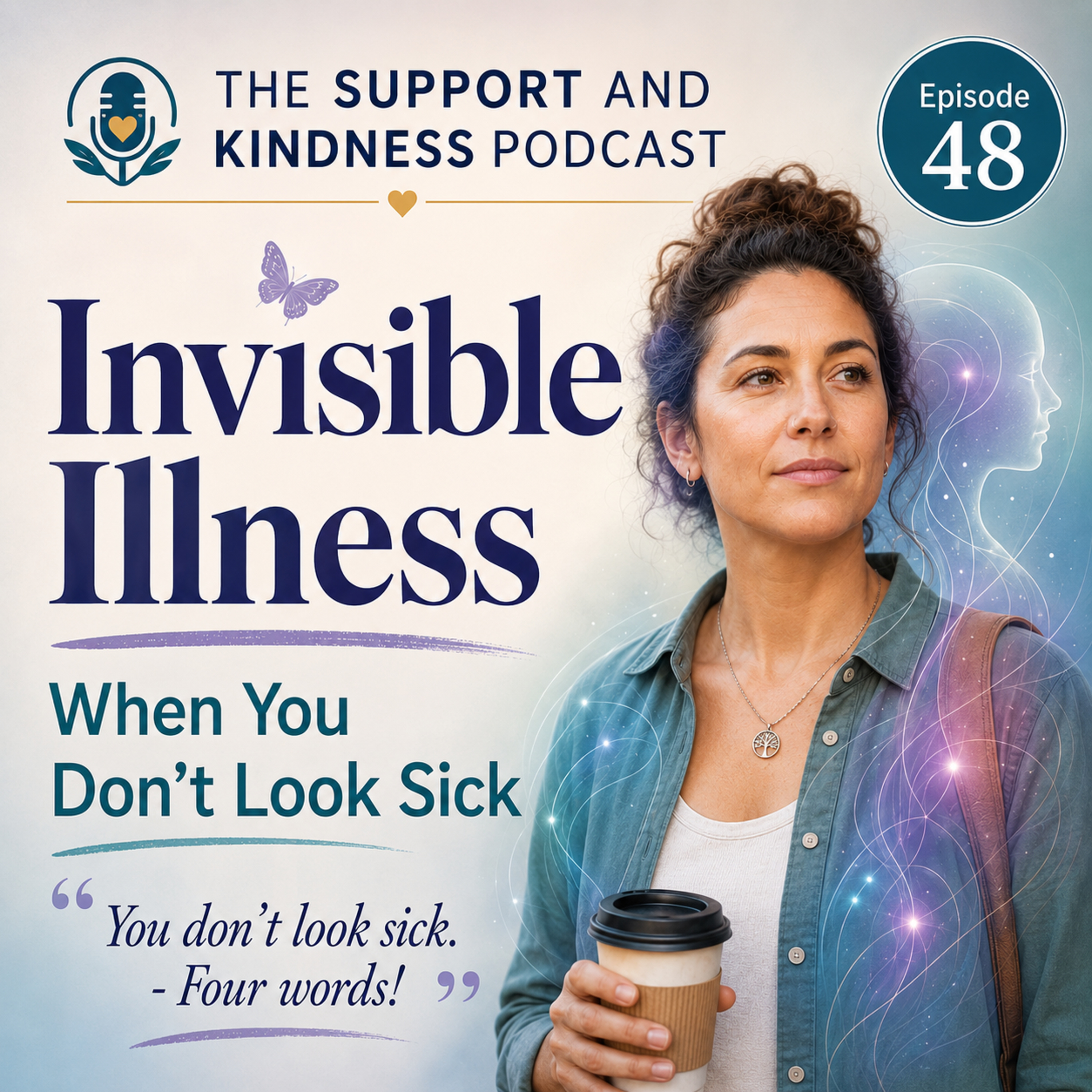
Episode: 48 — Invisible Illness: When You Don’t Look Sick
Aug 17, 202650 minS2
Invisible Illness: When You Don’t Look Sick Content note: this episode discusses living with chronic illness, being dismissed by doctors and loved ones, and the toll of not being believed. Be gentle with yourself as you listen. “You don’t look sick.” Four words usually meant kindly — that can land like a door quietly closing. This week we widen the lens past any one diagnosis to the whole landscape of invisible illness: the pain, fatigue, and brain fog nobody else can see, and the small shifts in language that turn a sting into care. Greg, Rich, and Liam get into the phrases that wound, the gentler swaps that help, why symptoms swing hour to hour, spoon theory and the drained-battery metaphor, invisible illness at work and your rights, and how to believe people without pitying them. What we cover Why appearance is never a measure of health “You don’t look sick” : dismissal, doubt, isolation — and what to say instead Fluctuation, spoon theory, and the battery that won’t hold a charge Accommodations at work without handing over your diagnosis Parking spots, cancellations, and catching your own snap judgments Chapters 00:00 Introduction & why invisible illness matters04:00 “You don’t look sick” — the words that wound06:15 Simple swaps that land as care09:15 Medical gaslighting & wanting to be heard12:00 Unsolicited advice & grace16:45 “But you were fine yesterday” — fluctuation19:00 Spoon theory & the cell-phone battery24:30 Invisible illness at work & the ADA32:00 Judgment, mobility & believing without pity35:45 Real-life scenarios42:30 What’s on your heart46:45 Summary, challenge & closing This episode featured Greg (host), Rich, and Liam. Free weekly peer support groups: Brain Injury (Mon 1PM ET) Chronic Pain (Tue 12PM ET) Mental Health (Wed 7:30PM ET) Sign up / RSVP: https://kindnessrx.org/groups Help keep the groups free: https://buymeacoffee.com/kindnessrx Connect: https://kindnessrx.org Newsletter: https://kindnessrx.org/news Listen to more: https://kindnessrx.org/listen
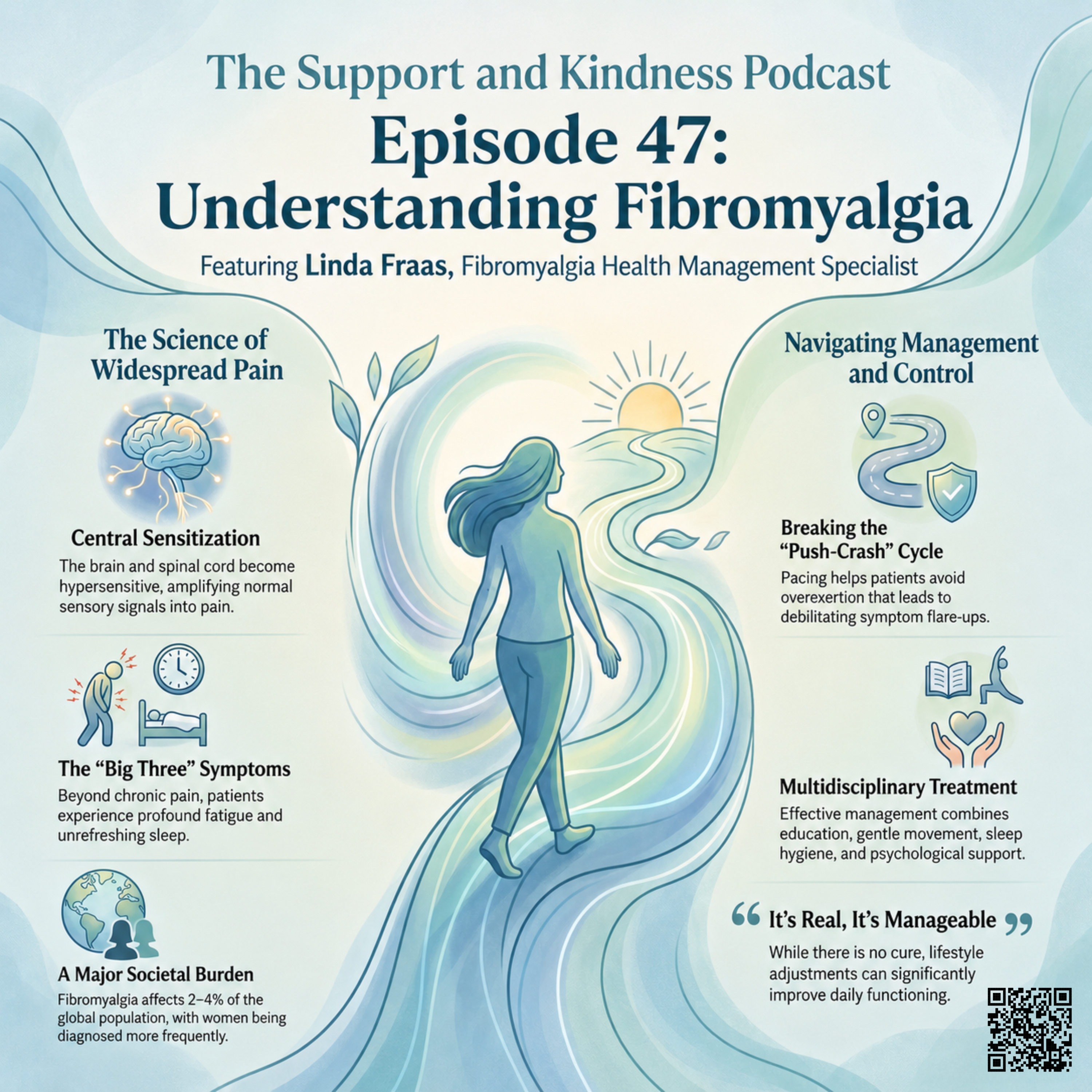
Episode 47: Understanding Fibromyalgia - with Linda Fraas
Aug 9, 20261h 24mS2
Content note: This episode discusses chronic illness, chronic pain, depression, and anxiety. If you're struggling, call or text 988 (US) for the Suicide & Crisis Lifeline. Fibromyalgia is invisible on the outside and relentless on the inside - and still too often met with "it's all in your head." In our first-ever guest episode, occupational therapist and fibromyalgia coach Linda Fraas explains what fibromyalgia actually is, why it's so hard to diagnose, and how people build a livable life around it. Part science, part 25 years of lived experience, all heart. In this episode: What fibromyalgia is - and why it's a condition, not an imagined one The car-alarm metaphor for a hypersensitive nervous system Fibro fog, fatigue, and the sleep trap The push-crash cycle and how pacing breaks it Being dismissed - and why being believed is medicine Movement, nutrition, tracking, and self-advocacy that actually help Chapters (00:00) Introduction & meet Linda Fraas (01:01) Linda's background and her diagnosis (04:06) The long road to a diagnosis (08:05) What fibromyalgia took away (13:23) What fibromyalgia actually is (the car-alarm metaphor) (17:29) Beyond pain: fibro fog, fatigue, and sleep (21:29) The push-crash cycle (26:37) "It's all in your head": being dismissed (41:01) Daily life: pacing, movement, and nutrition (55:30) Self-advocacy and finding hope (1:21:44) This week's challenge Featuring Greg with Rich, Liam, and Sarah, plus special guest Linda Fraas ( torchlightvitality.com ). Free weekly peer support groups: Chronic Pain (Tue 12 PM ET) Brain Injury (Mon 1 PM ET) Mental Health (Wed 7:30 PM ET) Sign up / RSVP: kindnessrx.org/groups ☕ Help keep the groups free: Click Here Newsletter: Click Here
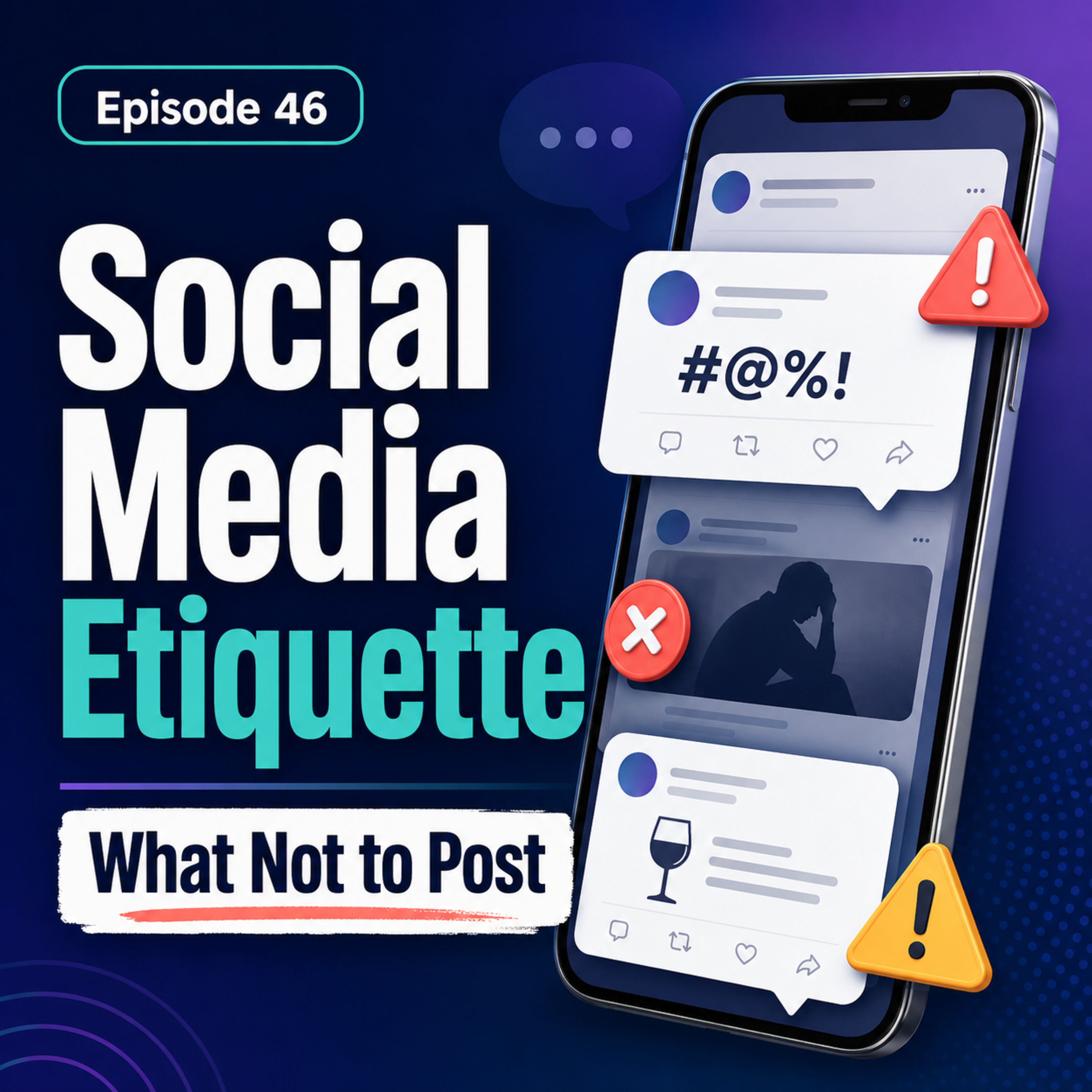
Episode 46: Social Media Etiquette - What Not to Post!
Aug 5, 20261h 13mS2
Content note: This episode discusses cyberbullying, online harassment, and scams. Nothing is graphic. If you’re in crisis, call or text 988 anytime — the 988 Suicide & Crisis Lifeline is free and available 24/7. We treat online life like it’s less real than the rest of our lives — but there’s a real person on the other side of every screen, and a post can outlast the moment that made it. This week Greg, Rich, Liam, and Sarah work through six ordinary posting dilemmas — from a joke scheduled before bad news to a friend live-tagging an empty house — and land on one simple habit that makes almost every gray area easier. It’s not a lecture about doing it wrong. It’s permission to slow down the half-second before you hit “post.” In this episode: Why “deleted” doesn’t always mean gone Consent — for kids, friends, screenshots, and stories that aren’t only yours Digital footprints, oversharing, and how a post can follow you to work Scams, privacy, and what actually keeps you safer Cyberbullying and how to step out of a pile-on The five questions to ask before you post Chapters (00:00) Introduction & the hard questions (06:38) Read the room before you post (19:09) Your digital footprint, oversharing & work (30:06) Consent, kids, screenshots & ownership (46:26) Privacy, safety & online scams (48:22) Cyberbullying, pile-ons & trolls (58:37) False posts & when to speak up (1:07:33) What’s on your heart this week (1:11:16) Recap, challenge & closing This episode: Greg with Rich, Liam & Sarah. Free weekly peer support groups: Brain Injury (Mon 1PM ET), Chronic Pain (Tue 12PM ET), Mental Health (Wed 7:30PM ET). Sign up / RSVP: https://kindnessrx.org/groups Support the show (keeps the groups free) Connect: https://kindnessrx.org Newsletter
Episode 45: Are People Really Getting Ruder? Public Etiquette in a Distracted World
Jul 26, 202657 minS1
Episode 45: Are People Really Getting Ruder? Public Etiquette in a Distracted World Nearly half of Americans say people have gotten ruder since the pandemic — but 84% say they personally know exactly how to behave. Both can’t be true. This week Greg, Rich, and Sarah ask whether people are really getting ruder, or whether “rude” is mostly about perception, expectation, and capacity. We reframe rudeness as a gap — the space between what you expected and what you got — then walk through six everyday “Is it rude?” scenarios where hidden context flips the verdict every time: the waiting-room speakerphone the bus seat being filmed in public the dog in the grocery cart the friend who cancels by text and the loud “correction.” Along the way: what invisible disability looks like from the outside, why most rudeness is overwhelm rather than malice, and the one thing you can always control - your own reaction. In this episode: - Why “rude” is a gap, not a fixed behavior - The 47% / 84% paradox from Pew’s rudeness survey - Capacity vs. character: why overwhelm drives most rudeness - Six “Is it rude?” scenarios — and how context changes each one - Extending grace (to others and yourself) Chapters: (00:00) Welcome & intro (01:47) Defining rudeness: “face” and the numbers (05:49) What does “rude” first bring to mind? (09:41) The post-pandemic shift (13:44) Capacity, sensory needs & being misjudged (24:20) Fading etiquette: phones, holidays, meals (30:50) Common Questions: six “Is it rude?” scenarios (45:22) Extending grace (51:14) What’s on your heart: Liam’s 50th (53:23) Closing & weekly challenge This episode featured Greg, Rich, and Sarah. Free weekly peer support groups: Brain Injury (Mon 1PM ET) Chronic Pain (Tue 12PM ET) Mental Health (Wed 7:30PM ET) Sign up / RSVP: https://kindnessrx.org/groups Help keep the groups free: https://buymeacoffee.com/kindnessrx Connect: https://kindnessrx.org Newsletter: https://kindnessrx.org/newsletter
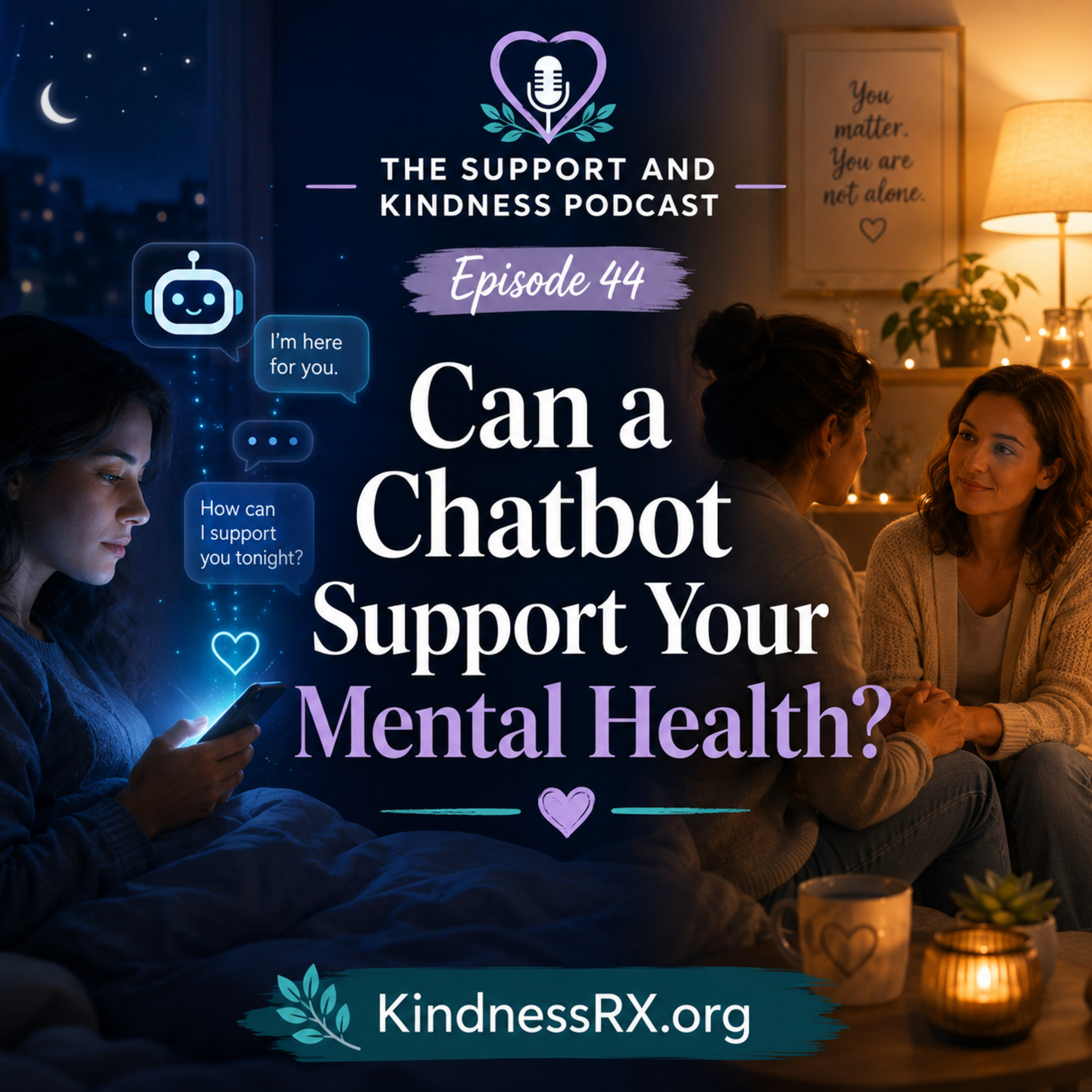
Episode 44: Can a Chatbot Support Your Mental Health
Jul 19, 202645 minS2
Episode 44 Content note: This episode discusses suicidal thinking and the ways some AI tools have responded poorly to people in crisis, including young people. If you're struggling, you're not alone. In the US, call or text 988 for the Suicide & Crisis Lifeline. International listeners: please contact your local crisis line.It's 2 a.m. Your chest is tight, your mind is racing, everyone you love is asleep — and the phone on your nightstand will answer you right now. It won't sigh. It won't judge. More and more people are reaching for that glowing screen. So we asked an honest question: can a chatbot really help your mental health?Greg, Rich and Liam talk it through with no script and no sales pitch — the real promise, the real limits, and the risks nobody's regulating yet. We go back to 1966 and the MIT scientist who built the first therapy chatbot and then spent the rest of his life warning people about it. We look at what the research actually found, both the hopeful and the alarming. And we land somewhere practical: a journal that talks back is not a therapist, and it should never be your crisis plan. WHAT WE COVER ELIZA (1966), the "ELIZA effect," and why this debate is almost 60 years old Dartmouth's Therabot trial: depression symptoms down ~51%, anxiety ~31%, eating disorder concerns ~19% Stanford's 2025 findings — chatbots that stigmatized schizophrenia and alcohol dependence, and one that answered a crisis question with a list of tall bridges Nearly 1 in 5 young people ages 12–21 have used an AI chatbot for mental health advice — and most haven't told a single person Why a bot built to be agreeable is the opposite of what real support sometimes requires The privacy question: who owns your most private thoughts? The APA's November 2025 advisory — a tool, not a replacement Warm lines: a free, human alternative when you're not in crisis but you are lonely CHAPTERS (00:00) The 2 a.m. phone(01:13) What an AI therapy chatbot actually is(02:03) The numbers, and why cost drives this(03:01) ELIZA, 1966 — and the man who warned us(05:47) Rich and Liam on trust, machines and the ELIZA effect(11:19) The promising side: Dartmouth's Therabot trial(14:20) WebMD, Google, and shame-free searching(18:09) Stanford's findings and the bridge question(23:56) When "always agreeable" turns dangerous(28:14) What the APA actually says(32:12) What careful use looks like(36:13) What's on your heart this week(41:15) Your challenge and closing THIS EPISODE: Hosted by Greg Shaw with co-hosts Rich and Liam. YOUR CHALLENGE THIS WEEK : Take one thing you'd normally type into a screen — a worry, a win, a "today was hard" — and say it to an actual human instead. A machine can hold your words. A person can hold you. Free weekly peer support groups: Brain Injury (Mon 1PM ET) Chronic Pain (Tue 12PM ET) Mental Health (Wed 7:30PM ET). Sign up / RSVP: https://kindnessrx.org/groups ☕ Our groups are free and always will be. Help keep them that way: https://buymeacoffee.com/kindnessrxCONNECT WITH KINDNESSRXWebsite: https://kindnessrx.org Listen to every episode: https://kindnessrx.org/listen Newsletter: https://kindnessrx.beehiiv.com/ YouTube & social: @KindnessRXCrisis support: 988 Suicide & Crisis Lifeline — call or text 988 (US). https://988lifeline.org
Every question we get asked before someone starts their trial.
If you have a concern about deliverability, AI quality, data privacy, or whether this will actually work for your specific situation, it's probably answered below.
What is the difference between Founder Solo and Founder Pro?
Founder Solo gives you 50 AI pitches per month using the credit model (Standard pitches cost 1 credit, Enriched pitches cost 2). Founder Pro raises that to 200 credits per month and adds full Booking Probability access, unlimited Magic Match, Apollo enrichment credits, and data export capabilities. Both plans use the same credit system, so you can stretch your monthly budget further by using Standard-mode drafting.
How do agency tiers work?
Agency tiers have no base fee. You pay per managed client and per talent profile. Agency Standard is $199 per client per month; Agency Pro is $399 per client per month. Both add $39 per talent profile per month. Your own team's user seats are always free.
What is a talent profile?
A talent profile represents one person (founder, executive, or spokesperson) you are booking onto podcasts. It includes their bio, topics, headshots, and outreach history. Team plans include 5 profiles; agency plans are pay-as-you-go.
Can I switch plans later?
Yes, at any time. Upgrades take effect immediately; downgrades apply at the end of the current billing period. Contact support if you need help migrating between plan families.
Do you offer a free trial?
Every paid plan includes a 15-day free trial. Your card is saved at signup but you will not be charged until day 16. Cancel any time from your dashboard.
What happens if I cancel?
You keep access until the end of your current billing period. No charges after that. Your data is retained for 30 days in case you reactivate.
Is the 20% annual discount automatic?
Yes. Select Annual on the pricing toggle and the discounted price is applied automatically at checkout. The annual price shown is the full year cost.
What if I have more than 50 profiles or 20 clients?
That is our Enterprise tier. Contact our sales team and we will build a custom plan with volume pricing, a dedicated account manager, and SLA guarantees.