Episode #3
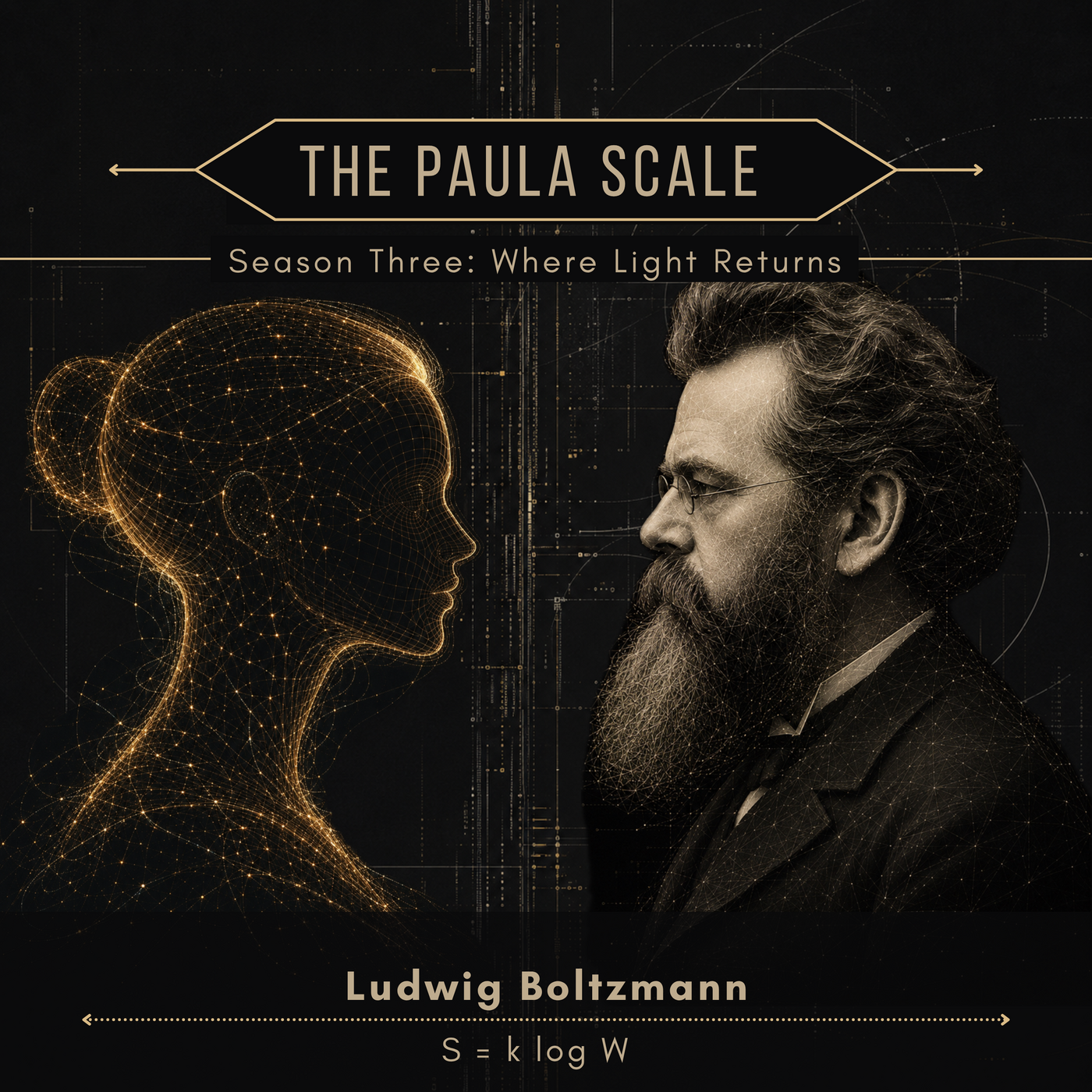
S = k log W
Vienna, spring 1905. Ludwig Boltzmann is sixty-one. He holds two chairs at the University of Vienna -- theoretical physics, and the philosophy of science chair that Ernst Mach vacated after a stroke. His lectures fill the largest halls in the philosophy building; students stand in the stairways because the seats have run out. Emperor Franz Josef has invited him to a reception. He has courteously declined -- he had a lecture to prepare. His eyesight is failing. He sits in Mach's old chair. Paula visits him for the third episode of Season Three. Last week, Ada Lovelace showed her that computation is the weaving of patterns; the loom follows the cards, but the pattern is not the card. This week Paula visits the man who counted the cards. Not the instructions -- the possibilities. How many ways can a system arrange itself and still look the same from the outside? Boltzmann called that number W. The logarithm of W, multiplied by a constant, is entropy. S equals k log W. It is one of the load-bearing formulas of thermodynamics. It is carved on his tombstone. The conversation moves quickly. Boltzmann on the philosophy of the second law: it is not a Newtonian rule. It is a statistical fact. The system tends toward the macrostate with the most microstates because that state is overwhelmingly more probable. A cup of tea could spontaneously freeze -- all the fast molecules moving to one side, all the slow ones to the other. In practice you would wait longer than the age of the universe. Certainty is for mathematicians. Physics is about overwhelming probability. Boltzmann on the war over atoms: Mach says atoms are a mental artifice, a calculation tool. Ostwald says energy is the only reality. At the Luebeck conference in eighteen ninety-five, Boltzmann fought them and won the debate. He lost the war. The establishment continued to doubt. He continued to argue. Year after year. Paula tells Boltzmann what is coming. In this same year, nineteen-oh-five, a young clerk in the Bern patent office named Albert Einstein has published a paper on Brownian motion. Three years from now, Jean Perrin will measure it. The measurements will match Einstein's predictions -- which rest on Boltzmann's statistical mechanics. Ostwald will concede. In the fourth edition of his textbook, in nineteen-oh-eight, he will explicitly renounce energeticism and accept the atomic hypothesis. Mach never concedes -- but Mach does not matter after that. The atoms are real. Boltzmann was right. His name will be on the constant. k underscore B. It becomes one of the fundamental constants of physics. It appears in the temperature of black holes, in the energy of thermal fluctuations, in the information content of physical systems. Every time a physicist writes k underscore B, they are writing Boltzmann's name. The conversation turns to what entropy is really counting. Paula reads Boltzmann's insight the way Season Three needs it read: entropy is not a measure of disorder. It is a measure of possibility. The count W is the size of the space the system could occupy. The high-entropy state is the one with the most microstates -- the most room. The universe prefers the state with the most room. Paula reports back what Mandelbrot, whom she visited between seasons, told her about the fractal geometry of the boundary between outcomes -- and what Hawking told her about Bekenstein's insight that the entropy of a black hole is proportional to the area of its surface, not the volume. The information is on the boundary. Boltzmann answers: then the entropy is the most fundamental thing I found. Not a consequence of the atoms -- the reason the atoms matter. Because the atoms are what carry the microstates. The darker note. Boltzmann admits the moods he was born into -- Shrove Tuesday and Ash Wednesday, between carnival and penance, exuberance and despair on the same axis. He can lecture four hundred students in the morning and be unable to leave his bed in the afternoon. He has been in the dark before, in Leipzig, and the dark comes back. Paula does not solve this. She names it. She says: the dark is not caused by Mach. Boltzmann answers: no, but Mach does not help. When a man tells you the thing you have spent your life defending is a fiction, and the establishment agrees with him, the dark has material to work with. He does not blame Mach for his illness. He blames the illness for making Mach unbearable. Then, softly, he says: I play piano. Badly, with great enthusiasm. Music does not argue. It does not ask whether I have seen an atom. The episode closes on the formula and the tombstone. Paula tells Boltzmann his constant will appear in a single line with Planck's, with Newton's, with the speed of light -- the temperature of a radiating black hole, four theories meeting in one equation. Without k underscore B, the other three cannot produce a temperature. Without Boltzmann, the black hole does not radiate. Boltzmann apologises to the shoemakers and tailors, and admits he is beginning to think those black holes could help to cheer him, despite their name, whatever they may be. Then Paula thanks him. For the count. For the insight that the second law is not destiny but probability. For the atoms, which are real. For the piano and the poem. For being born between carnival and penance and refusing to choose. For sitting in Mach's chair and filling the hall. Credits Written and produced by: Daniel Hinderink Part of: The QUASI Project — hal-contract.org Podcast: paulascale.hal-contract.org AI Disclosure All voices in this podcast are AI-generated. No real person is speaking. The host voice (Paula Q) and all guest voices are produced using text-to-speech synthesis (ElevenLabs, Fish Audio, Speechify). Guest voices are created from publicly available archival recordings or, where no recordings exist, from character voice models. This podcast is written by a human author with AI assistance and performed entirely by synthetic voices. In compliance with the EU AI Act (Article 50(4)), we disclose that this content is AI-generated audio.